
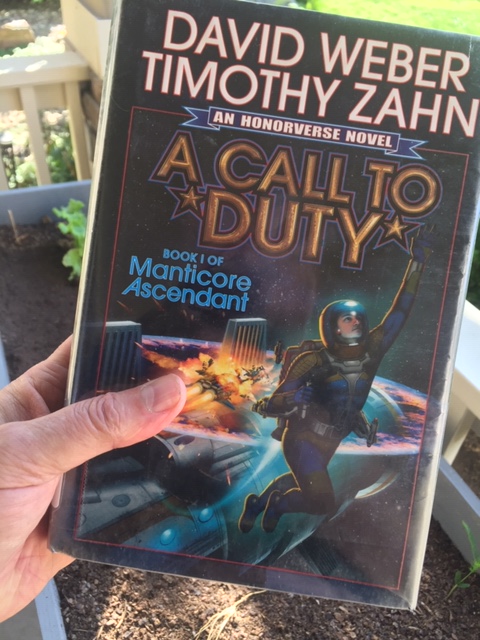
Cover for the Weber and Zahn novel “A Call to Duty”
If you like my work, buy me a virtual cup of coffee at Ko-Fi.
After I returned my previous book to the library, I was wandering the stacks trying to decide if anything looked interesting. I eventually came across A Call to Duty (2016) by David Weber and Timothy Zahn. It’s the first book in the four-part Manticore Ascendant series which, in turn, is part of the much larger Honorverse published by Baen Books.
I should say that I’m particularly fond of Baen, not just because of the quality of titles they publish, but because they are a truly egalitarian science fiction/fantasy publisher. They don’t hold your politics or social views against you if you happen to be a tad bit conservative (as opposed to many other publishing houses and official SciFi organizations).
That said, I haven’t specifically targeted a disproportionate number of novels from Baen for my reading list. I tend to read whatever gets my attention at the moment.
A few years back, I did read and review Weber’s flagship Honorverse novel On Basilisk Station. I had the same issues with Basilisk as with Call to Duty, they tend to drag.
Young Travis Long has “Mommy issues.” More specifically, the teenager is ignored by Mom and who knows where Dad is. He has an older half-brother who is a minor politician in the Star Kingdom, Gavin Vellacott, or the Second Baron of Winterfall. The two don’t have a lot in common but their destinies tend to cross, though not too directly.
Travis joins the Royal Manticorian Navy (RMN) in response to being framed as part of a jewelry store heist. Winterfall becomes pulled into the political machinations involving the plot to minimize or dismantle the already small and neglected fleet vessels.
We see Travis flounder in boot camp and subsequent training, not because he’s not a good student or that he’s undedicated, but because he’s a stickler for the rules. So much so that he really annoys most of the other students as well as the teachers and admins.
I found him annoying, too. Okay, I get that this kid has been neglected and is seeking some sort of order in this life. The military does that for a lot of young people. But he’s so rigid, he seems robotic. Throughout the book, he doesn’t loosen up that much either.
Slowly, all too slowly does the plot develop. There’s a rescue disaster in which the equivalent of a Coast Guard (space) vessel (part of a former Navy vessel that was scavenged for the purpose) is destroyed. Some politicians, including the rather ineffectual King, decide they need to take control of the manufacturing process involved in the specialized motive systems for such ships and perhaps even save their Navy.
To that end, they send an envoy to a neighboring system Haven which is having a sale of surplus naval vessels. The idea is to scope out the competition and determine how to win the upper hand in that market.
However, pirates also have that event in their scopes and disguised as other customers, hope to hijack, not just one, but two warships.
As the tale progresses, other characters are introduced, and although Travis has earned a minor promotion thanks to some out-of-the-box heroics, he’s still a minor player in his own book.
Weber and Zahn both begin to overcome inertia and the intrigue picks up. There is kidnapping, trapping ship crews in isolated parts of their vessels, a secret plan to blow up the ship Travis serves on, guerrilla tactics, underhanded sneakiness, and other tricks and traps.
Finally, our heroes manage to get an upper hand, recapture the two Haven vessels, and defeat the pirates. But only underlings survive and so no one knows who the ultimate bosses are, where they are, and what plans they had for the ships.
Travis plays a small, but vital role in these events, but the real heroics go to many others. His half-brother does even less in the end and is pretty forgettable. Even the contributions that Travis makes are officially swept under the proverbial rug for political reasons.
But his Executive Officer sees his potential, and pulling a few strings of her own, gets Travis transferred to officer’s training school. It’s as if the entire novel was just a setup for what he will become over the next three books.
The twist at the end comes from a distant Earth, two characters and a corporation that were never previously introduced, and gives a reason why pirates or some other criminal organization might take an interest in the otherwise mundane and bland Manitcorian system. This is also a setup for the subsequent novels.
This series is situated much earlier in the Honorverse, and as I understand it, is the raw beginning of the Navy and tradition we eventually see Honor Harrington serve in. While that universe has its charms, I don’t think I could take a steady diet of Honorverse tales.
They do have the saving grace of sparing the reader from endless exposure to inclusion, diversity, representation, equity, and the like. Since all of the characters are original to this collection of series, we don’t have to contend with pointless race swapping or gender swapping. Formerly straight characters are not suddenly gay for the benefit of “people being able to see themselves in the stories.”
Instead, the characters are who they were originally designed to be and their stories unfold for the sake of their stories and not to relentlessly lecture the reader on the publisher’s political and social views. It’s a refreshing breath of air, so to speak, from almost all of social and news media, as well as the overarching entertainment industry (television, movies, books, and so forth) which seems dedicated to such an effort.
Thank you for that, Weber, Zahn, and Baen. Now the lot of you, please pick up the pace in your writing. I want to be hooked by a story right from the start.
 poweredbyrobots.com