
© James Pyles
If you like my work, buy me a virtual cup of coffee at Ko-Fi.
I became aware of Fenton Wood (a pseudonym) when he reviewed my SciFi/Fantasy novelette Ice on twitter (but alas not on Amazon or goodreads).
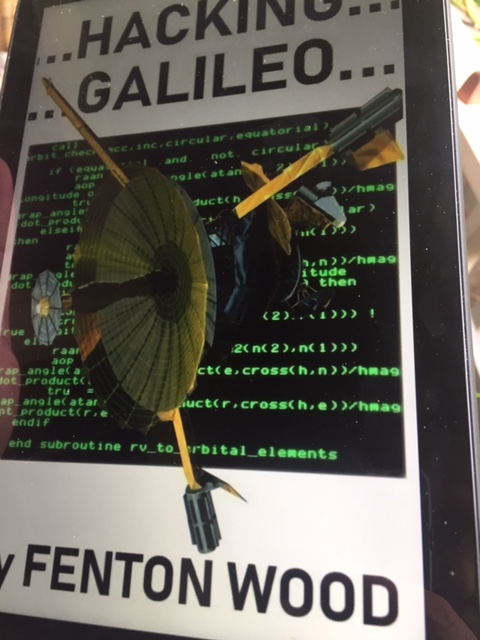
Curious, I took a look at his twitter/X account, which led me to his e-book Hacking Galileo.
It had fabulous reviews, an interesting premise, and was reasonably priced, so I downloaded it onto my Kindle Fire.
The first words you read in the book after the usual preamble stuff is “This is a work of fiction.” Wood then goes on to explain the inspirations and influences for various parts of his story, the background of some of the technical details, when he “cheated,” making certain events happen at a slightly different point in history for the sake of the plot, and how security at Cray Research and Bell Telephone Company weren’t quite as lame as he depicted.
That’s really important because the rest of the book is written from the point of view of a man who, in the 1980s, was part of a teenage hacker group, really just a bunch of high school friends in Palmdale, California, who performed acts of hacking from the interesting to the fantastic.
The main character Roger O. Miller (ROM, see what he did there?) is writing and recounting events that happened thirty years ago where he and his three friends actually saved the world from destruction by an alien space probe. There’s a lot of build up to get to that point, but almost all of it is fascinating.
Roger and his friends are bored teens who are also highly intelligent and skilled. They don’t automatically come by their skillsets as so many young people do in TV shows and movies. Wood shows how they do their research and with the technology available to ordinary people at the time and (mostly) publicly accessible data, are able to pull elaborate pranks just for fun.
I especially loved this part of the book. If it didn’t need a major conflict and a resolution, I’d have been perfectly happy spending all day reading about their adventures and how they managed to pull them off. It was kind of a “Mission: Impossible” vibe in the technical sense.
One of the downsides was how little supervision these kids were given. I don’t mean they were out late or that their parents didn’t know where they were at all times during the day. I mean these teens could disappear for days at a time and no one would raise an eyebrow.
Okay, to be fair, most of their long term excursions were covered up by field trips and other legitimate and explainable circumstances, but the times they were out all night or several nights in a row, especially with one of the family cars, was bizarre.
Sure, you could say that in the 1980s, parents were more chill, but growing up in the 1960s and 70s, especially as a teen, my Dad was all over me about not spending unaccounted for time with my friends. I got away with almost nothing. If Roger or one of the others had my Dad, they would have been under a microscope.
The real adventure starts after the boys (more on that in a minute) find a way to bounce a radio signal off of the Moon. That seems too elementary for them, so they decide to try it with Mars. That’s a hugely more complicated task and they fail at it.
However, they do find something. Something in space sends a kind of signal back in visible light. One thing leads to another and they determine that something out there is altering their signal significantly then returning it. The more they look, the more it seems like an alien craft.
Oh, about boys and no girls. Woods goes into an explanation at the lack of STEM interested girls in that place at that time. He also doesn’t seem to be writing the book to satisfy some social or political imperative, or at least not the ones we have been taught to expect (representation, inclusion, equity).
The guys manage to gain access to all kinds of help, including hacking into a Cray 2 supercomputer, accessing an online hacker group using their previous hack into “Ma Bell” as their “credentials,” and otherwise pulling off the improbable to impossible.
Although the teens in the 1980s don’t have any specific political views or agenda, Roger in the present sure does. Some examples:
Los Angeles wasn’t a third world city back then. It didn’t have homeless encampments extending for miles, epidemics of rats and typhus, or rampant carjacking and armed robbery.
It was named after the year it came out, 1984. It captures the feeling of that moment in time better than anything else. A moment when America was still a country. When it still had a future. You can’t understand the atmosphere of that time, how different it was from today, unless you were there.
This was before the rise of crowdfunding platforms. These platforms aren’t really decentralized; they represent a choke point where the Feds can apply pressure to shut down any campaign they don’t approve of.
Just because the main character of a book has certain political and social attitudes doesn’t mean the author must embody those attitudes. On the other hand, I haven’t read a book that had any sort of political tone unless it reflected the author’s. Even if the protagonist was an extreme hardliner alt-right supporter, if the writer was more to the left, then the protagonist in the end would be revealed to be either the soul of evil or a goofy buffoon.
Woods doesn’t write Roger as either.
Long story short, they discover that the object, which they later name Moloch (anyone familiar with the Old Testament or Hebrew Bible will recognize this particular type of vile abomination) is totally driven by gravity (no rockets or other internal motive power) and after swinging around the sun to pick up speed, will hit the Earth.
Their first idea was to hack a NASA space probe named Galileo (yes, an in-real-life space probe) and use it to get a closer look at Moloch.
Through various contacts in the hacking community, including one who has a lot of information about the Galileo’s computer systems, they discover that originally, Galileo had a military mission on top of scientific research. It was going to deliberately hit an asteroid and set off a nuclear explosion to test a method of diverting asteroids.
There’s always a small but non-trivial chance of an asteroid of sufficient (extinction event triggering size) size and mass hitting Earth. The government wanted to send a nuclear weapon into space to see if it could potentially change the course of one of these big rocks so, in the eventuality of an Armageddon (1998) scenario, they would be able to respond.
But anti-nuke influences won out and the nuclear potential was rendered inert. The traditional way of setting off the chain reaction was eliminated, but that didn’t mean there wasn’t another way.
The guys successfully hacked into Galileo (there’s a really long explanation for how this was even possible), but they were discovered all too soon and then locked out.
Just for giggles I looked up the history of the probe and was shocked to find it really was hacked and for the nuclear reasons I outlined (minus the alien space probe).
That sent a chill down my spine and several of my “paranoia alarms” started ringing.
Remember, “This is a work of fiction.”
Events became even more improbable with the guys finding one of the last of the pre-Soviet Russian princes is working as an auto mechanic in San Francisco. Just as the Soviet Union was falling, they used his influence and an actual Channel One high school trip to Russia to interview then Soviet leader Mikhail Gorbachev (the interview by American high school journalists was supposed to have really happened, but three different search engines have failed me) to get close to the Russian space agency and enlist their help.
I have no idea why any of this would work and why a former Soviet space agency now in an independent and contested state would offer American high school students even a minute of their time, but they did. The boys also gave the Russians access to their Cray 2 linkup which gets them in plenty of trouble.
The Russians find Moloch and agree to launch a probe of their own to rendezvous and then impact the alien craft, ideally shattering it and averting disaster. There was another long set of technical details involved and nothing was assured, least of which was Moloch’s actual mass.
Of course, upon returning home after three months, the boys were arrested and their ringleader, the only one who had turned 18 and the absolute brains of the group, sacrificed himself for the others. But he got away and then disappeared.
They managed to intercept the signals from the Russian craft long enough to capture real-time video. Then slowing it down, they examined the data and luckily took still photos. I say the latter because their school-borrowed specialized tape player broke destroying the tape.
The calculated date of Moloch’s impact with Earth was June 23, 1993, just a few days before my daughter’s fifth birthday. Moloch was supposed to hit the Earth somewhere in the Pacific Ocean. Either the Earth was going to be destroyed or most of the debris from the impact would burn up in our atmosphere. Only some of Moloch’s rubble would survive to sink into the ocean.
It took several different search engines, but I did find a meteor shower that occurred between 22 June and 2 July 1993. It wasn’t as described in the book, but I was surprised at the level of difficulty in finding anything about it (Google and other search engines focused on the Perseid meteor shower that happened between 17 July and 24 August, 1993.
Earlier in the story, two of the guys managed to locate and infiltrate an underground neutrino research facility in another state that had no guards, really no security of any kind, and were only tripped up by the facility administrator because they didn’t do a very good job at pretending to be UCLA students.
However, the administrator didn’t rat them out or turn them over to the Feds. He did explain what he knew about the asymmetrical nature of the speed of light (light travels at different speeds depending on which direction it’s going relative to the plane of the ecliptic. This is how the book theorizes we sent a (to the aliens) deadly beam of neutrinos into the “Silent Galaxy” at the edge of the universe and why they sent the probe to destroy us.
I know that piece of information was necessary for the plot, but it was the first major event in the book that completely took me out of the narrative.
The other was when the author took the narration duties away from Roger for a chapter and gave them to Jeff:
He (Jeff) insisted on adding his own contribution to this book. “It’s a story I’ve been working on for a while. It’s like Zelazny meets Lovecraft, with weird physics and Norse mythology.”
I’m sure Wood had his reasons, and he probably thought we was revealing the aliens’ reasons for wanting to destroy Earth, but I would have been perfectly fine without this interlude and it was actually disappointing. The rest of the book, even the highly improbable/impossible bits, were a lot of fun.
All that said, I had a blast reading the book. It’s a very easy read, in spite of all the technical aspects, and I shot through it in just a few days (I do have other things to do in life besides read).
I’m considering recommending it to my grandson, even though he’s more of a fantasy guy. I think he’d like it.
 poweredbyrobots.com