

© James Pyles
If you like my work, buy me a virtual cup of coffee at Ko-Fi.
I must have originally read Harlan Ellison’s landmark SF/F anthology Dangerous Visions (1967) sometime in the mid-1970s, but I remembered nothing about it when I picked up the book again. I only decided to re-read “Visions” because it was mentioned by a publisher as part of their open submissions call.
When a publisher throws their gates open and allows any and all (with certain caveats) authors (would be or established) to submit a story to them (usually in an anthology), they sometimes offer hints or ideas as to what kind of stories they are (and are not) looking for.
One such strategy is to suggest the author read some of the stories they’ve already published. Another is to ask the writer to read other novels and anthologies they favor.
Recently, I read an open submission call that suggested, among other books, Ellison’s original “Dangerous Visions.” I can’t say whether I submitted to that publisher or not. I step away from a certain percentage of them for a number of reasons. This can include them being just too darn picky (too many hoops to jump through), they are only open to a certain population (usually those they believe are marginalized), or they’ve rejected everything I’ve ever thrown at them in the past and I’m resigned to that publisher never liking my writing.
So I checked out a copy of “Dangerous Visions” from the public library to see what I could see.
The purpose of anthology, as Ellison originally envisioned it, was to make science fiction more “adult.” That is, to take the genre away from the day of ray guns, good Earth people vs. evil aliens, space operas, manly, bare chested male heroes, and their damsel-in-distress female counterparts.
For 1967, I think it did a good job. Ellison ushered in what is now called “The New Wave” in science fiction and nothing’s been the same since.
That’s both a good and bad thing, by the way.
What is so “dangerous” about the short stories within its pages? Largely, how sex is depicted in SciFi. First of all, there is sex. Secondly, it’s not just male-female, hetero sex.
Poul Anderson’s “Eutopia” is one of the two stories I did remember reading once I got into it (the other is “The Jigsaw Man” by Larry Niven). The story follows a research agent who has traveled into an alternate Earth and inadvertently broken a local custom, so much so that said-locals want to kill him. Even the allies he finds in that world are repulsed by him when they discover his “crime.” He finally makes it back to his home world and only then do we discover that what he did that was so offensive was to make a pass at another man.
Remember, in 1967, while being gay in and of itself wasn’t illegal, the crime of “sodomy” was. Gay bars were regularly raided by police and gay men were typically arrested for sex crimes by the Vice squad if/when caught participating in a hook up in a public place.
Theodore Sturgeon’s “If All Men Were Brothers, Would You Let Your Sister Marry One?” went one better on that theme. While I admire much of Sturgeon’s writing, in retrospect, he and I would not see eye-to-eye on certain things.
For instance, the “taboo” in his story had to do with not only incest, but sex with and between minors as young as infants and toddlers. Sounds repulsive and it’s meant to. I don’t know for a fact, but I think he was using the incest taboo, something just about everyone, even today, would find abhorrent, as a metaphor for gay sex.
There’s a passage where the “reasonable” incestuous leader of a ostracized planet is explaining to the protagonist that it does no harm to expose even very young children to books and video on sexual topics. There’s a lot of crosstalk on today’s social media regarding just this thing in relation to many LGBTQ+ themes, practices, and gender identities. A lot of people think deliberately exposing very young children to adult sexual themes is quite harmful.
Probably the topper on that subject in the book is Samuel R. Delany’s “Aye, and Gomorrah…” In his story, all space travelers (spacers) are raised from puberty for the profession. Due to intense radiation exposure experienced in space, all of those potential spacers as they enter puberty, are neutered (never mind that they are too young to give informed consent). This results in spacers not just having their reproductive organs removed, but in them appearing asexual and agender.
Whenever spacers come to Earth for recreation and some time off, they invariably encounter people who are “frelks.” These are individuals who are sexually attracted to neutered spacers and who will pay premium prices to have an intimate encounter with one or more.
This sounds very much like what we might consider gender queer or gender non-conforming in the 2020s. Again, I think Delany was using this metaphorically to talk about gays, but I’m not sure. It depends on how much information was publicly available about trans populations in the mid to late 1960s. I don’t even know if being “queer” the way we use the term today was a named concept back then.
You can see why these stories might have been considered “dangerous” almost sixty years ago.
As an aside, there were a number of authors who also wrote episodes for Star Trek.
Ellison famously wrote one of the top TOS stories “City on the Edge of Forever.”
Ted Sturgeon wrote two, “Shore Leave” and another classic, “Amok Time”
Robert Bloch rifted off of his classic “Jack the Ripper” stories with “Wolf in the Fold” and Norman Spinrad wrote “The Doomsday Machine.” Although Larry Niven didn’t write for the original series, he did a story for the 1970s Star Trek animated series called “The Slaver Weapon.”
Besides these writers, the anthology is awash is famous and noteworthy science fiction authors of the mid-twentieth century. Some of those are Philip Jose Farmer, Philip K. Dick, Brian W. Aldiss, Lester del Rey, Robert Silverberg, Fritz Leiber, Damon Knight, and Keith Laumer.
That’s just the short list.
Sex wasn’t the only dish on the menu, but it represented a large portion of the content. What I noticed was that what was once dangerous is now commonplace, ordinary, even passé. While “Visions” is indeed a landmark and should always be preserved as a major signpost in the genre, it’s “hook” has lost much of its grabbing power.
I can’t remember what I thought of those stories when I first read them. That was far too long ago. I didn’t even remember Anderson’s and Niven’s stories until I was reading them again. Still don’t remember any of the others.
I believe in reading older science fiction to get a sense of where the genre came from and how it developed over time. Yes, much of it comes off dated, but there are classics that will always remain timeless.
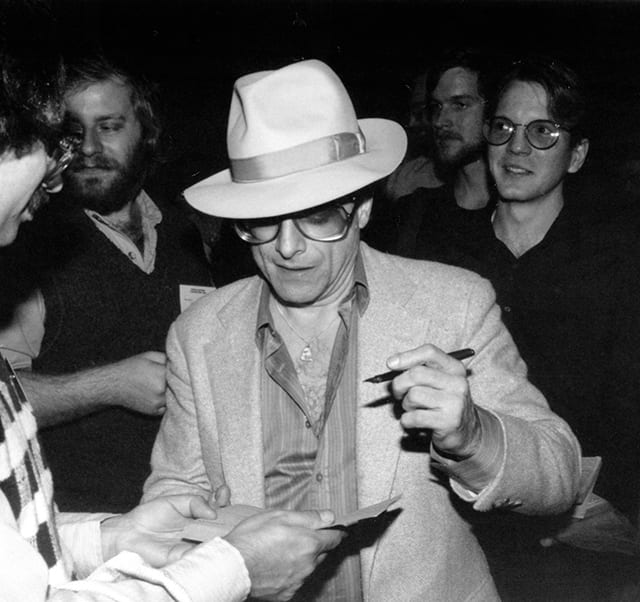
Harlan Ellison signing autograph. Photo by and copyright Andrew Porter
That said, I doubt even Ellison’s anthology (there were sequels) would pass the litmus test of the current gatekeepers in SF/F. The book would be too tame.
As I anticipated writing this review, I wondered what would be considered “Dangerous Visions” in the 2020s. It couldn’t be sex of any variety including the LGBTQ+ spectrum, gender identity in all the variants, race, whatever wave of feminism we are currently experiencing, representation, inclusion, anti-racism, or DEI.
All of that is total mainstream and easily accessible in a great number of SF/F novels and short stories (and TV shows, movies, comic books, and so on).
Whenever I read the specifications for a publisher’s open call, invariably (and I mean absolutely always), I encounter a line such as their being accepting and encouraging of all authors of color, LGBTQ+, races, religions (creeds), nationalities, ages, genders, and anyone else who is or has ever been considered a marginalized population.
While that sounds great and I agree that there should be room at the writers table for all comers, I automatically assume that the publisher is saying “except for straight, white, conservative, Christian males…you guys are out.”
In only one announcement (and I encountered it just yesterday) did the “we are inclusive” statement follow up by saying, “That said, we assess stories by their merit.”
That, I can only hope, means that if your story is objectively considered “good,” they won’t care about the author’s personal demographics or those themes (unless they’re heinously offensive) presented in the story. Well, like I said, I can only hope.
What I consider “dangerous” in the 2020s is stories about people who are heroic, men and women, presenting the family as having value (and not just a dysfunctional jumping off point for an equally dysfunctional protagonist). Also, let’s add religion, including Christianity as a positive attribute and practice, men as good husbands and fathers (and Grandpas), women who are intelligent, capable, and heroic, but not just men with boobs, and who experience their world through a female (and dare I say it, feminine) lens.
Said differently, what is now “dangerous” was (to some degree) once acceptable and even noteworthy. Masculinity, for example, wasn’t always considered toxic.
There are two moments of dialog from the Marvel movie The Avengers (2012) that I think apply:
Steve Rogers (Chris Evans): “When I went under, the world was at war. I wake up, they say we won. They didn’t say what we lost.”
and…
Steve Rogers (Chris Evans): “The uniform? Aren’t the stars and stripes a little…old-fashioned?”
Agent Phil Coulson (Clark Gregg): “With everything that’s happening, the things that are about to come to light, people might just need a little old-fashioned.”
Now that’s dangerous.
 poweredbyrobots.com