
© James Pyles
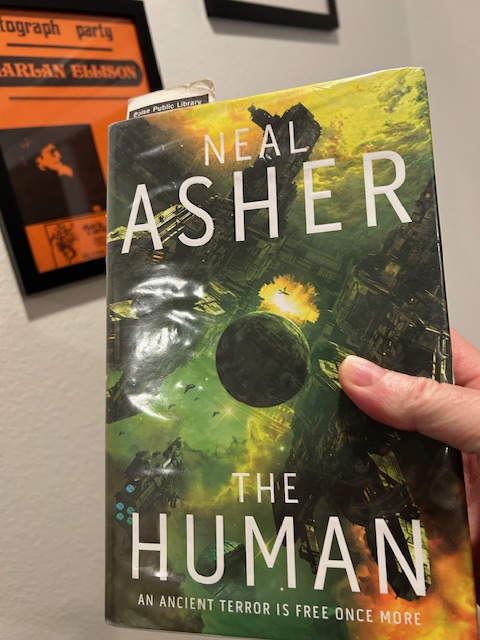
I know it seems like it took forever, but yesterday, I finished reading Neal Asher’s novel The Human: Rise of the Jain, Book 3 (2020).
To read my reviews of the first two books in this trilogy, see The Soldier (2018) and The Warship (2019).
This was another book not available through my local library system (boo on them) so I bought a used copy, another former library book, in order to finish the saga.
Like so many of Asher’s other books, this one is also set in the Polity universe and sometimes references a wider collection of places and characters.
As you might imagine, this novel wraps up the Jain’s incursion and the struggles of the Polity, the Prador empire, and a number of other interested parties in trying to stop the Jain but also learn from it.
The Jain are an ancient civilization/technology which conquers by assimilating information and technology through a sort of mating/rape.
Nothing I can write can really do justice to Asher’s writing or this story. His characters and circumstances are incredibly dense and detailed, so much so that at the beginning of each of these books, Asher has included a cast of characters and a glossary.
When my sixteen-year-old grandson read the description of “Dragon,” I think he immediately gave up all hope of understanding the story (he’s more of a fantasy guy anyway). I couldn’t even begin to describe it to my nine-year-old granddaughter.
However, by this time, I was becoming accustomed to Cog, Trike (I love these names), Orlandine, the Client, and the AI Earth Central (EC) to name just a few.
I’ve found the best way to read one of Asher’s books is just to let myself be swept away by the narrative and see where I end up.
The Jain have been presented as an overwhelming force that has long been hidden or contained but finally released. The Client possesses ancient information about the Jain culled from an intelligence called The Librarian, which was absorbed (as far as I could tell) by the insect-like Client.
In spite of the title, most of the characters aren’t human. Both Cog and Trike have been significantly altered by the Spatterjay virus plus an infusion of Jain technology.
In defense of the Polity world Jaskor, the formerly Haiman (another long story) entity Orlandine loses all touch with her humanity as she takes literal possession of the planet along with its millions of inhabitants, transforming and weaponizing both against their will in the cause of defense.
The Client has developed the closest thing to a weapon that will be effective against the Jain, but it’s both Cog and Trike that come the closest to stopping them, though Trike is at one point taken over by the Jain.
The book is divided into chapters which is typical, but individual sections within each chapter are told from different character points of view. I was surprised near the end of the novel to see sections told from the Jain’s perspective.
Through a complex interweaving of characters and forces, the Jain are seemingly defeated. However, they operate on a very long timeline on the order of thousands to millions of years, so even if some small, unnoticed portion of them survives, they will eventually rise again.
Never throw away a good villain.
Reading Asher (for me at least) is a lot of work but it’s also greatly satisfying. One of the lessons budding writers should take to heart is to always be reading. I have no interest in copying Asher’s style (not that I could if I tried), but he does provide some inspiration showing me that A) there is no such thing as too many characters (if done well) and B) you can create a universe that you can milk across dozens of different novels, races, planets, timelines, and characters.
I know that approaching Asher’s massive bibliography and his writing style may seem daunting, but once you cross over into that world, there’s no turning back.
Dive in somewhere and have fun.
Oh, an author’s attitudes, beliefs, ideologies, and politics are bound to leak into their writing and Asher is no exception. I’m posting a couple of chapter openings for example. Given how the currently popular gatekeepers of science fiction are biasing the narrative (including who gets included and excluded), I found them refreshing.

Photo of the opener for Chapter 5 in Neal Asher’s novel “The Human.”

Opener for Chapter 18 in Neal Asher’s novel “The Human.”
 poweredbyrobots.com