
© James Pyles
This review requires some explanation.
Spoiler alert: Before I get going, just be warned that there are tons of spoilers in this review. If you want to be surprised, stop reading after the break.
I originally saw the 1980 movie Somewhere in Time on cable TV within a year of it being in the theater. I became a fan of Christopher Reeve after seeing him in Superman the Movie (1978) and it was a pleasure seeing him in a very different role.
I was looking up the movie (not Superman) online a while back and came across a reference to the book upon which it was based. That would be Bid Time Return by Richard Matheson. Matheson is best known (to me anyway) for his novels I Am Legend (1954) and The Shrinking Man, both of which have had movies made from their material.
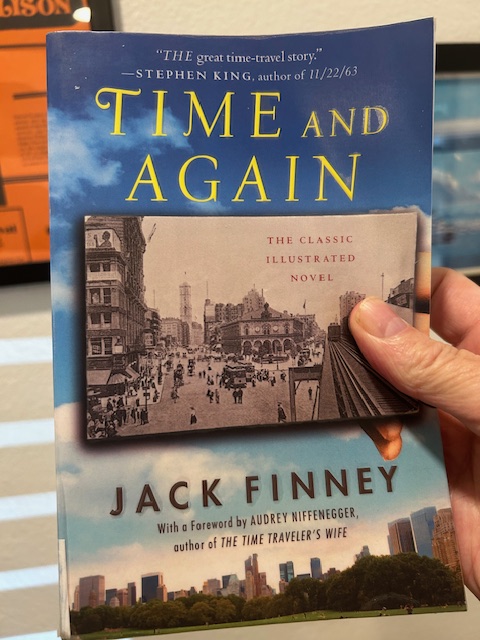
So, what does all this have to do with reviewing Jack Finney’s 1970 novel Time and Again?
The Christopher Reeve movie, Matheson’s book, and Finney’s book all have to do with a unique form of time travel, that a person can be hypnotized or so conditioned to believe that they belong in a certain place and year that they are actually transported there.
I read Finney’s rather than Matheson’s book because it was supposed to be a superior treatment of the subject.
Stephen King called it “The great time-travel story” and even science purest Carl Sagan said that it was among stories:
“…that are so tautly constructed, so rich in the accommodating details of an unfamiliar society that they sweep me along before I have even a chance to be critical.”
Written and initially set in 1970 New York City, advertising artist Simon “Si” Morley is selected by the government, along with a number of other subjects, as having the unique qualities to be able to travel through time.
The process involves spending a lengthy period educating and acclimating the individual to the target time and place, which for Si was New York City 1882. The person lives in a simulated mockup of what would be their home in the period, sees, smells, reads, eats, and talks only within that specific context until that place and time become second nature.
Coincidentally, Si is dating a woman named Kate who has her own mystery linked to New York in 1882. According to the plot description at Wikipedia:
She has a letter dated from that year, mailed to an Andrew Carmody (a fictional minor figure, a developer later associated with Grover Cleveland). The letter seems innocuous enough — a request for a meeting to discuss marble — but there is a note which, though half burned, seems to say that the sending of the letter led to “the destruction by fire of the entire World”, followed by a missing word. Carmody, the writer of the note, mentioned his blame for that incident. He then killed himself.
Another coincidence about the place and time is that the parents of the creator of the time travel process, the elderly Dr. E. E. Danziger, first met in the lobby of a theater in that city and year. Danziger just wants Si to observe the meeting without interfering. As an additional motivation, both Si and Kate are interested in who mailed the letter to Carmody, its complete message, and how it played into Carmody’s suicide.
The project has mapped out dates when a suite in The Dakota apartment building (which is real and still exists today) will be vacant (The Dakota wasn’t built until later in the 1880s, which was one of the few licenses Finney took with history). They set Si up in the 1970 version of The Dakota especially decorated to be identical to its 1882 counterpart. Si lives there for a significant period, after having undergone extensive hypnotic preparation.
He goes out for a walk on one snowy evening in November 1970 and the Manhattan of the present is subtly replaced by that of November in 1882.
The most remarkable feature of this novel is the level of detail Finney includes. Since Si is an artist, Finney mined libraries and museums for photos and drawings of New York specifically in late 1882 and early 1883, using them as Si’s own drawings. His descriptions of the people, events, objects, sensations, and conversations that Si experiences truly capture the very texture of that place and time. The people become real and even somewhat alien to Si and to the reader.
Most science fiction stories, television shows, and movies, either don’t have the time and resources, or simply don’t care about reproducing that level of accuracy (what a horse-drawn carriage would sound like traveling over a cobblestone street covered by thick snow). Although the novel has a fairly slow pace most of the time, I became enthralled by how absolutely real everything felt. Reading this book was the next best thing to actually traveling back in time.
Si eventually has to become involved in people and events of the time. Innocently at first, he simply witnesses the meeting of Danziger’s parents. However, in witnessing who mailed the letter to Carmody, Si follows the man, finds out where he lives, and then rents a room in the same boarding house.
He becomes closely involved in the lives of the proprietors and other guests. The man who mailed the letter is a brutish and difficult person named Jake Pickering. Si, of course, becomes attracted to and then falls in love with Julia Charbonneau who is the niece of the boarding house owner and the supposed fiancée of Pickering.
As it turns out Pickering is blackmailing Carmody in a very involved and convoluted plot based on actual events. The evidence Pickering is using is in his offices in a building that did actually exist at the time and Si delves deeply into discovering this secret, eventually involving Julia as well.
There’s a fire that eventually destroys the structure (as it did historically) and both Si and Julia barely escape.
The mystery of the letter deepens when they discover Pickering has disappeared (presumed dead) and Carmody, though disfigured, is alive and charges Si and Julia with starting the fire purposely.
After a desperate struggle to elude the police, again everything is described in such incredible detail that I could easily believe these things really happened, Si finally realizes their only escape is through time. Thus, he holds onto Julia in a place he knows will exist in 1970s and travels forward.
Julia can’t stay in 1970s. While a lot of what she sees is fascinating, life is far too different, especially women’s clothing which runs very much counter to her modesty. But it’s Si who especially can’t tolerate her presence. He has fallen in love, not just with Julia, but with New York of 1882. Although the past has its own crimes and sins, Si considers the history leading up to his present to be far more appalling.
This book was written towards the end of the Vietnam War and I don’t doubt that the author injected his personal, social, and political views into Si’s personality. It was the only part of the book that jarred me out of the narrative and where I disagreed with Finney. Sure, Si could have had those feelings, but the political commentary was blatant to the extreme.
Si is able to send Julia back alone. But wait! What about the police hunting them down?
Somehow, they reasoned that the disfigured Carmody they met was actually Pickering who, meeting with Carmody’s upwardly mobile wife after the real Carmody’s death, made a deal with her to pretend he was her husband. By herself in 1882, she would have no hope of earning the wealth she required to involve herself in New York’s high society, so she needed her “husband.”
Supposedly, once Julia revealed to fake Carmody that she knows who he is, he has the charges dropped and leaves her be, that is assuming she doesn’t reveal his true identity, which I guess she doesn’t.
Thus, the man Kate thought was her old uncle was really Jake Pickering who, in old age, atoned for his various crimes by suicide.
In the present, the project had changed hands, becoming a property of the military. That military directed Si to go back and to influence Carmody, a minor advisor of then President Grover Cleveland, to purchase Cuba, changing history by preventing it from becoming a Communist nation (this purchase was on the table in real life, but Cleveland didn’t go for it).
Si, detesting the military’s intention in changing history for its own ends, agrees to go back, but with his own agenda.
He somehow manages to go further back again to the point where Danziger’s parents are about to meet, and delays Danziger’s father long enough so he never encounters the woman who would have been his mother. No Danziger, no time travel project…
…except Si is already in the past and intends to stay there with Julia.
So far in the novel, a day in the past equals a day in the present and Si never even tries to go back to some point he’s already visited to change something. The book doesn’t describe how he accomplishes this, except that it’s important to the plot.
The ending is left ambiguous as we never see Si reunite with Julia although he intends to.
Except for those few hiccups, the book is amazing. Again, while there are exciting, action-packed portions of the story, most of it pretty much ambles along. I didn’t mind though because it was such a pleasure to be immersed in the past as Si experienced it. I wish there were more time travel stories like this one.
 poweredbyrobots.com