
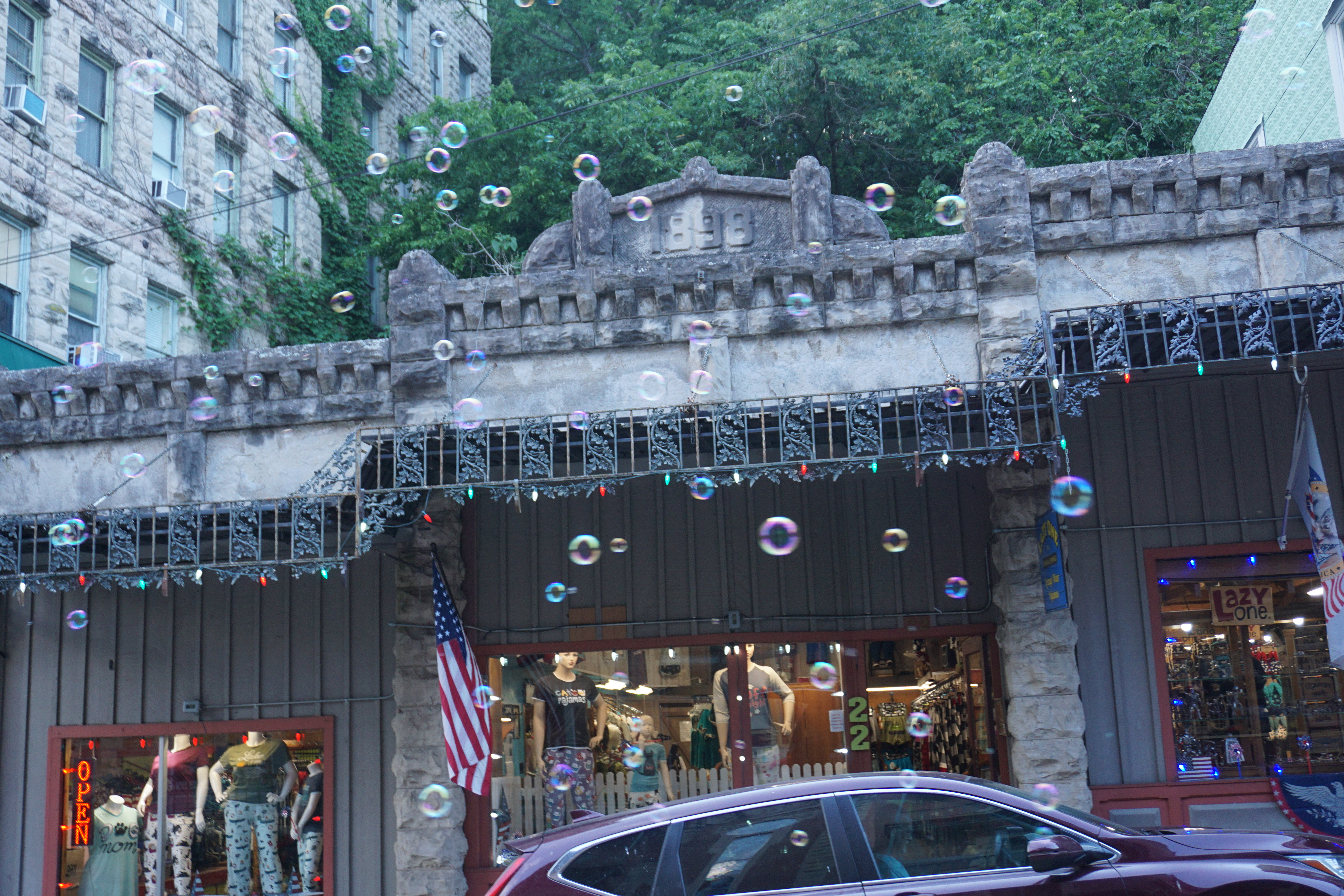
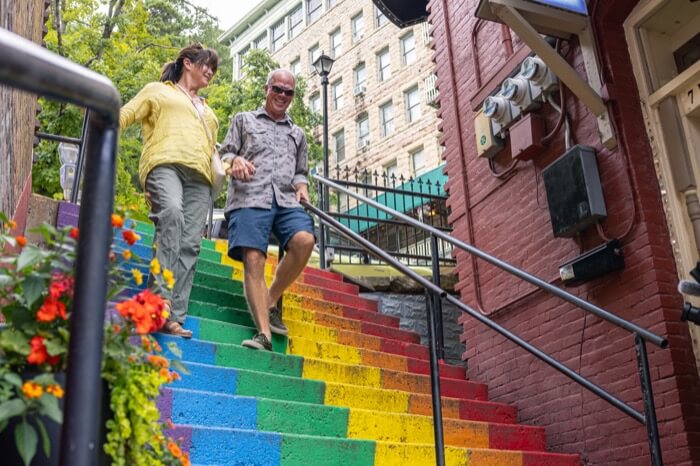
PHOTO PROMPT © Lori Wilson
Charles and Leon’s white and black fingers intertwined while exploring Eureka Springs.
“Glad we got here a few days early for their Pride event,” said Charles.
“Uh huh,” muttered Leon.
They started walking down a set of rainbow steps. Charles was fairly trotting while Leon let go of his hand and slowed to a stop.
“What’s wrong?” Charles looked back at him craning his neck
.
“This town used to have a lot of blacks in it,” lamented Leon. “I got old family photos. First the whites segregated us, then kicked us out.”
“That’s the real reason you came,” said Charles.
It’s Wednesday and time again for this week’s edition of Rochelle Wisoff-Fields’ Friday Fictioneers. The idea is to use the image at the top to prompt the crafting of a poem or short story no more than 100 words long. My word count is exactly 100.
Found at http://www.visiteurekasprings.com
Once I found out the photo was taken in Eureka Springs, Arkansas, I did a quick and dirty look up of its history at Wikipedia.
Among other things, I discovered:
On May 10, 2014, Eureka Springs became the first city in Arkansas to issue marriage licenses to same-sex couples. On May 12, 2015, voters approved a Non-Discrimination Ordinance (Ordinance 2223) by a margin of 579 to 261. The ordinance prohibited discrimination on the basis of sexual orientation and gender identity and applied to both residents and tourists, making Eureka Springs the first city in the state to enact such protections.
Also…
Eureka Springs continues to attract a significant gay and lesbian population. The Metropolitan Community Church of the Living Springs conducts commitment ceremonies for same-sex couples. Municipal tourism materials promote the city as a place of tolerance and mutual respect.
All that, plus…
The Annual Eureka Springs Pride Festival takes place June 11–14. The four-day event is one of the town’s largest celebrations, featuring a weekend of parades, drag shows, vendor markets, and community activities.
However, the town hasn’t always been so tolerant and accepting.
Early African-American residents included freedmen who moved to Eureka Springs from surrounding farms where they had previously been enslaved. Some initially arrived seeking employment or medical treatment and later settled permanently. During the era of segregation, Black-owned hotels served African-American visitors, who were barred from whites-only accommodations. The Black community established a school and an African Methodist Episcopal Pilgrim’s Chapel in the 1890s. Following the United States Supreme Court decision in Plessy v. Ferguson, segregation intensified, and African Americans were prohibited from accessing all springs except Harding Spring.
To continue…
Economic decline, racial segregation and discrimination, Klan activity, and the collapse of tourism during World War I contributed to the gradual decline of the African-American community in Eureka Springs during the 1920s and 1930s. The African Methodist Episcopal church disbanded in 1925. Members of the Banks family, descendants of the African-American Fancher family long associated with the city, continued to reside in Eureka Springs until their deaths in 1966, 1969, and 1975, respectively.
The African-American community that had developed during the city’s earlier tourism boom continued to decline. Local accounts indicate that the two African-American children known to live in Eureka Springs during the 1940s were denied admission to the city’s schools. The last known resident of the historic Black community died in 1975.
Social media is already pretty much flooded with messages about Pride Month even though June is still a few days away as I write this. I thought the contrast of how the LGBTQ community has been well accepted there vs. how the Black community was systematically marginalized and then expelled with the last black resident dying over fifty years ago to be rather significant.
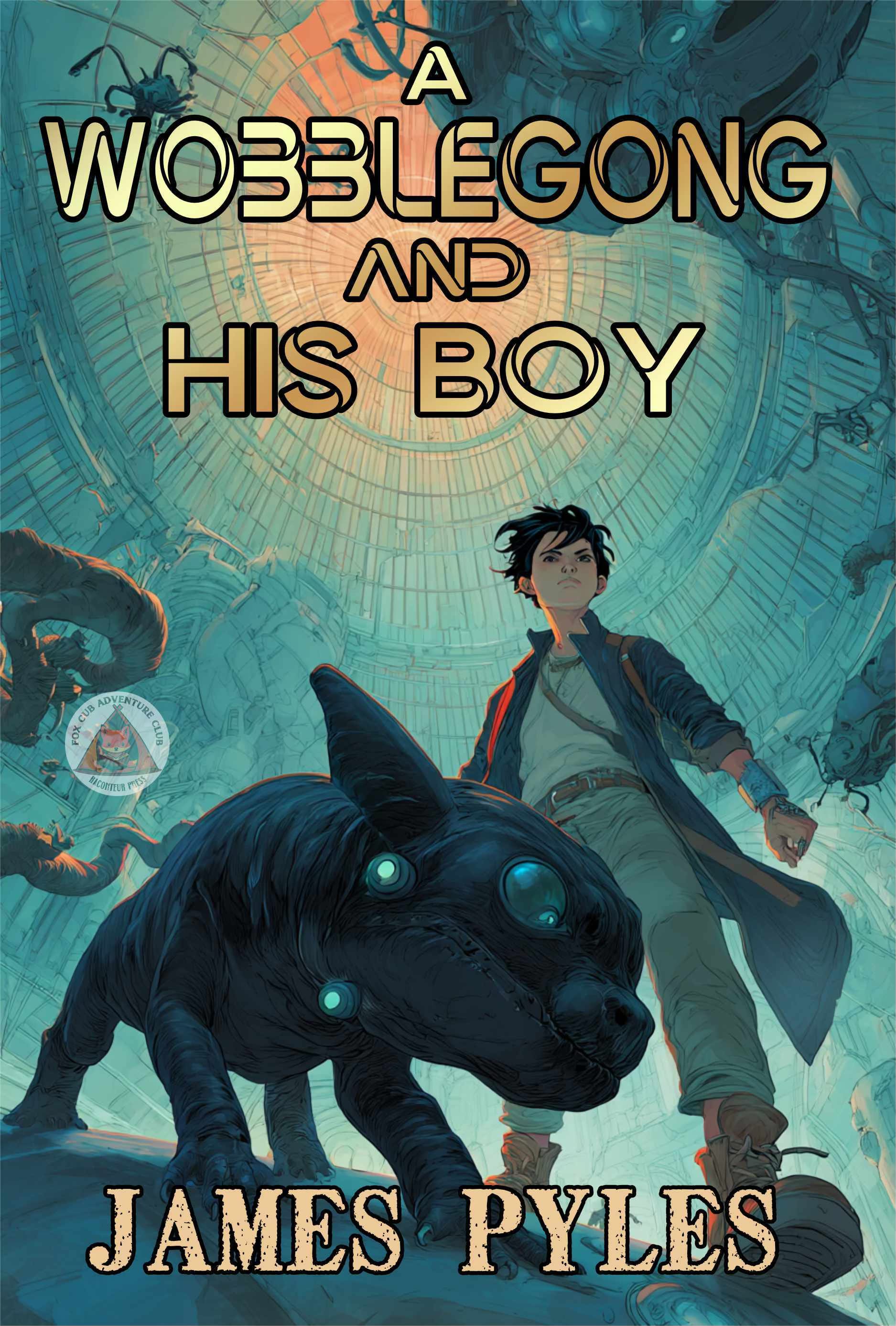
Cover image for my novel “A Wobblegong and His Boy”
I’m sure my story won’t be very appealing to a few, but some stories need to be told.
To read other stories based on the prompt or to contribute one of your own, visit Inlinkz.
My YA science fiction novel A Wobblegong And His Boy has been selected as the Featured Book of the Month by Amy’s Bookshelf Reviews (scroll down a bit). You can click on the image she’s displayed to see and purchase my book or go directly to Amazon. Don’t forget you can also review my novel at Goodreads.
Oh, it’s up to eleven ratings/reviews on Amazon with 87% of them being four and five stars!
 poweredbyrobots.com
First they came for the Communists And I did not speak out
LikeLiked by 1 person
I just wrote a story about gentrification this week- not for this prompt but yeah. This has been on my mind. Thanks for all the background.
LikeLike
You’re welcome, Violet. Thanks for reading.
LikeLiked by 1 person
Dear James,
Interesting bit of history.
Shalom,
Rochelle
LikeLike
Funny what you learn from these prompts, Rochelle.
LikeLike
A constant theme that lurks in the shadows, but is always present in our minds.
LikeLike
Yes indeed, James. Thanks.
LikeLiked by 1 person
Everyone has their reasons for going places.
LikeLike
That much is true, even if they don’t always recognize them, Dale. Thanks.
LikeLiked by 1 person
For sure
LikeLiked by 1 person
Injustice discovered should be called out whether there are ears to listen or not. Words are powerful.
Congrats on your success with the book reviews and Book of the Month award! Write on!
LikeLike
You’re right and thanks, Clare.
LikeLike
sadly racism and all the other ‘isms’ are always lurking awaiting for an opportunity to emerge and show their ugly faces – good write
LikeLike
Thank you.
LikeLiked by 1 person
interesting tidbit of history. now i know. thanks.
LikeLike
You’re welcome and thanks for reading.
LikeLiked by 1 person
This photo transported me to Montreal. And, Montreal’s Gay Pride Parade is one of the world’s largest LGBTQ gatherings. Some stories need to be told…
LikeLike
There are always two sides. Thanks.
LikeLiked by 1 person
That was interesting, and sad too.
LikeLike
Yes, it is sad. Thanks, Chris.
LikeLiked by 1 person
I’m pleased I read this James, not just the story but the footnotes too. I leave wiser.
LikeLike
Thanks, Keith. I leave wiser having written the story.
LikeLike
That’s fascinating, James. A great story with a basis in history. It’s great to learn about all that.
LikeLike
Thanks, David.
LikeLike
So glad you told this story.
LikeLike
Thank you, Dawn.
LikeLiked by 1 person
Interesting bit of history. While reading your story I was thinking I can’t imagine Arkansas being so open, but happy to be proven wrong. And you are right, being so accepting to the LGBTQ community vs the racism and marginalization against black people is interesting. I was mainly focused on 1898 and the building in my research, but when looking through reviews of the hotel on trip advisor I couldn’t help but notice it was all white people everywhere, except in one promotional stock photo for tourism. I am of the opinion that we need to feel uncomfortable and outraged, I appreciate your story, thanks.
LikeLike
Thanks for reading and commenting. If I know the place where a photo is taken, sometimes the history is far more interesting than one static image.
LikeLike
And now… seems the past truly does repeat
LikeLike
It does indeed, Laurie. Thanks.
LikeLiked by 1 person
Excellent bit of history, James. How did you find out the location of the storefront? Inquiring minds want to know.
LikeLike
It was in the image’s file name if I recall correctly. Thanks, Nancy.
LikeLiked by 1 person