Ava (Alicia Vikander) from the film “Ex Machina” (2015)
When they heard her laughing, they thought she might actually be hurt. It didn’t sound like real laughter. More like one of those novelty store laugh bags, mechanical laughing, maniacal laughing.
Mikiko hadn’t owned her life for the past three years, ever since the accident at the Fukushima Daiichi nuclear plant, the one that had nearly killed her. Well, maybe it did kill her. Mikiko Jahn was dead. Who she was now was someone else.
Because she didn’t own her life, the door to her rooms wasn’t locked. Reintegration Team members Tashiro Momoru and Brigit Monroe rushed through almost side-by-side. Mikiko was in her living room, the only light coming from the television. She turned to see the pair run in and still laughing her strange, mechanical laugh, she pointed at the show being played and said. “Oh, hi. Glad you’re here. You’ve got to see this. It’s hysterical.”
“It’s a seizure alright, and it’s because she’s panicking. Can’t you bloody fools keep her sedated?”
Professor Daniel Hunt had Ph.Ds in Cybernetics and Synthetic Biology, but not only was he no medical doctor, he had the bedside manner of a highly annoyed badger.
“Thank you, Professor. We’ll handle it.” Dr. Tate tried his best to mimic the annoyed tone he heard in his boss’s voice but if Hunt noticed, he ignored it.
The medical team was the finest in the world. When both the Japanese and British governments had given Hunt a virtual blank check in order to use his experimental techniques to rebuild the horribly disfigured and crippled Mikiko Jahn, a young technician who had been burned beyond recognition while trapped in a control room next to a melting reactor core, he called in the finest practitioners in each required field from all over the world.
Benjamin Tate and Allie Ramirez were the attending physicians, Rosemary Shelton was one of the three top neurologists on Earth, Brent Patrick was the best reconstructive surgeon in Europe and the Americas, and the much beleaguered Edward Simon was chief anesthesiologist.
“There’s a limit to what pharmaceuticals can do, Hunt. Besides, there’s practically no access to her circulatory system. I’ve got just one line into her and it’s on the verge of collapsing.”
Mikiko Jahn never forgot that she was no longer human, although the casual or even careful observer would hardly notice. She was what Professor Daniel Hunt once referred to as “the happy accident” (he hadn’t realized she was listening when he said it).
The Fukushima Daiichi Nuclear Power Plant disaster was a lot more severe in certain aspects than was generally known. Three technicians, including Jahn, had been trying to shutdown Reactor One when it began to meltdown. Maki Yamamoto and Kondo Hirofumi made it out just in time, but a strong aftershock knocked Mikiko off her feet. Before she could get up, the heavy safety door slammed shut and the steel door frame bent making it impossible to open, especially during the chaos of a disaster.
Thirty-three percent of Reactor One’s core melted before it could be cooled, but even the slight breach of the wall between the reactor and the auxiliary control room allowed the searing nuclear furnace to burn her body beyond recognition.
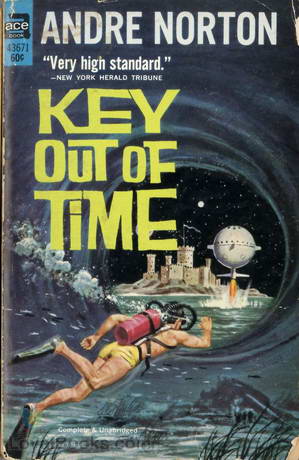
Cover to one of the paperback editions of Norton’s 1963 novel “Key Out of Time”.
Circa 1333 BCE – Egypt
“So you’re the legendary Sennedjem, called the Overseer of Tutors, Father of the God, Beloved of the God, and Fan-bearer of the Right Hand of the King. Such illustrious titles for a glorified teacher.”
“And you Ross Murdock, can only see and hear me because who I was, the legend and the man, was recorded in an alien artifact over 3300 years before you were born. Thanks to an extensive telepathic session with similar but dissimilar aliens, you are able to interpret that recording through means even a man of your experiences would find astounding.”
The 21st century time traveler and former professional thief didn’t seem to find it strange that he was standing on a balcony in a palace overlooking an ancient Egyptian city, and yet the city was not a ruin, but a living, breathing community of men and women, from the very young to the very old. He was dressed as he expected to dress when not on assignment, yet the man called Sennedjem was attired as an 18th Dynasty Egyptian.
“You brought me here to tell me something, Sennedjem. What? You’re an alien?”
“Hardly. I am as human as you are and we have something else in common. We both know about aliens and time travel.”
Travis woke up with a tremendous headache. The light was dim. He was laying on his back in what felt like a conventional bed.
Was he back home at the Project? He tried to get his eyes to focus. Dim light coming from his right. Shades pulled down over a window. He was in a bedroom but it wasn’t one at the base or for that matter, at his ranch.
He tried to sit up, but it didn’t work the first time. The headache suddenly increased behind his eyes. He lay back down a moment and then tried again. This time he managed to sit up. He could hear a dog barking outside.
Yes, it was a bed. Pillows, quilt, looked hand-made. Pictures on the wall of people he didn’t recognize. A cheap painting of some foothills. Wallpaper. Beat up wooden floor with throw rugs. He hadn’t seen one of those pull down shades since he was a kid (he liked to pull them down all the way, let go and watch them shoot up to the top). It gave the light coming through it a golden cast, as if the world were a sepia tone photograph.
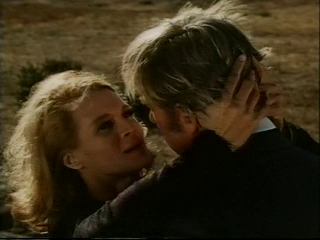
Lloyd Bridges and Angie Dickinson in the 1970 made for TV movie “The Love War”.
Allan didn’t need the glasses to read and he didn’t even need them to survive, not anymore. He had written an app so that it accessed the camera on his phone, letting it perform the task of detecting his adversary automatically.
He took a seat in the back of the coffee shop where he had a clear view of everyone coming and going. He had ordered the establishment’s trademark latte more to blend in than because he liked it.
To the world around him, he looked like a middle-aged man, blond, athletic, bronzed from the sun. He could have just finished a game of tennis or golf.
In front of him was a mystery novel by a well-known author whose name was, as they say, a household word. And yet Allan couldn’t have told you any other books the writer had penned. Like the latte, it was camouflage. Even his name was misdirection and subterfuge.
Actor Lloyd Bridges in the 1970 television movie “The Love War”.
Allan didn’t need the glasses to read but he did need them to survive.
He took a seat in the back of the coffee shop where he had a clear view of everyone coming and going. He had ordered the establishment’s trademark latte more to blend in than because he liked it.
To the world around him, he looked like a middle-aged man, blond, athletic, bronzed from the sun. He could have just finished a game of tennis or golf.
In front of him was a mystery novel by a well-known author whose name was, as they say, a household word. And yet Allan couldn’t have told you any other books the writer had penned. Like the latte, it was camouflage. Even his name was misdirection and subterfuge.
From the first episode of “The Invaders” (1967) with Roy Thinnes as David Vincent and Diane Baker as Kathy Adams.
No one believed him. He wasn’t surprised, but he was frustrated. He wasn’t some nut or UFO conspiracy kook. He was a rational human being who had been thrown into an irrational if not insane world.
Architect David Vincent. 29 years old, considered reasonably good-looking, divorced for two years, no kids, a successful career but at the cost of friendships, marriage, and family.
It wasn’t his fault that he’d seen an alien spaceship land near a deserted diner off of an old State road used by almost no one anymore. It wasn’t his fault that the only two witnesses, a newlywed couple who had been camping nearby, hadn’t seen or heard anything, not even the approach and then rapid departure of David’s car. It wasn’t his fault that the local Sheriff thought he was another crazy Californian trying to play a prank on what he thought was some dumb country Arizona officer.
There had to be evidence at the site. David had to tell someone. He drove to the nearest town, burst into the Sheriff’s office, and demanded an investigation.
The strange irony was not lost on David Vincent when his car’s GPS device failed to lead him to the all-night diner off the old state highway and instead revealed a horrifying discovery.
“Damn it.” The young architect, driving through a remote area of Arizona after meeting a developer at the proposed site of a new data center, wanted to grab a cup of coffee before continuing his drive back to Los Angeles. It was after midnight and he was exhausted. Instead of a hot coffee and maybe a pastry, he found a restaurant closed for over a year. No town, not even a gas station within miles.
“I can’t make it. Got to get some rest.”
He pulled his Audi R8 off to the side of the building and after stepping out to relieve himself on a dying shrub, returned to the car’s interior and prepared for an uncomfortable nap in the front seat.
At first he thought he was dreaming. There was a shrill sound getting louder, fluctuating in tone. David opened his eyes and looked out the windshield. Off to his left, around the corner of the building. Bright, multicolored lights. He got out and hiding in the shadow of the old diner, peered around the side.
It was big, about the size of a two-story house. A short cylinder flaring out at the bottom. Three…no, four landing struts. It was setting down. There were windows in the top part of the cylinder. He could see figures moving inside. Then a light shone down one of the landing struts. Stairs. Figures were coming out. People. No, they couldn’t be.
“It began with a closed, deserted diner, and a man too long without sleep to continue his journey. It began with the landing of a craft from another galaxy…Now, David Vincent knows that the invaders are here. That they have taken human form. Somehow he must convince a disbelieving world that the nightmare has already begun.”
The Invaders was an American television show that ran on ABC in 1967-68 and starred Roy Thinnes as David Vincent, a man who had witnessed the landing of an alien spacecraft and learned that their intention was to invade and take over the Earth.
The last bit of narrative above in italics is taken from the opening title sequence and was dramatic as heck to me when I was thirteen years old.
I was reminded of the show when I read a piece of fan fiction earlier this morning, so I decided to recreate that opening for 2017. Below is a YouTube video of the show’s opening sequence. To find out what happens to my version of David Vincent next, read The Hidden.
Burial sled of Anubis from King Tut’s tomb, on display at the Egyptian Museum – Cairo, Egypt.
The Egyptian Museum – Cairo – December 22, 2016
“Here’s what we’re preparing for our 2018 exhibit, Gordon.”
Archeologist Gordon Ashe was being given a private tour of the new wing of the Egyptian Museum in Cairo by his friend Dr. Tarek Sayed Tawfik, the general director.
“This is truly astounding, Tarek. I have to admit to being more than a little envious. All five thousand of the artifacts that had been discovered in King Tutankhamun’s tomb will be displayed together for the first time.”
“You shouldn’t be envious, Gordon. After all, you’re here almost two years ahead of schedule, and you didn’t even have to pay the price of admission.”
“I guess being a personal friend of the director helps.”
Both men laughed. Gordon and Tarek had become friends at Oxford as undergraduates some decades ago. Both had a passion for antiquities but their lives traveled along highly divergent trajectories. Tarek had eventually gone into administration and Gordon gave up life as a field archeologist to work for the U.S. Government, though of course Tarek wasn’t sure exactly what services the esteemed Dr. Ashe performed for them.







 poweredbyrobots.com