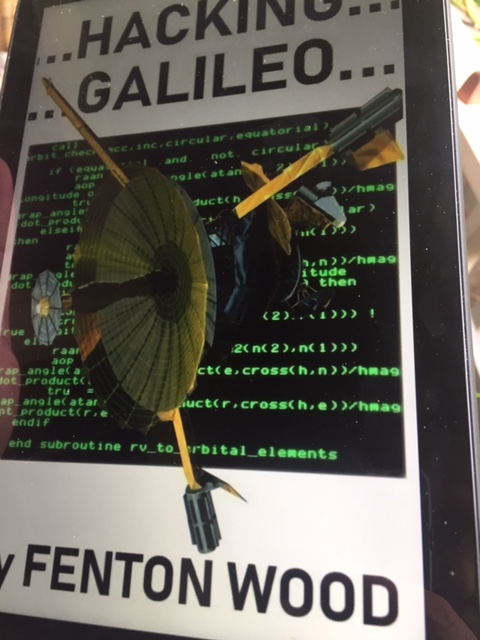
Book Review of “Hacking Galileo” by Fenton Wood

hack

© James Pyles

If you like my work, buy me a virtual cup of coffee at Ko-Fi.

I became aware of Fenton Wood (a pseudonym) when he reviewed my SciFi/Fantasy novelette Ice on twitter (but alas not on Amazon or goodreads).

Curious, I took a look at his twitter/X account, which led me to his e-book Hacking Galileo.

It had fabulous reviews, an interesting premise, and was reasonably priced, so I downloaded it onto my Kindle Fire.

The first words you read in the book after the usual preamble stuff is “This is a work of fiction.” Wood then goes on to explain the inspirations and influences for various parts of his story, the background of some of the technical details, when he “cheated,” making certain events happen at a slightly different point in history for the sake of the plot, and how security at Cray Research and Bell Telephone Company weren’t quite as lame as he depicted.

That’s really important because the rest of the book is written from the point of view of a man who, in the 1980s, was part of a teenage hacker group, really just a bunch of high school friends in Palmdale, California, who performed acts of hacking from the interesting to the fantastic.

The main character Roger O. Miller (ROM, see what he did there?) is writing and recounting events that happened thirty years ago where he and his three friends actually saved the world from destruction by an alien space probe. There’s a lot of build up to get to that point, but almost all of it is fascinating.

Continue reading

Assault by Sex Toy

robot

statue of the famous “Sexy Robot” created by Hajime Sorayama

In the past, I’ve written about some rather unusual technological trends we can expect in the near future. One in particular should be very much anticipated, but sometimes too personal to talk about. I’m discussing sex with machines.

My previous commentaries are When Your Sex Toy Tattles on You, An AI Sexbot That Can Love You, and Will People Be Marrying Machines by 2050?.

But compared to what I’ve been reading on the progressively sanctioned twitter and Facebook platforms, frankly, people “marrying” their sexbots by 2050 or sooner actually wouldn’t surprise me. More’s the pity.

However, yesterday, I came across an article on LinkedIn titled Smart sex toys come with Bluetooth and remote hijacking weaknesses.

Continue reading

The Machines Are Hacking The Machines

AI hack duel

Spectators at an AI hacking duel
DARPA

I just read a story at New Scientist called Autonomous AI guards to stalk the internet fighting hackers. Apparently, earlier this month at the Black Hat conference in Las Vegas, with a $4 million prize hanging in the balance, different Artificial Intelligences were set up to hack each other while defending themselves from their opponent’s hacking attempts.

I know, right? The machines are hacking each other.

This has a good side and a bad side in the real world. The good side is you can configure an AI to look for vulnerabilities in your own system, patching them as they’re found. The bad side is that malicious players can set up their own AIs as autonomous hackers, scanning the web looking for vulnerable systems and exploiting them when discovered.

The New Scientist article ends with the somewhat humorous and ominous paragraph:

In a talk at Black Hat, Devost (Matt Devost of cybersecurity firm FusionX in Washington DC) joked that the competition heralded the launch of Skynet, the malevolent AI in the Terminator films. “Everyone laughed,” he says. “The humans were applauding their own demise!”

Continue reading