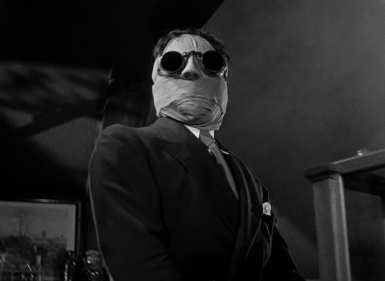
Image: From the 1933 film The Invisible Man
When Charlie Rainier realized he could turn invisible, he was absolutely giddy. From his point of view, nothing had changed. He could still see his reflection in a mirror, he cast a shadow, he didn’t have to take his clothes off like in the old movies, and he could still see. But no one else could see him.
If invisibility worked by causing light to pass directly through a person or to curve around him, he should be blind. To see, light enters the eyes through the pupil. The iris changes the size of the pupil depending on how bright the light is. Then the lens focuses that light onto the retina at the back of the eye. Light has to stop after hitting the retina.
If light curved around the invisible person, it would never reach the eye and the invisible person would be blind. If light went right through him, it wouldn’t stop at the retina but pass right through it, and again the person would be blind.
Fortunately for Charlie, he found a way around that problem.
Continue reading →


 poweredbyrobots.com