

© James Pyles
If you like my work, buy me a virtual cup of coffee at Ko-Fi.
Minecraft: The Island (2017) isn’t a book I’d choose to read. My wife actually read it to our grandson three times when he was much younger and more into the game. Now my eight-year-old granddaughter loves Minecraft.
Some background. When my grandson was about five or six, we started playing “the game.” It started out as teasing each other. He’d make up a character and say it was doing something to my character to which my character would respond. A very simple, adversarial, totally verbal, roleplaying game.
Eventually, it became more sophisticated, kind of like Dungeon and Dragons, but with only two players and no dice, just our imaginations. The games were largely centered on his interests at the time, which included Minecraft. It also included whatever he was watching or reading. I’d add my virtual two cents worth and plug in anything from my imagination and childhood.
His sister wanted to play with us, but there’s a six-year age gap between the two of them and she was too young.
Our games ended up fueling about two-and-a-half years of stories on my blog (you can still look them up) as well as my first two published short stories. It was loads of fun.
Well, kids grow and now a teen, my grandson has other interests (I do miss our games).
However, my granddaughter now plays “the game” with me. They haven’t been as focused and tend to fizzle out a little faster. Then she hit on Minecraft and we’re in the middle of one of those games now.
But her Minecraft-based games follow the “rules” of the computer game more closely than the way my grandson played. It’s so close that I don’t understand how the world works. I expect it to work like our world, or a world I’d create if I were writing a story. But that’s not Minecraft.
My wife has been bugging me to read Brooks’ book for a while and finally she got my grandson to loan me his copy. Not the sort of book I’d normally read, but what the heck.
It’s actually entertaining. It starts off with a “regular” person waking up in an ocean in a Minecraft environment. It would be as if you or I had materialized in a Minecraft world with no memory of our previous existence.
Eventually our hero (he never discovers his name) makes it to an island, the only solid ground supposedly in the world, and by trial and error, discovers the “rules” of Minecraft.
Of course there are many variations, but I can only assume Brooks chose the most basic.
We encounter zombies, creepers, skeletons, spiders, and the other nasties in Minecraft. Our protagonist befriends a cow, a herd of sheep, and a bunch of chickens.
Although after learning how to use a furnace to cook, and partaking of the yummy flesh of chickens and one cow that had all been killed by an explosive creeper, our hero almost never again eats meat for some reason. He is sometimes confined to a diet of rotting zombie flesh which he has to wash down with cow’s milk. He finally settles on fish from the sea, veggies he’s able to plant and harvest, and bread he can bake (he also eventually discovers how to make cake).
Within the context of the book and world of Brooks, the animals are our lonely protagonist’s only friends, so I guess he feels guilty about killing and consuming them. It’s clear from what he remembers of his former more human life, that his food came from the store and he didn’t have to kill to live (and may have been a vegetarian).
Our hero shows us his life one day at a time, one adventure (and disaster) at a time, taking us along with him on his journey of discovery. On the way, he develops a set of principles that are also chapter titles and a list of “what I learned from Minecraft” at the end of the book.
Especially for young readers, it’s a good way to help them develop a similar set of principles in how to approach day-to-day life.
The book also indeed shows how the rules of Minecraft differ drastically from the laws of physics and such.
I mentioned the day-to-day learning, guiding the reader a step at a time into the Minecraft universe, but that gets thrown out the window during the last quarter or so of the book.
It was as if Brooks got tired of the pacing and decided to step on the metaphorical gas. He “invented” machines, gunpowder, vending devices, and ways to dispatch his foes with ever more efficiency and devastation at super high-speed.
He also discovered books and other treasures, supposedly left behind by some past resident who didn’t bother to create a document introducing themselves or how they knew so much about the universe.
As an aside, I keep saying “he” because Brooks is a “he” but I guess there’s nothing in Minecraft to determine a character’s gender in case you’re into that sort of thing.
Anyway…
Up until now, the hero has been toggling between figuring out a way back to his own world of the past, or making a home on the island. He knows, from building a tower, that there is no other land in sight of his island. He knows from one of the books, that this world had a massive flood that drowned the continents, leaving this one, tiny island behind. He has no idea who the previous tenant of the island was or where they disappeared to.
So he builds a boat (one of several), loads up on supplies, and leaves the only place that contains the raw materials for him to survive and find a purpose.
He leaves behind his house, chicken coop, veggie garden, some books including a journal, which “The Island” turns out to be, and his best wishes as he sails into the unknown.
Funny how the previous resident only left behind useful stuff underground with absolutely no evidence on the surface that they had been there before him.
The ending was incredibly rushed, damaging the integrity of an otherwise good and well-written story. Oh well, at least I learned something about Minecraft.
This is only one of many Minecraft books, but I understand it’s the first.
Fun fact: Max Brooks is the son of the late actress Anne Bancroft and Mel Brooks. That’s right. Blazing Saddles, Young Frankenstein (today’s Marty Feldman’s birthday), and Spaceballs Mel Brooks.
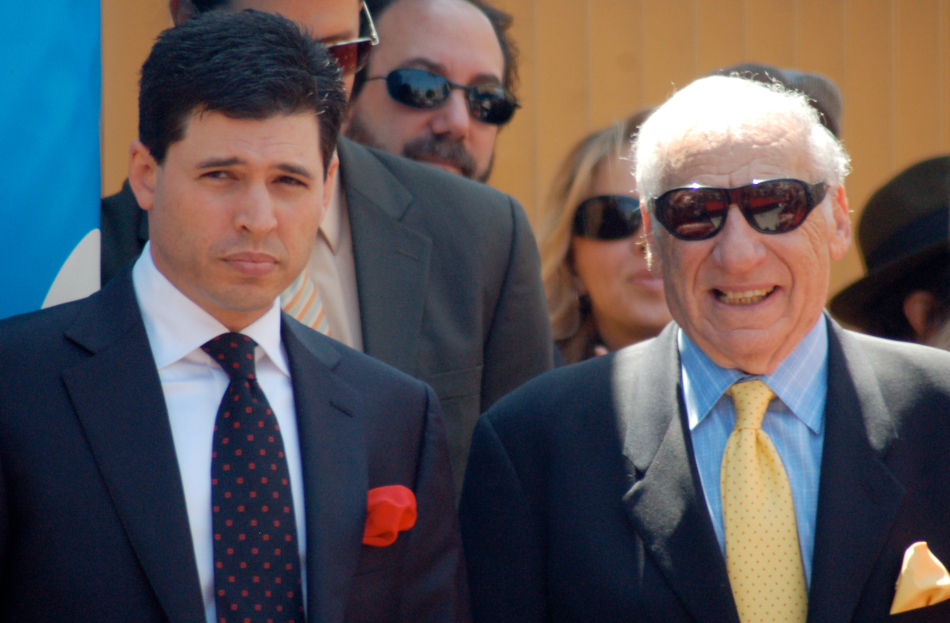
Max and Mel Brooks attending a ceremony for Mel to receive a star on the Hollywood Walk of Fame in 2010. Photo taken by Angela George. This work is free and may be used by anyone for any purpose.
Imagine having him as your Dad. Max has one son, so imagine having Mel Brooks as your Grandpa.
The book is fun, a very quick read, and, if you want a lesson in the Minecraft universe, a pretty good teacher. It’s also considered almost flawless according to the 94% of four and five star ratings at Amazon.
In addition to being an author, Brooks is also a “public speaker, and nonresident fellow at the Modern War Institute at West Point.” He was on the writing team of Saturday Night Live from 2001 to 2003. Not a bad set of credentials.
 poweredbyrobots.com
I’m unfam8liar with Minecraft, despite having heard occasional reference to it, so my response to your description of it was entirely unpremeditated. What first struck me was how appallingly unkosher this world was — not just in its dietary requirements but in its behavioral ones. Imagine, then, my surprise that it was produced by the offspring of Mel Brooks, who relied on so many Jewish and Yiddish memes in his films. If I read into this any inference about the condition of American Jews, at least the financially successful ones in the entertainment industry, I feel terribly ill.
LikeLike
I feel certain that Max Brooks wasn’t trying to communicate Jewish values in this particular books. The majority of his written works also involve Zombies for whatever that’s worth.
LikeLike