
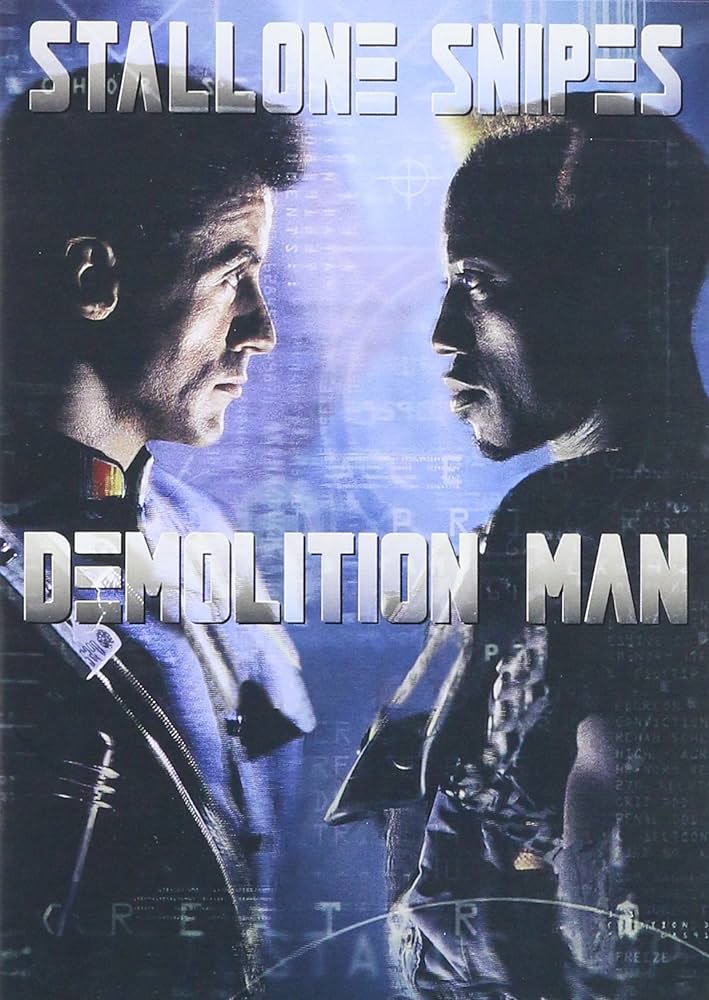
Poster for the 1993 film “Demolition Man”
If you like my work, buy me a virtual cup of coffee at Ko-Fi.
Last night I finally got around to watching the 1993 film Demolition Man starring Sylvester Stallone as Detective John Spartan (some of these made up names are lame) and Wesley Snipes as Simon Phoenix. This is an action/adventure science fiction film with some unique insights on the future, but I’ll get to that.
The story opens in 1996 Los Angeles. Spartan is in a helicopter with two other cops (the pilot Zachary Lamb is played by Grand L. Bush, who played “Little Johnson” in the 1988 classic Die Hard).
Spartan is closing in on his nemesis, the notorious criminal Simon Phoenix, who is holding hostages taken from a commercial aircraft. This L.A. is even more brutal and lawless than the actual Los Angeles in the 1990s, already establishing a break between the film and the reality of the audience.
In typical “Rambo” style, Spartan breaks into the bad guy headquarters and caps off all of the baddies before confronting Phoenix. A heat scan didn’t show any signs of the hostages and Spartan and Phoenix fight over where they are. But Phoenix has rigged enough gasoline and C4 to blow the building into orbit.
Spartan drags Phoenix outside just in time before the whole building goes up (there’s a reason Spartan is called “The Demolition Man”). Turns out the hostages were in the building all along. Phoenix said that Spartan knew that and didn’t care. I guess L.A. coroners in this movie are dumb because they should have figured out Phoenix killed the hostages (no heat signatures) well before Spartan’s arrival.
Both Phoenix and Spartan are convicted of their crimes. Spartan is sentenced to 70 years cyrofreeze. While he’s under, his brain will be reorganized to give him more productive behaviors upon thawing. So both of these men undergo a deep freeze.
Switch to the year 2032 and the fine city of San Angeles. In 2010, THE earthquake hit and wiped out Southern California. San Angeles is built on top of Santa Barbara, Los Angeles, and San Diego. After the disaster and the utter terror of the survivors to even leave their homes, political savior Dr. Raymond Cocteau (Nigel Hawthorne) reorganizes society so that safety is emphasized at the expense of almost all human freedoms (I’ll get to that).
SAPD Lt. Lenina Huxley (Sandra Bullock) is driving to work after having asked the computer if anyone needed police assistance. No one does. The world is a peaceful nirvana (mostly) where the police are more like kindly social workers (sound familiar?) whose most dangerous weapon is an electrified baton (kind of like a taser).
Meanwhile, at the cryo-facility, Simon Phoenix is revived to face a parole hearing. Mysteriously, Phoenix knows all the computer codes that set him free and he immediately kills three people and maims the Warden (Andre Gregory) by removing his eye. Phoenix uses it to fool the biometric scanners so he can gain his freedom.
At police headquarters, Huxley receives a small dressing down by the police chief George Earle (Bob Gunton) about some snarky remark she made earlier. Huxley accepts takes it in stride seemingly before going into her office and calling her boss an asshole. A monitor device charges her one credit for violating the language morality laws.
Here we get into the meat of what was changed and why everyone (except the Scraps which I’ll get to) have virtually no rights left.
In order to create the ultimate peaceful society, just about any behavior that might lead into even a small conflict is outlawed.
Language: Cussing in any form is outlawed. People are constantly monitored by computer at work, home, and in public. If you say “shit” or “damn” or “fucker,” the computer takes one credit out of your account as punishment.
Government monitoring of people: Everyone is “lo jacked” with an electronic tracer so that the government knows where you are and what you’re doing at all times. Even in the real world, everyone carries smartphones by which the government can track us and we’re okay with that.
Digital money: This is a cashless society where all money is virtual. It’s bad enough now that our money isn’t backed by any standard, meaning it could go worthless at any time. Anyone in the future can have some or all of their money frozen for breaking whatever law happens to be on the books.
Electric Cars: All cars are electric and can be manually or computer driven. They can be diverted, stopped, and locked by police as deemed necessary.
No Meat: In the “Franchise Wars,” Taco Bell won, so all restaurants everywhere are Taco Bell. Good luck getting a beef burrito, though.
Non-contract social greetings: In the future, people don’t touch. They swipe hands near each other instead of handshake.

Sylvester Stallone and Sandra Bullock in a scene from the 1993 movie “Demolition Man”
Sex: No physical sex. Abortion is illegal but so is pregnancy without a license. Sex occurs between two people wearing helmets over a neural link where they “imagine” sex with their partner. You get to keep your clothes on, but what happens when the male orgasms must be a little messy. The no-contact sex is to prevent passing STDs (AIDS was only the beginning). To procreate, women visit a lab where the man’s sperm is artificially inserted. Where’s the fun in that?
Virtual meetings: Not Zoom, but a slab of metal with a TV screen showing the person’s face is set up in a conference room.
Soyboys/Andro males: Benjamin Bratt and Rob Schneider play police officers who seem to have not an ounce of testosterone between them. The thought of even the slightest bit of violence would make them swoon. Associate Bob (Glenn Shadix) is the “Mayor’s” right hand man, but he’s fat, badly dressed, and effeminate. On the other hand, he has excellent survival skills, the weasel.
While we still have sex the old fashioned way in the real 21st century, the general idea of being completely non-offensive, agreeable to all, happy and cheerful, and so syrupy sweet I could get diabetes just from listening to them, is very DEI, progressive, and “woke.” This wouldn’t have been imagined in 1993, but just add racial quotas, trans inclusion, and financial sanctions (and canceling) for anyone violating the political correctness of society and you’d have 2024 to a “T“.

Sylvester Stallone and Sandra Bullock in a scene from the 1993 movie “Demolition Man”
Obviously, this future isn’t meant to be taken too seriously, but it’s amazing (and I’m hardly the first person to point this out) how well the movie predicted the future. Most science fiction movies of this type do a terrible job, but this one nailed it.
The police being totally helpless in the face of the hyper-violent Phoenix and based on Huxley’s historical research, the Chief agrees to reanimate Detective Spartan. Everyone gets more than what they bargained for since he hates almost everything in their world. Spartan is reinstated into the police force and authorized to find Phoenix. That’s when the fun begins.
There’s a scene where Spartan meets his old friend Zachary Lamb (older version played by Bill Cobbs) and they have a happy reunion with real handshakes, cussing, and so on. Huxley remarks to Officers Alfredo Garcia (Bratt) and Erwin (Rob Schneider):
Well, if you had read my study, you would know this is how insecure heterosexual males used to bond.
The three of them chatter together like ten-year-old schoolgirls.
There are others, a countermovement lead by Edgar Friendly (Denis Leary) who literally live underground in the old cities, using cobbled together tech to tag (graffiti) public places and who raid the surface world for food. They have what looks like homemade firearms and one really cool “muscle car.”
As it turns out, Cocteau engineered Phoenix’s re-education as a computer genius and terrorist to kill Friendly. Imagine a world with police so ineffectual that they can’t bring down a bunch of starving anarchists with high tech cans of spray paint. I guess that’s the logical outcome of “defunding the police.”
It’s more than Cocteau wanting to wipe out a political enemy. He wants to use Phoenix to create a world so dangerous, that people will give up every right they have in order to be safe. Cocteau will create that totalitarian world for them where “you will own nothing and be happy.” Again, sound familiar?
It’s easy for people to imagine a Hitler or Donald Trump creating a dictatorship with women dressed in The Handmaid’s Tale reds and priests forcing evil religion on the populace, but it’s just as easy to believe that Joe Biden, or in a few years Alexandria Ocasio-Cortez, creating the same “freedomless” nation and imposing it on the rest of us “for our own good.”
Safety by force is just another dictatorship, especially when the dictators have all the freedoms reserved to themselves.
Phoenix turns the tables on Cocteau by freeing a few other of his henchmen. Since Phoenix is programmed not to harm Cocteau, he has one of his bad guys (Jesse Ventura as Adam I think) off him. I silently cheered.
The movie proceeds through several improbable fights between Spartan and Phoenix while at the same time Spartan’s trying to figure out his “Brave New World.”
Huxley, whose hobby is the 20th century, is the only person who approaches competence in this world. She even holds her own in hand-to-hand combat with a 20th century thug twice her weight (she learned kicking from Jackie Chan movies). Another example of how she should have gotten her ass kicked, but again, don’t take the movie too seriously.
Another comedy aside was the behavior Spartan was programmed to take up while in cryofreeze was knitting and sewing. Fortunately, it doesn’t detract from this classic 1980s and 90s action hero violence and mass destruction. He did knit Huxley a nice sweater, though.
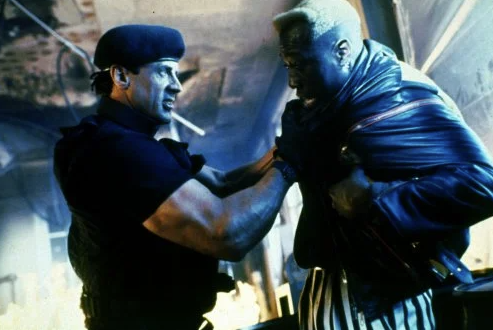
Sylvester Stallone and Wesley Snipes in a scene from the 1993 movie “Demolition Man”
For the final scene where Phoenix is going to unfreeze ALL of the violent 20th century felons, Spartan uses his electro-baton to knock Huxley out before pursuing him. This is supposedly to keep her out of danger while he has his showdown with Phoenix.
I really thought she’d show up at the 11th hour to save Spartan. If this movie ever gets a 21st century remake, Huxley will be the hero, the super-peaceful world of the future will be played straight and not for laughs, and Spartan will be a bumbling, destructive, ineffective idiot who really will be sent back into the deep freeze at the end of the movie.
In this case, she doesn’t show up during the climax and afterwards she thanks Spartan for knocking her out to keep her safe. Good grief, do you see what I mean? How close is this to how people will bend over and take it just to feel “safe?”
Spartan, Huxley, and Garcia took a trip into the underground where people eat meat (rat burgers) to meet with Friendly, letting him know Phoenix and his merry band of miscreants are coming to kill him. As it turns out, Friendly is leader by accident. He’s an anarchist who just wants to do what he wants, not hurt anyone, and live free.
As an aside, during a fight in the underground, Garcia gets knocked out. When next we see him, he’s joined the Scraps and even tries his hand at cussing.
Before I go on, popular music in this era are the advertising jingles of the 1960s through 1990s (“I wish I was an Oscar Mayer wiener…”)
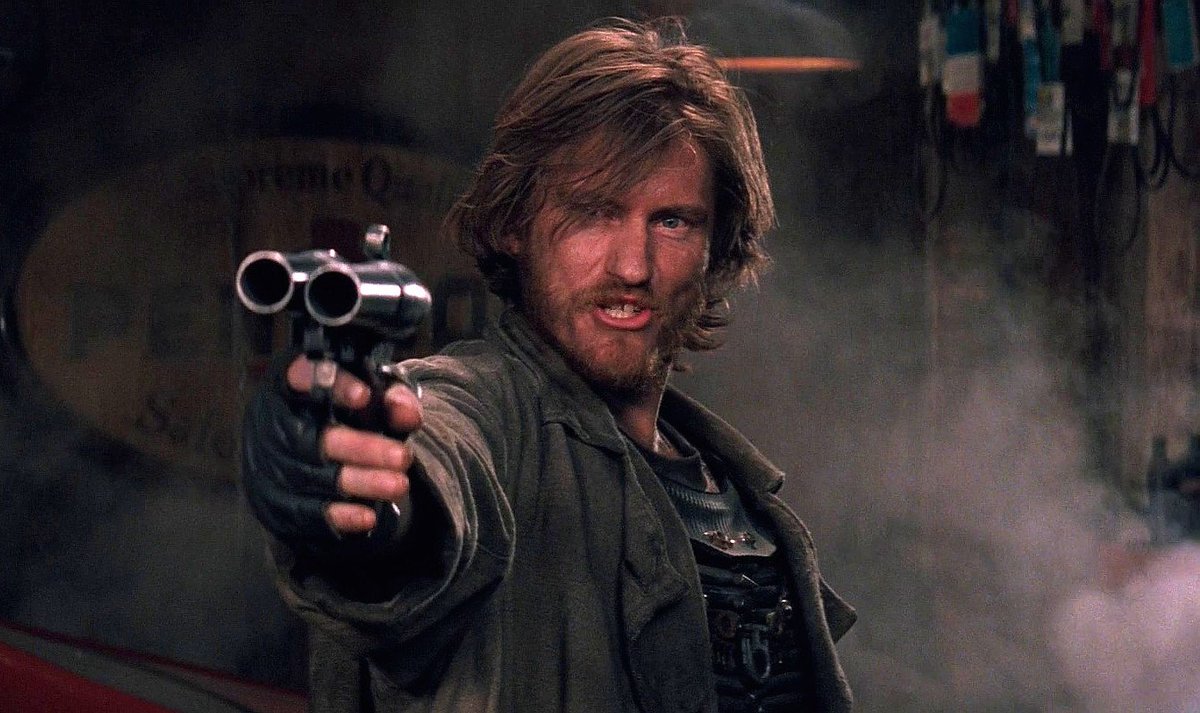
Denis Leary in a scene from the 1993 movie “Demolition Man”
Near the end of the movie, with Cocteau and Phoenix dead and no one around to run anything, Friendly delivers a terrific speech:
Edgar Friendly (Denis Leary): So, you think you’re taking me in, huh? Guess what, not happening. You tell Cocteau he can kiss my ass. Yeah, that’s right, you tell Cocteau it’s gonna take an army of assholes to get rid of me ’cause I don’t give a shit, I’ve got nothing to lose.
John Spartan (Sylvester Stallone): I don’t wanna rain on your parade, pal. But, I don’t know who the hell you are, let alone wanna take you anywhere. So stay here, be well and Cocteau’s an asshole!
[In anger, he slaps a scrap’s weapon to the side]Wasteland Scrap (Jack Black): Let’s stake them and dump them up top, they’re only down here to spy on us.
John Spartan: Wait a minute, you’re the guy outside Taco Bell.
Edgar Friendly: Yeah. What do you want?
John Spartan: I guess you weren’t part of the Cocteau Plan.
Edgar Friendly: Greed, deception, abuse of power? That’s no plan.
John Spartan: And that’s why everybody’s down here?
Edgar Friendly: You got that right. See, according to Cocteau’s plan, I’m the enemy. Cause I like to think, I like to read. I’m into freedom of speech and freedom of choice. I’m the kind of guy who wants to sit in a greasy spoon and think, “Gee, should I have the T-bone steak or the jumbo rack of barbecued ribs with the side order of gravy fries?” I want high cholesterol. I want to eat bacon, butter and buckets of cheese, okay? I want to smoke a Cuban cigar the size of Cincinnati in a non-smoking section. I wanna run through the streets naked with green Jello all over my body reading Playboy magazine. Why? Because I suddenly might feel the need to. Okay, pal? I’ve seen the future, you know what it is? It’s a 47-year-old virgin sittin’ around in his beige pajamas, drinking a banana-broccoli shake singing “I’m an Oscar-Meyer Wiener”. You wanna live on top, you gotta live Cocteau’s way. What he wants, when he wants, how he wants. Your other choice: come down here, maybe starve to death.
John Spartan: All right, then why don’t you take charge and lead these people out of here?
Edgar Friendly: I’m no leader. I do what I have to do. Sometimes, people come with me. All I want to do is bury Cocteau up to his neck in shit and let him think happy-happy thoughts forever.
John Spartan: Then I got bad news: I think he wants to kill you.
That’s the point of the movie. Both Spartan’s and Huxley’s worlds are fueled by extremism in one direction or the other. Spartan suggests finding something in the middle and Associate Bob (who offered his services to Phoenix and then bailed) offers to help Friendly in “adjusting” society.
While Spartan’s wife died in the 2010 quake, his daughter is still alive. Spartan wants to see her but against the backdrop of this “perfect” world, he’s afraid she’ll see him as a caveman. While she never is revealed in the movie, trivia says she was living with Friendly’s group all along. Test audiences didn’t like the reveal since Spartan would end up having sex with with a woman her age (Huxley), so those scenes were deleted.
At the end, Spartan literally sweeps Huxley off her feet and they exchange bodily fluids by kissing. She really likes it and kisses him back. Probably not the most realistic response since she was raised in a world to consider physical, intimate contact to be primitive and repulsive.
But then again, this movie wasn’t meant to be taken very seriously either.
As I said before, its attraction these days is the marvel of how the writers predicted the 2020s so closely. Friendly is the real hero of the movie because he’s got a plan to “don’t worry and be happy.” He’s sort of like a libertarian or at 1960s free speech Democrat as opposed to the far-left slant the party has taken in the present (Turn on, tune in, drop out).
Don’t take the movie seriously except to enjoy the commentary of the 2020s safely from 1993. That’s what I did.
By the way, then 29-year-old Sandra Bullock looked great.
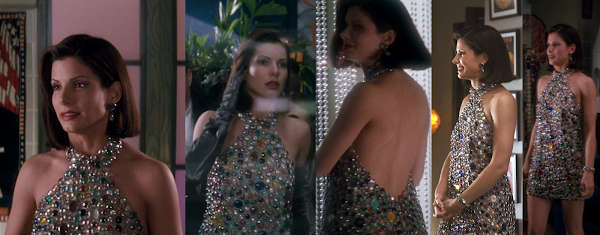
Sandra Bullock in scenes from the 1993 film “Demolition Man”
 poweredbyrobots.com