
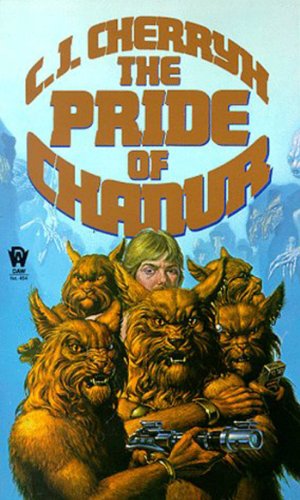
Cover art for C.J. Cherryh’s “The Pride of Chanur.”
If you like my work, buy me a virtual cup of coffee at Ko-Fi.
I finished C.J. Cherryh’s The Pride of Chanur a few days ago but am just now getting the time to write the review.
I remembered reading this back in the 1980s but didn’t recall the details (forty years is a long time). When I saw it on Bookbub, I was curious. There wasn’t a copy in my public library system so I bit the bullet and bought a digital copy from Amazon.
The story is set in a universe involving a species called the Hani. They’re cat-like, their space traveling freighters are captained and crewed by females, as the males aren’t suited to space travel, and their particular region of space is dominated by them and other races who trade with each other via a system of space stations in an alliance called “The Compact.”
The chief “baddy” in this tale are the Kif which are tall, thin, and hairless. They are also predatory, cunning, and devious.
While the ship “Pride of Chanur” is at Meetpoint station, a strange alien is seen to be skulking on the docks. It finally manages to slip by the Captain, Pyanfur Chanur, into her ship, but is wounded in the attempt.
Communication is a chore since the creature doesn’t speak a civilized language. It’s eventually discovered that this is an intelligent creature which had been a captive on a Kif ship and was trying to escape.
You guessed it, the outsider is a human. The Kif discovered a human ship in their space, damaged or destroyed the ship, and captured four of the crew. Tully was the only survivor after the Kif murdered the other three.
The rest of the book is haggling over the value of Tully and his race. Pyanfur is determined to protect him no matter what, even over the objections of her own crew (who are also her relatives).
This is basically capitalism in space and a refreshing change from human beings having the center spotlight in a science fiction story. It’s true that Tully is the “gold ring” being fought over, but since he can only be understood through a translator he programmed, and then only partially, he has no power in any situation.
Members of Pyanfur’s own species (competing Hani traders) turn against her, the Kif accuse the Pride of stealing from them, and the various acts Pyanfur and her ship have to commit to keep Tully safe piss off just about everyone.
Pyanfur manages to make deals (that’s what she does), buys off various station owners, develops a few allies, makes enemies out of former allies, and faces an insurrection within her own clan upon returning to her home world.
The unpredictable methane-breathers manage to bring a human ship to this conflict (much against that crew’s will) to settle everything and from that point on, the story calms down. The humans are depicted as well-meaning but generally clueless about how the rules work in the Compact. Tully becomes the “flavor-of-the-month” with the rest of the humans because he at least has some idea of what’s happening (finally).
The reader never gets to know Tully through his own eyes or any of the humans for that matter. They are always seen from Pyanfur’s perspective. This makes them kind of two-dimensional, but that’s to be expected since people are totally alien.
This story occurs in a larger universe of tales written by Cherryh. I know I’ve read a number of others, but that was back in the day and I’ll have to revisit them.

Cherryh at NorWesCon in 2006.
Oh, C.J. Cherryh is actually Carolyn Janice Cherry for those of you who think I don’t read female authors (actually, I read plenty). Thankfully she’s still alive at the age of 81, married to Jane Fancher since 2014, and is a Hugo and Locus award winner.
I say that because in the past I’ve been “chided” by the current gatekeepers of science fiction for not conforming to their codes of conduct, such as not reading enough current, “bleeding-edge” science fiction focusing on the various “woke” topics, not disdaining white, male authors and exclusively reading stories by and about people of color, females, and LGBTQ+ works.
Yes, I get cranky because it’s no one’s business but mine what books I read (except I make it people’s business by writing these reviews) and which authors I follow. I’ve “experimented” just to see what’s up and have more often than not been disappointed.
Although interesting, “The Pride of Chanur” lacked both a certain depth and pulse-pounding excitement. Yes, it had it’s space and ground battle and yes, the puzzle of Tully had its compelling moments, but I think it could have been developed more. It would have been interesting to see the perspective toggle back and forth between Pyanfur and Tully and, for that matter, the Kif, just to flesh out their various viewpoints as well as the world of the Compact.
I do want to read (re-read) more of Cherryh’s work. Sometimes going back to novels you’ve sampled in your past can remind you of old friends.
I should say that although Cherryh’s website has the most recent copyright date of 2012, it looks like it hasn’t been touched since the 1990s.
 poweredbyrobots.com
Rimrunners by her is my favourite Cherryh story, but the Chanur series is good fun too. What might be considered borderline YA today, though that was probably not the intent of the story back then. Still worth a read.
LikeLike
Thanks, Ashley.
LikeLiked by 1 person