
© James Pyles
Seven years ago, at his request, I reviewed author Rick Sulik’s supernatural murder mystery novel Death Unmasked. Seven years is a long time, and I ultimately forgot all about it.
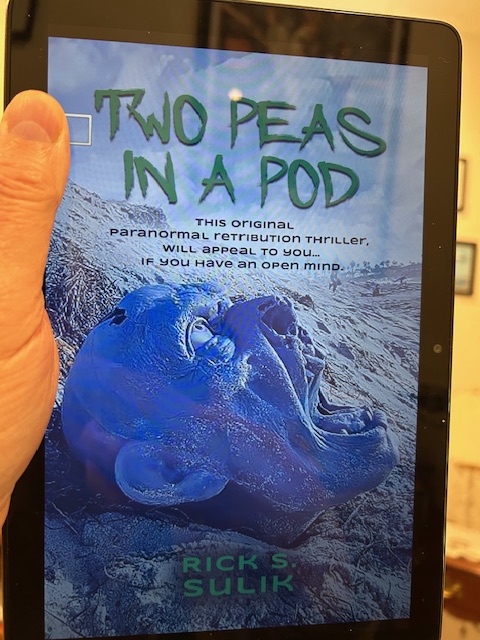
Then I got an email from Sulik asking if I’d be willing to review the book’s sequel Two Peas In A Pod. My memory was jogged and of course, I’ll generally review a book for a free copy. I said “yes.”
I didn’t revisit the first novel or my review so I could approach “Peas” fresh (as opposed to “frozen” – okay, bad joke). Here are my impressions.
First, the stuff I liked.
The novel’s strength is the accuracy of police procedure. That’s no surprise given Sulik’s extensive background in law enforcement. He worked three-and-a-half years with the Houston Police Department, twenty-two years with the Pasadena (suburb of Houston) Police Department, and ten years as a courthouse bailiff with the Gonzales County Sheriff’s Department. That also helps in that the setting of both books is in and around Houston.
I’ve never been near Houston, but I’ll take it on faith that Sulik’s description of the area is accurate and that residents of Houston and Pasadena would be impressed with his rendition. I’ve watched movies and TV shows set in places where I’ve lived and just shook my head at how inaccurately the locations were portrayed. Anyway.
Where the book could have been better.
I don’t know if it was the pacing or the overall structure of the book, but events just seemed uneven or “off.” Situations I thought should have been highlighted were given a gentle pass (Sean’s actual return to Houston for a visit – the big conspiracy reveal) while those that could have stood with just a little attention (the lead up to Sean’s return) were presented as if the characters were uniformly obsessed over it.
I had trouble with the majority of the dialog. I understand that when police officers are dealing with the public, their language is professional and rightfully so (think the old TV show Dragnet). However, much of the time, the characters spoke with formality you’d never see in an actual conversation.
For instance, the friend of a recent suicide victim when being interviewed by police said:
“Officers, Kathy is a very depressed woman and has been for quite a while. She’s being treated for severe mental despondency. Several of her friends and I are trying to help her cope with her misery.”
I’m sorry Rick, but who talks like that? No one. That’s not how the average person would express herself when talking about a suicidal friend to the cops or anyone else. “…help her cope with her misery?”
There are too many similar examples to list them all, but it made reading the novel a bit of a chore. This is where, as a writer, reading a lot of other really good character-driven stories comes in as well as just listening to how people talk.
I’ll post one more:
“I swear, Roman, you remind me so much of my partner, Sean Jamison, before he retired last year and married Laura six months ago.”
Both Roman and the speaker, Paula, know Sean, know when he retired, and know when he got married. All Paula had to say was:
“I swear Roman, you remind me so much of Sean sometimes.”
This scene happened about two-fifths of the way through the book, so the reader had already been introduced to these facts. It wasn’t a matter of sticking dialog in just to provide information.
I mentioned a conspiracy theory with a big reveal at the end of the book. I don’t want to drop too many spoilers, but the details of that reveal were treated almost as an afterthought and should have been given more of a build up.
There’s a murder victim in a graveyard who supernaturally reveals to Sean (who has psychic powers) that the other investigators (the FBI) won’t solve her murder and will sweep it under the rug. Besides the fact that it came out of left-field and Sean shouldn’t have understood what was being said at the time, I still wasn’t sure what this victim had to do with the two “main” victims.
There really needed to be a better thread weaving through the novel tying all the little loose pieces together because they were hard to keep track of. For instance, the above-mentioned murder victim came and went without any sort of preamble or follow up. If she was connected to the actual murderer, that should have been made more overt.
As far as Sean’s “powers” went, there just wasn’t enough drama around them. It would have been a lot better if we got Sean’s POV during an event, got his feeling sick, headaches, a sense of terror, the feeling of hands around his neck as if he were the victim, breaking out in cold sweats.
Another thing is that if Sean and his wife hadn’t just happened to be vacationing in Houston at that point, he would never have gotten his visions and the police may or may not have solved the case.
What if Sean had premonitions weeks before and felt compelled to go back to Houston? What if he knew he wouldn’t get enough info to help the victims unless he returned to his old “stomping grounds?” Paint Sean as a man tortured and driven by his visions.
There could have been a lot more dramatic build up in a lot of ways that would have pumped up the book’s tension level.
I would have considered having the Captain of the homicide division hire Sean as a consultant. It would have made having him involved in official investigations less awkward (it should have been more awkward), although I’m sure the actual procedure for doing so would have been lengthy. If there are future sequels involving Sean, having him get a private investigator’s license in Houston and being hired as a consultant would grease some wheels.
In the novel, everyone in various parts of the police force very easily accepted Sean’s abilities as facts. The FBI agents involved, if they knew about it, didn’t mention Sean at all (and they should have for a variety of reasons). There should have been some doubters, probably most of the officers, actually.
Bottom line is that Two Peas In A Pod really needed an editor and at least an alpha reader. Restructured and probably lengthened, it could have been a much better supernatural thriller in the vein of some of those old 1970s made-for-TV movies I used to love.
 poweredbyrobots.com