
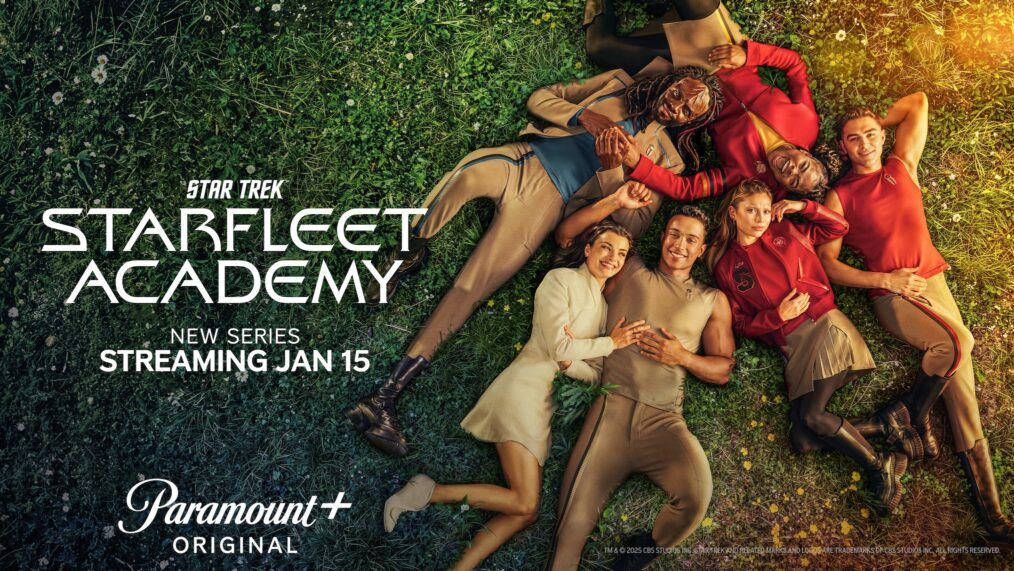
Promotional art for the Paramount Plus show “Star Trek: Starfleet Academy.”
I’ve read that episodes 1 and 2 of Star Trek: Starfleet Academy were available to watch for free on YouTube, but I could only find episode 1, Kids These Days. So be it. I watched the thing.
But why?
I mean, everything I’ve heard, well almost everything, about the show says it stinks. It’s awful. It’s horrible. It makes no sense.
I’d watched at least some of the Starfleet Academy Red Carpet video hosted by Celia Rose Gooding who played Uhura in Star Trek: Strange New Worlds. Between her and the junior (by age) cast members of SFA, it was like watching a bunch of undisciplined, uneducated, and spoiled teenagers with rich Mommies and Daddies prance around being impressed with themselves in their designer clothes that they didn’t have to pay for.
It was terrible. I could hardly stand it. I wonder how Robert Picardo, who is at least an adult, could stand it?
That doesn’t tell you why I forced myself to watch SFA.
It occurred to me, and it’s been in my thoughts for a while now, that if all of the earlier Star Trek shows, from the original going forward, had gotten started when social media existed, they might have been raked over the coals and, worst case scenario, been cancelled before they had a chance to find their feet.
The original series was always on the brink of being cancelled because, in its case, it had the virtue of having never been tried. No one knew what to do with it, least of all the network and sponsors. In fact, Kirk, Spock, McCoy, and company didn’t find its massive following until the show turned up in syndication in the early 1970s. Then it exploded.
But the same could be said for the first seasons of all of the other shows we now so cherish from Next Generation to DS9 to Voyager and even Enterprise. All of the “Treks” we older fans generally consider “real Star Trek.”
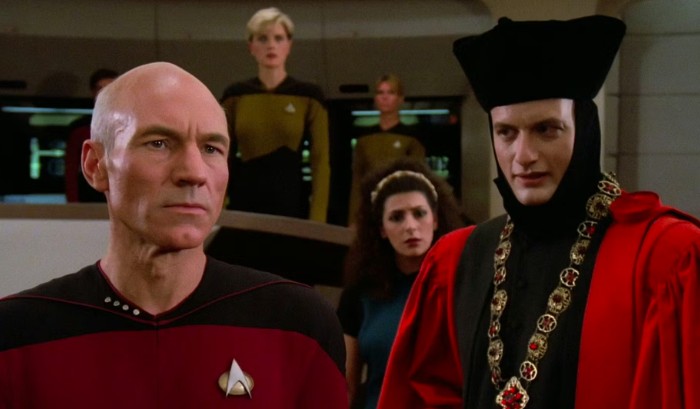
Scene from the Star Trek the Next Generation episode “Encounter at Farpoint.”
Their first seasons were almost unwatchable and it took, in some cases, to their second or third seasons to become the classics we now consider them. Really. When’s the last time you watched Encounter at Farpoint? I have the series on physical media and almost never touch season 1. I re-watched “Farpoint” about a year ago and barely made it through the episode. Yes, it was that bad. I think I pushed through season 1 in 1987-88 because it was the only new Trek around and I was trying to give it the benefit of the doubt. It also would eventually be my children’s Star Trek, although they were still in diapers (actually, my daughter wasn’t born until Summer of 1988) when TNG debuted.
So maybe, just maybe, I was being unfair, even a little, to SFA.
Oh, I’ve had this thought before. I watched seasons 1 of Discovery and Strange New Worlds and seasons 1 and 2 of Picard. I didn’t touch any of the others. I thought I was being fair enough. I tried them and, for various reasons, I dropped them all. Nothing more to see here. Move along, move along. These aren’t the droids you’re looking for.
So I watched one hour and some odd minutes of “Kids These Days.”
It’s very visually appealing. Lots and lots of open space and pretty lights.
I actually (sort of) liked the opening scene. A mother is railroaded into being an accomplice after the fact in the death of a Starfleet officer. She’s ordered (without trial) to a rehab colony by Nahla Ake (Holly Hunter) separating her from her very young son Caleb Mir (the adult version played by Sandro Rosta).
It’s an obvious comparison to President Trump’s treatment of illegal immigrants and how parents are sometimes separated from children because you can’t send kids to grown up jail. Never mind that Biden, Obama, and other Presidents have done the same thing. Oh, the horror and Ake quits Starfleet in the aftermath.
But before that, she promises the kid he’ll be taken care of and get to see Mom often. But as she goes to another room to get the kid’s teddy bear, he boosts her comm badge and uses it to escape the city into a sandstorm (I wonder how the kid lived through that?).
Up to that point, the story could have taken a very different direction and been the adventure of a young boy growing up on the mean streets of desert city whatever, dreaming of freeing his mother someday, and becoming a rogue anti-hero like Aladdin in the 1992 film of the same name. I like boy adventure books and using that as a jumping off point, I could have written a good one.
It wouldn’t be Star Trek but it might be interesting.
But such was not meant to be.
Bad writing example number one: The villain Nus Braka (Paul Giamatti) who got Mama Anisha Mir (Tatiana Maslany) in trouble gets sent to prison but Mama only gets sent to a rehab colony, implying her sentence would be short and she’d be released fairly soon, which meant that little Caleb escaping in a panic was a major screw up on his part.
However in a fist fight between Braka and older Caleb toward the climax of the episode, Braka mentions that he and Caleb’s Mom escaped prison together and that something bad happened to her afterwards.
What?
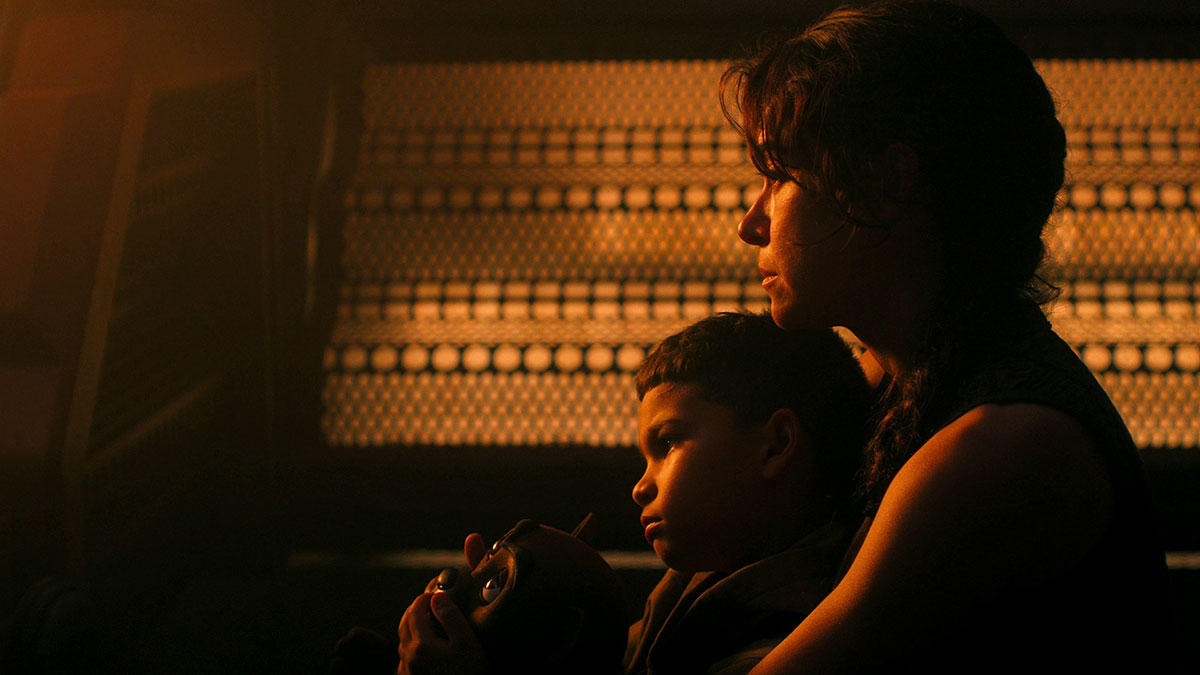
Scene from the Star Trek: Starfleet Academy episode “Kids These Days” featuring Tatiana Maslany and Luciano Fernandez.
Mom trusted Braka to get food for her and little Caleb because for some reason, there were no replicators on the planet where they lived, even though there was a Starfleet presence. Ake even tells little Caleb that she’d put him in a school on Bajor where they had a lot of food. So why was there a famine here and what was Ake eating all this time?
All Mama is guilty of is accepting stolen property. She had no idea how Braka got the food, therefore couldn’t be considered an accessory in the death of the Starfleet officer.
Like I said, bad writing.
As an aside the episode was written by the series creator Gaia Violo.
Fifteen years later, Ake is conned into becoming the head of a new Starfleet Academy, the first one in 120 years, by the lure of finding the now young adult bad boy Caleb and getting him to go to the school with the promise of finally finding Mommy.
The school is both the USS Athena, a huge starship designed to look so fragile that you could blow it away with a sneeze, and a ground campus in San Francisco.
I won’t regurgitate the plot for you. There are tons and tons of reviews online that can do that for you.
I will spotlight some points.
Robert Picardo returns as “the Doctor.” He explains that he added an aging program to make we poor organics feel more comfortable, as if anyone would care. After all, everyone he knew on Voyager is now long dead so why bother?
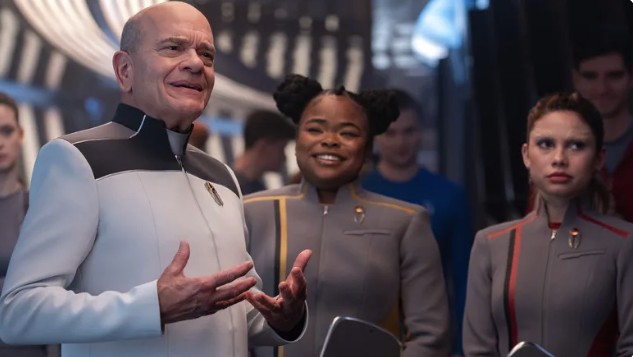
Robert Picardo as The Doctor, Kerrice Brooks as Sam, and Bella Shepard as Genesis.
He is (almost) his usual abrasive self except he’s dumber or maybe more tongue-in-cheek saying such lines as “breathing is your friend.” He’s also still interested in opera, so much so, that he’s teaching it as an elective class and being obnoxious about it. I just hope they’re paying him a ton of money for lowering himself and his iconic character this way.
Funny though that after so many centuries he still hasn’t picked out a name for himself.
He meets another “photonic life form”, SAM (Kerrice Brooks) who apparently comes from an entire planet of holographic sapient beings.
Why? Why program holograms to be independently intelligent and sapient? What purpose do they serve? There’s no real reason for her to exist at all, let alone be a cadet, let alone be a heavyset young black woman, let alone to have been created mere months ago and thus incredibly “neurodivergent,” let alone appear as a seventeen-year-old girl (the actress turns twenty-six next April).
Oh, and where is her projector? On Voyager, the Doctor was either projected by the sickbay holographic system or his portable emitter. On Athena, it’s assumed that there are ship-wide emitters, but that doesn’t account for SAM.
Also, at one point in the episode, we find out that the ship’s emitters have been damaged and thus most of the medical staff is unavailable. That implies they’re all holograms. And yet, the Doctor is seen still up and running.
When he appears, he still starts by saying “Please state the nature of the medical emergency” when in fact, he’s the Academy’s staff physician. After hundreds of years, that message was never edited, especially when he’s a self-determining photonic life form?
Oh, the silly little cadet who swallowed her comm badge, the one who didn’t make it into the main cast listings for the episode at IMDb, I was hoping there was some sort of explanation for how she managed such a feat. None. In fact, the Doctor’s response was “Already?” like it was expected but not so soon. All of these cadets (adjusted for human) are in their late teens or early twenties. Yet this one sucks on her comm badge like an oral-fixated toddler?
Getting back to Ake, she’s the most chill starship Captain I’ve ever seen, in fact really far too chill, like melted Velveeta cheese. She’s oozy and gooey and oh my stars and garters, she drives me nuts (and I like Holly Hunter as an actress). A lot of reviewers criticize her for curling up on the command chair on the ship’s bridge like a cat and reading a book. Turns out in the heat of battle, when she orders an enemy ship destroyed, she’s still curled up. When Braka shows up holographically and is trying to intimidate her, she folds up in her chair like an “origami chicken.”
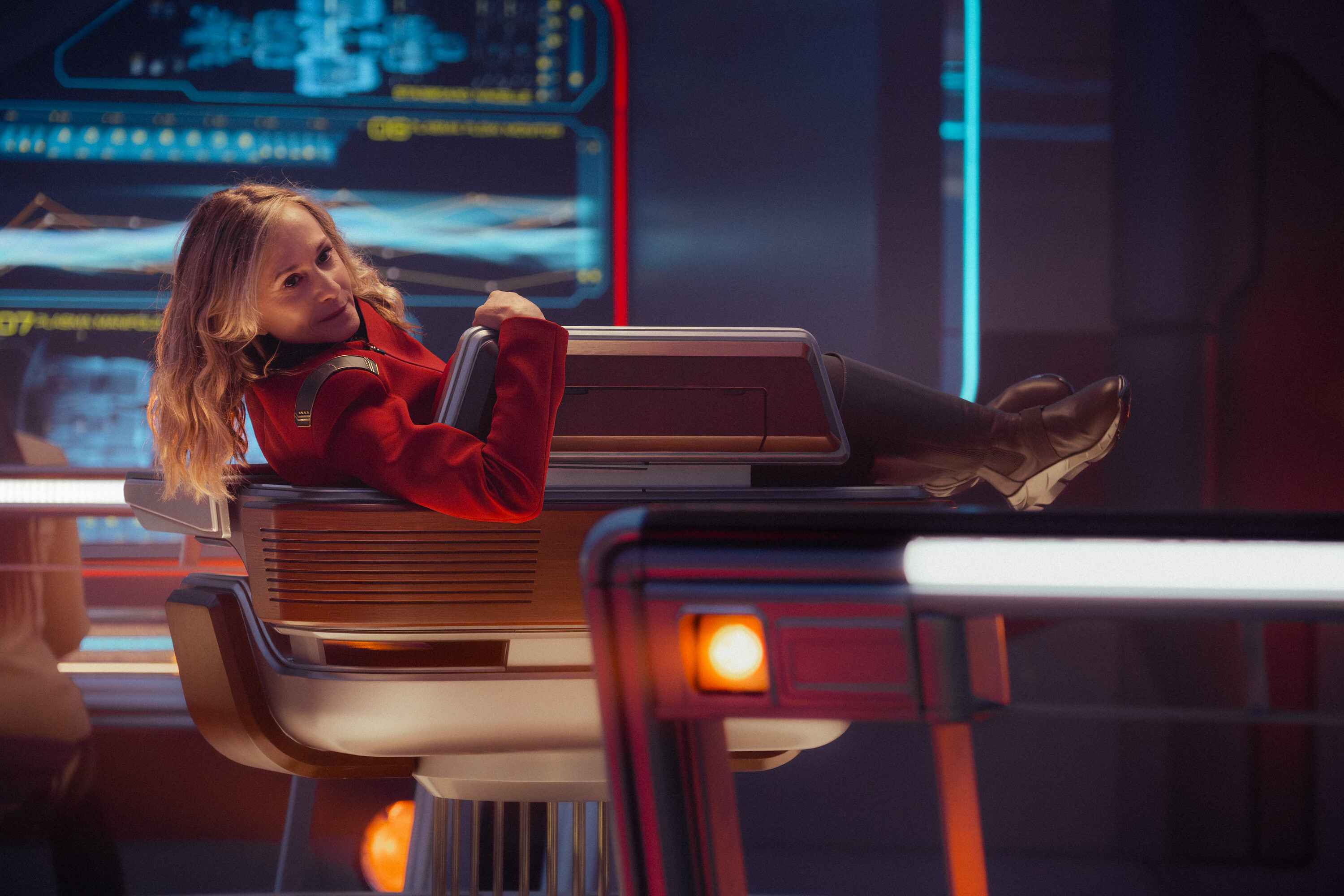
Holly Hunter as Captain Nahla Ake in the Star Trek: Starfleet Academy episode “Kids These Days.”
Janeway would have been terribly disappointed in her.
The ship is lured to the edge of the Badlands and then attacked. In spite of the fact that Ake ordered a red alert and raised the shields, the assault blew through them like they didn’t exist. There was no explanation for this, just that the ship was blown half to hell. What’s worse, after it’s all over and they chase off the bad guys, the ship looks perfectly fine. Not a scratch on her.
I mean, if the Athena can be taken out in such a short amount of time, then the ship is utterly useless. Who needs it? Plus Ake is over 400 years old. You’d think with that level of experience, she’d know better how to get the ship out of such a jam.
Oh, and Braka’s reappearance has nothing to do with Caleb and his Mom. Well, actually it does. Caleb hacks into the staff communication’s system to use a code his Mom taught him when he was a boy to check and see if she’s finally left a message for him. Nada, so he leaves yet another for her. Braka’s been monitoring that channel and uses it to find the Athena.
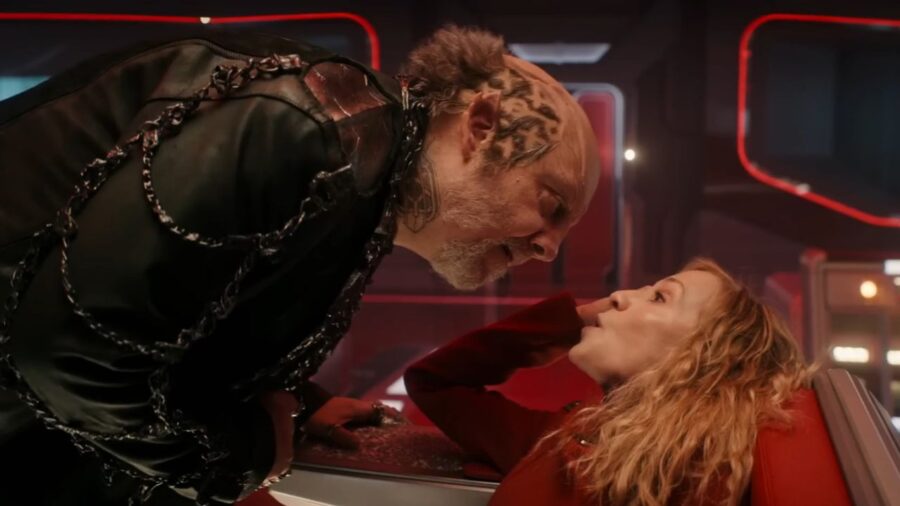
Paul Giamatti as Nus Braka and Holly Hunter as Nahla Ake in a scene from the Star Trek: Starfleet Academy episode “Kids These Days.”
Why does Braka care? He wants to steal Athena’s warp core. The situation, given that Ake ordered a distress call be sent, is that Braka and his pirates have something like 45 minutes to disassemble the core and transport it to his vessel. I guess post Burn, functioning warp drives are rare and in high demand.
Imagine a group of pirates hijacking a 21st century nuclear aircraft carrier and having 45 minutes to disassemble and remove its nuclear reactor. I’m sure something like that would take days if not weeks, except in the Star Trek universe, instead of managing fissionable material, you’re dealing with high-energy plasma and anti-matter. Good luck with that (hint: more bad writing).
A disproportionate number of the command crew seem to be female which, beyond Ake includes Cadet Master Lura Thok (Gina Yashere) and Lt. Rork (Tricia Black), the latter two in desperate need of a gym membership and laying off the pizza and donuts. The Doctor is the only significant male (adult) presence and his appearance is generated by a computer program, not biology.
I know Thok is a half-Klingon and half-Jem Hadar warrior and acts as the Marine Drill Instructor of the show, but she’s still a tremendous pain in the ass. Instantly after having a hunk of metal removed from her side and going through a painful cauterization of her wound, she yells in victory and hits her Klingon “nurse” Jay-Den Kraag (Karim Diane), knocking him across the room from sheer enthusiasm. Still more bad writing.
In the trap, some sort of substance coats Athena’s hull rendering all of her systems useless. Caleb recognizes how to get it off but needs a bunch of help, which is provided mainly by SAM, “Mary Sue” character Genesis Lythe (Bella Shepard), and Darem Reymi (George Hawkins) who is an obnoxious pretty boy bully but with some very handy alien powers.
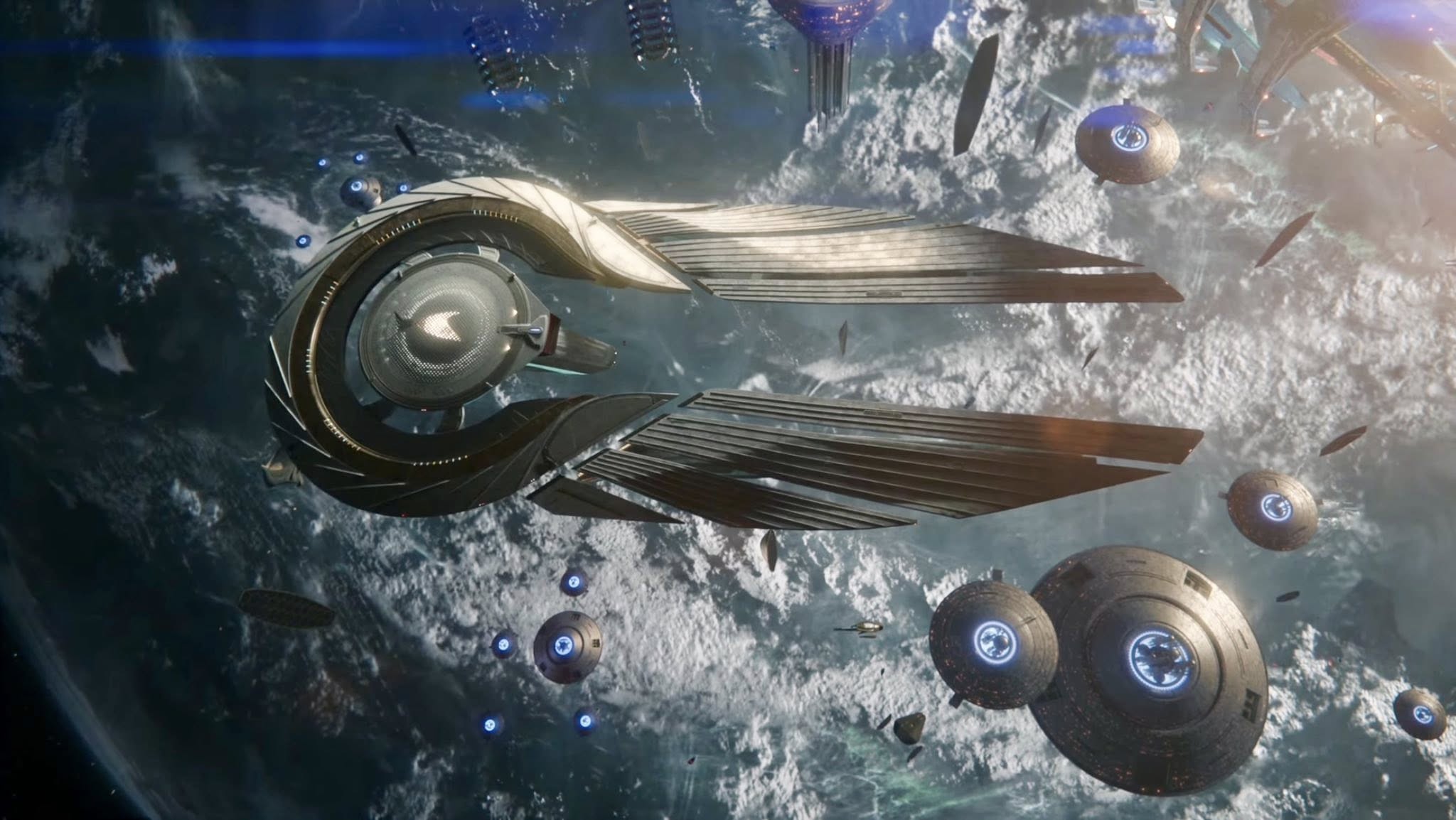
The starship USS Athena from the television series “Star Trek: Starfleet Academy.”
Half the systems are still offline but those that are still running can’t be accessed by Genesis because she’s a cadet and doesn’t have the command codes. She tries to use Thok’s which she overheard earlier, but fails voice recognition. But Caleb had already contacted the bridge and notified Ake of what he wanted to do and why and she said to go for it. Since they still had comm access to the bridge, why couldn’t Genesis just ask Ake to open the required systems for her?
Why does Jay-Den have an eyebrow piercing?
In the final scene, Ake appears to live in Kirk’s old place as we saw it in the movies Star Trek 2 and 3 way back in the 1980s.
After the battle Braka steals a shuttlecraft and escapes. However, at that point, all of Athena’s systems have been restored and they had just destroyed the alien attacker. It should have been child’s play for them to track Braka’s shuttle on sensors and capture him. Instead, he gets away clean. Yet again, bad writing.
But for me, the biggest, the very biggest insult is when Athena (or rather its saucer section) is on final approach to the San Francisco campus, a version of Scott McKenzie’s 1967 hit pop song San Francisco was playing. This had an even greater cringe factor than “Star Trek Enterprise’s” Faith of the Heart and completely ruined all of the memories I have of listening to McKenzie’s lyrics in the 1970s (I was a little young for the “Summer of Love” in San Francisco in ’67).
Actually, the whole thing reminded me of how I’ve done all this before. I tried, really tried to get into and like the 21st century “continuation” of Quantum Leap starring Raymond Lee, Caitlin Bassett, and Ernie Hudson. You could say it was somewhat like the classic original Quantum Leap of the 1990s starring Scott Bakula and Dean Stockwell. It even had the same producers Donald P. Bellisario and Deborah Pratt.

QUANTUM LEAP — “Closure Encounters” Episode 203 — Pictured: (l-r) Nanrisa Lee as Jenn, Mason Alexander Park as Ian, Ernie Hudson as Magic, Caitlin Bassett as Addison — (Photo by: NBC)
But it was a bait and switch. The show from it’s very beginning, was dedicated, not to continue it’s commentary on the human condition within the context of science fiction, good writing, and good acting, but to use a beloved franchise as a smokescreen for selling one and only one main ideology to its audience. I hung in with the show, reviewing it week after week, almost until the end, but finally drew the line and quit when I couldn’t take the severe twisting of reality anymore.
How much more so with Star Trek which is a far better known and influential IP. I keep making these mistakes in the quest for being fair, but then there’s a difference between fairness and foolishness. Don’t let yourself be sucked in by the marketing.
Yes, social media can heavily contribute to either making or breaking a show, but it really still comes down to the quality. As I mentioned before, it’s pretty unfair (I know, I know) to take a bad beginning and instantly deem the show unworthy of the name “Star Trek.” Remember the lessons we learned from very early TNG, DS9, and Voyager.
All that said, as far as Kurtzman-Trek is concerned, it’s not just a matter of needing time to fully develop a good concept into a great show. Kurtzman, as far as I can tell, is deliberately creating Trek shows that emphasize representation, diversity, and inclusiveness while sacrificing logic, good writing, and actual science fiction.
“No, it wasn’t a choice,” Kurtzman answered. “I think we’re not slowing down on representation in any way. We’re certainly planning like representation is at the beating heart of Roddenberry’s vision and we’ve already done the work of bringing it to that new place. So there’s really no reason to change course there.”
In other words, this is cringe by design rather than a concept needing time to develop. From his point of view, this is developed. This is the way it’s supposed to be. Mistakes were not made.
And this is why I hate “NuTrek.” It’s not because there are people of color. It’s not because there are females in command positions. It’s not because of some the characters are gay. It’s not even because the Klingon seems really wimpy and has a piercing.
It’s because Kurtzman actually, really, authentically believes that what he’s doing, putting everything that made Star Trek “Star Trek” aside and replacing it with DEI-speak is what Roddenberry would have wanted.
It’s pretty easy for him to say that when Roddenberry is dead.
There have been some pretty terrific Star Trek over the last half century or so. Yes, I know that Trek is celebrating its 60th anniversary this coming September. Heck, I was twelve years old on September 8, 1966 when The Man Trap introduced Star Trek to television and the world.
I say “half century” because most of Trek for the past ten years has severely steered off course compared to what came before it. Kurtzman says that’s the “mirror” Star Trek has always been reflecting the times we live in. To some extent, that’s true. That’s part of what science fiction does. But for the most part, Kurtzman-Trek is a lot like other TV, movies, books, comics, and so on. They aren’t written for the obvious audience, the masses of people out there hungry for good Star Trek. They’re written for the writers, showrunners, and the narrow and “out-of-touch-with-real-people” folks populating the so-called “entertainment industry.”
In other words, they’re creating show after show that THEY want to watch and then hoping to lure, seduce, bully, and finally demand that the rest of us “love” what they’re doing or be called bad names.
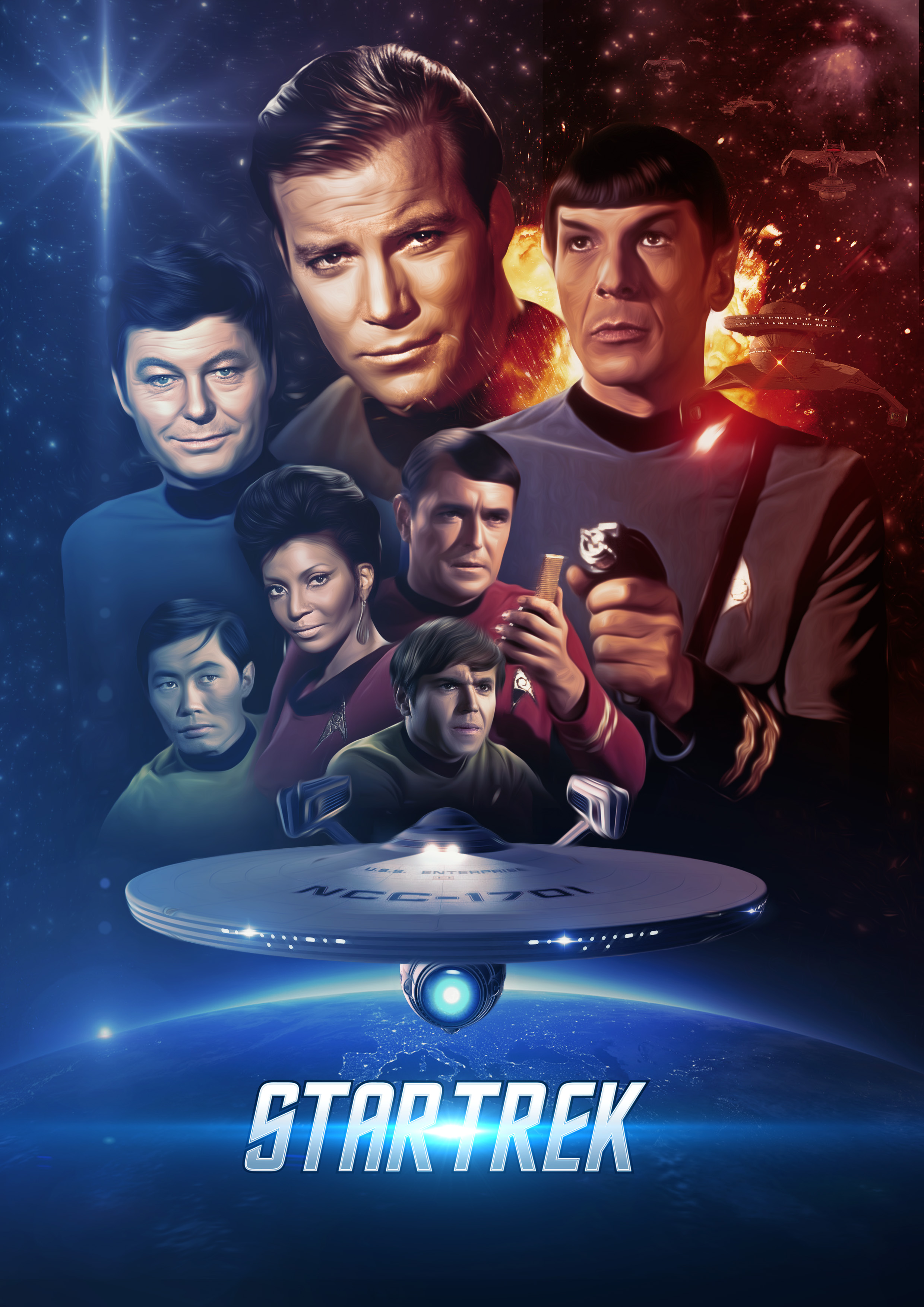
Promotional poster for the original Star Trek series.
Even if social media didn’t exist, SFA would still be deeply flawed by design. Yes, even at my level of talent and experience, I could create a Star Trek that would be more interesting, more entertaining, and more fun without the endless lecturing. After all, I’m a Star Trek fan from way back. I have a pretty good idea of what makes good Trek.
 poweredbyrobots.com