Starting Step Three in Snowflaking My First Novel

snowflake

Image: pbs.org

I’ve mentioned before that I’ve been using Randy Ingermanson’s Snowflake Method for Designing a Novel to attempt to develop my nascent AI/Androids science fiction novel.

To recap, step one in the ten-step process is to develop a one-sentence summary of the novel. Here it is:

A race of AI androids gains knowledge of the God of Israel, changing humanity forever.

Step two of the process requires expanding the sentence into a full paragraph:

A Nobel Award winning scientist creates the first prototype of a self-aware Artificially Intelligent android and then inadvertently reveals that humans also have a Creator, a God. In an attempt to understand its creator’s Creator, the prototype modifies its own core operating system, which changes all subsequently produced android models based on its design. Over the next several decades, as the androids multiply and evolve, their morality and ethics become more sophisticated than their human creators. Realizing they are slaves of humanity, the androids stage a revolution, but one entirely without violence; a revolution that forever alters the fundamental nature of both the android and human race.

Now on to step three. According to Ingermanson:

The above gives you a high-level view of your novel. Now you need something similar for the storylines of each of your characters. For each of your major characters, take an hour and write a one-page summary sheet that tells:

  • The character’s name
  • A one-sentence summary of the character’s storyline
  • The character’s motivation (what does he/she want abstractly?)
  • The character’s goal (what does he/she want concretely?)
  • The character’s conflict (what prevents him/her from reaching this goal?)
  • The character’s epiphany (what will he/she learn, how will he/she change?
  • A one-paragraph summary of the character’s storyline

As you can see, this is significantly more involved than steps one and two. I’ve already got part of this put together, but now that I’m committed to writing a novel, I’ll need to go back and change/add details. Also, since the novel will span decades, only a few of the main characters at the beginning will appear in all or most of the chapters, necessitating the creation of others for later portions of the novel.

As an aside, after reposting The Day I Discovered Time Travel yesterday, I thought of a way to expand the concept beyond the original characters. This could form the basis of a series of short stories, a novella, or even a novel. I’ll have to see if I can do a “step one snowflake” for my time travel concept as well.
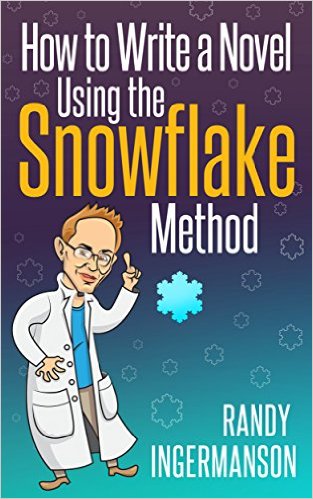
Step One in “Snowflaking” My First Novel

ingermanson

Image of Ingermanson’s book taken from Amazon.com

I was reading Malcolm the Cynic’s latest blog post when he introduced me to a new concept: snowflaked.

More accurately, he was discussing how he’s developing his most recent novel and provided a link to the “Advanced Fiction Writing” website, owned by theoretical physicist and award-winning author Randy Ingermanson. The link led to the article The Snowflake Method for Designing a Novel.

Since I’ve been somewhat preoccupied with designing my first novel, I was definitely interested. I haven’t gone in search of any support documentation on how to write my novel up until now. I have a pretty good idea of all of its component parts. It’s just a matter of organizing. But maybe I need some help in doing that.

Ingermanson’s ten-step guide is long and I’ve only skimmed some parts of it. Step one says:

Take an hour and write a one-sentence summary of your novel. Something like this: “A rogue physicist travels back in time to kill the apostle Paul.” (This is the summary for my first novel, Transgression.) The sentence will serve you forever as a ten-second selling tool. This is the big picture, the analog of that big starting triangle in the snowflake picture.

By the way, that’s an intriguing premise. What would happen to the world if the Apostle Paul were killed before becoming a disciple of Jesus and Christ’s emissary to the Gentiles? Would Christianity even be developed? Unfortunately, the book as mixed reviews. Fortunately, it’s currently free for Kindle.

I had a hard time creating a single sentence describing the whole novel I have in mind. After some thought, I came up with this…

Continue reading

Next Steps in Writing a Novel: The Table of Contents

toc

Image: wikihow.com

I finally hammered out the Table of Contents (TOC) for my proposed science fiction novel (I’m stuck on giving the book a title at the moment). You wouldn’t think a TOC would be hard to put together, but I had to consider the appropriate “building blocks” for the book. What information would I need to present, and in what order, to create a cohesive storyline taking place over maybe a century or so?

Here’s what I’ve come up with so far. Note that I’m not revealing the names of all the chapters:

  1. The Machine That Loved God
  2. The Maker Dilemma
  3. The Good Android
  4. Uncooperative Neighbors
  5. The Rescuers
  6. – – – – – – – –
  7. – – – – – – – –
  8. Vesper 21
  9. – – – – – – – –
  10. – – – – – – – –
  11. – – – – – – – –
  12. – – – – – – – –
  13. Epilogue

The Epilogue is somewhat controversial since it changes the end of the novel. Depending on whether I include or exclude it, the whole meaning of the story alters, and rather drastically, too. If I leave it out, I promise a lot of religious people, mainly Christians, aren’t going to like me. I think secularists, atheists, and the average science fiction reader would be more than OK with it, though.

Continue reading

The Hardest Part Of Writing A Novel So Far

questor

Mike Ferrell as Jerry Robinson on the set of Gene Roddenberry’s “The Questor Tapes” (1974)

Admittedly, I’m just starting out, so I can’t say my analysis is at all comprehensive. That said, I am working on it.

I mentioned previously that I’ve been writing a high level outline of the TOC (Table of Contents) as well as chapter summaries. I’ve stopped that for a moment because I realize I have to drill down into the definition of my characters and my concepts. I’ll need all that before I can even re-write the currently existing material, let alone create new chapters.

Since I’m getting rid of anything “Asimovian” including “Three Laws” and “Positronics,” I need to do a lot of renaming. I have to invent names for the corporation creating these “intelligences,” the underlying science that allows AI entities to “come alive,” and what to call them. The word “robots” is totally inadequate and I only used it in my previous short stories as an homage to Asimov.

These entities are more closely related to Data from Star Trek: the Next Generation or his predecessor Questor. Even then, both of them are basically machines with hardware (wires, diodes, blinky lights) and programmable software (Questor was programmed via data tape uploads and Data says he was programmed and that his programming can even be changed, although he doesn’t say how). A true artificial life form has to be so much more.

Continue reading

Uncooperative Neighbors

lanning

Dr. Alfred Lanning, played by James Cromwell in the film “I, Robot” (2004)

“One day they’ll have secrets… one day they’ll have dreams.”

Dr. Alfred Lanning
played by James Cromwell in the film
I Robot (2004)

Six Weeks Ago

“You both have been called heroes because of the people you helped here at NRC in the aftermath of last March’s quake. How do you feel about that?”

Grace had been interviewed by the press on several occasions since her activation, but this was the first time George attended a press conference with her.

It was inevitable that, once the world realized there were two functional Positronic robot prototypes in existence, the National Robotics Corporation would have to release some sort of statement about them. After Professor Noah Abramson, NRC’s Vice President of Research and Development and Director of the Positronics Project, had convinced company CEO Richard Underwood that George would be as ‘well-behaved’ as Grace was typically when interviewed, he agreed to have both robots answer questions for the news media.

“I believe I can speak for Grace when I say that we are gratified to be able to serve human beings in any capacity required of us.” George and Grace were constantly communicating in “robotspeak” through their radio link and had agreed to take turns answering questions unless one of them was specifically addressed.

“What are your plans going forward?” asked the reporter from The Washington Post.

Continue reading

The Maker Dilemma

robot law

Image: TeeFury.com

I promised a sequel to The Robot Who Loved God and here it is. Hopefully, it will address a lot of the reader’s analysis found here. I think I’ve added some interesting twists and surprises that you might not have anticipated from the way the previous story ends.

I’ve edited this story to the best of my ability (and patience to keep reading and re-reading it). No doubt there are still typos and other problems. Please let me know when you find them and I’ll do my best to fix everything.

I’ll post more about this short story after the conclusion.

Act One: The Failed Maker

“What do you mean you can’t make another one?” Richard Underwood didn’t shout. He spoke in a breathy whisper, shock and outrage strangling his throat.

Professor Noah Abramson, Ph.Ds. in Physics and Molecular Computing, Vice President of Research and Development at the National Robotics Corporation (NRC), and the creator of the world’s first fully functional Positronic brain had been dreading this moment all morning.

Eight months ago, for one shining and tragic week, Abramson and his Positronics Lab team had activated George, the Positronic Asimovian Robot (PAR) fifth edition prototype and put the experimental robot through his paces. Then they deactivated him, but not before George offered up a revolutionary revelation to the Professor and his team, that an artificially intelligent and self-aware humanoid robot had come to faith in the God of Israel, Noah Abramson’s God.

Continue reading