The Sphere

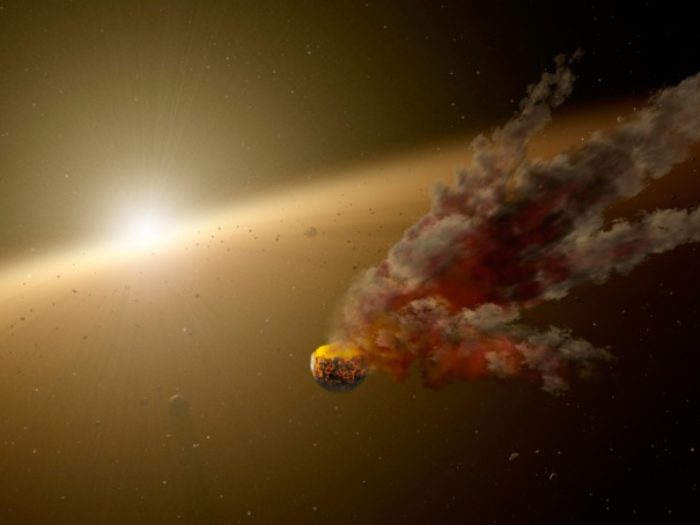
NASA

Image: NASA, JPL-Caltech

Kahve Coffee in Boise, Idaho, Earth

“A Dyson Sphere? Are you out of your mind, Chris?”

Mike and Chris met every other Sunday afternoon at Boise’s only Turkish coffee and tea emporium for delicious caffeine and conversation. A wide variety of topics were bandied about between them, including the latest action and superhero movies, vintage comic books, and science fiction novels, as well as real science and technology news.

“Yeah, I know! But it fits the observations made of the dimming and flickering of Tabby’s Star.” Both friends were reasonably grounded and able to separate fact from fantasy, but of the two, Chris was far more speculative.

“Look at this.” Chris did some quick manipulating of his smart phone to pull up a webpage, and then turned the screen towards Mike. “Kepler’s been taking images of Tabby’s for four years now. Right here…” Chris quickly flipped the screen so he could see it, making sure he was pointing to the right part of the news story, and then flipped it back, “it says that not only does the star’s luminosity vary, sometimes by as much as 20 percent, but the total luminosity also has been reduced by nearly four percent.”

Continue reading

Excerpt from “The Good Synthezoid”

the perfect woman

Image: shutterstock.com

The synthezoid was the first to feel it but even forewarned would barely react in time.

Miller had just pressed the ‘up’ button for the private elevator that would return him, Quinto, and Grace to the third-floor lab. Abramson was standing furthest from the group, nearest to the hallway exit to the lobby while Sophie was holding Grace’s hand and saying good-bye.

Although Grace detected the earthquake before any human being could, the shearing action along the Raymond fault line was abrupt and intense, so instead of a slow rumbling building to a maximum over several seconds, the quake was a sudden and severe jolt.

The overhead glass lighting fixtures shattered raining shards down into the hallway. Not even a second had passed, and if a human had been gifted with Grace’s perceptual schema, it would have looked as if everything was in slow motion.

The synthezoid swept Sophie up in her arms and immediately took her through the doorway to the stairwell just opposite the elevators. At the same time, the previously unknown flaw in the beam supporting the metal stairs leading upward bent radically. Grace rapidly drew the screaming child beneath her, using her android body as a shield as tons of steel stairs and beams collapsed on top of them.

Continue reading

Book Review of Echo Volume 1: Approaching Shatter

approaching shatter

Kent Wayne’s “Echo: Approaching Shatter”

Wait! What?

I just finished reading Kent Wayne’s novel Echo Volume 1: Approaching Shatter. I knew it ended on a cliffhanger, but I didn’t realize it would be so abrupt. It was like slamming into a brick wall at sixty miles an hour.

I’ve been reading it on my Kindle Fire and the thing said I’d finished something like 86% of the book. When I swiped to turn the page at the end of a chapter, I was confronted with a message stating it was the end of the story and if I liked it, to write an Amazon review. The rest of the book is a preview of Volume 2: The Taste of Ashes.

Somewhere in the creation of my blog and writing stories, Kent Wayne took notice of some of the things I’d authored by “liking” them, and so I checked out and eventually followed his blog Dirty Sci-Fi Buddha. That’s how I became aware of his Echo series.

My understanding is that “Kent Wayne” is a pen name (Clark Kent, Bruce Wayne), and I recall reading one bio on him saying he had military experience but preferred not to give out details, making Wayne and what he did in the service a bit of a mystery. That may seem irrelevant, but I do have a point to make.

He does go more into his history on his blog’s About page, and Echo: Approaching Shatter definitely gives the impression that Wayne is mining his own professional experience.

I had a tough time getting into the novel. It’s not like I’m opposed to military based science fiction. I’ve read and thoroughly enjoyed Joe Haldeman’s The Forever War and Timothy Zahn’s Cobra, but that was decades ago. For about the first half of the book, I kept struggling for a handle or a hook and couldn’t find it. I didn’t know whether to even like the protagonist Atriya (and mentally, I kept pronouncing his name as “Attila”).

Continue reading

The Alien

ellie

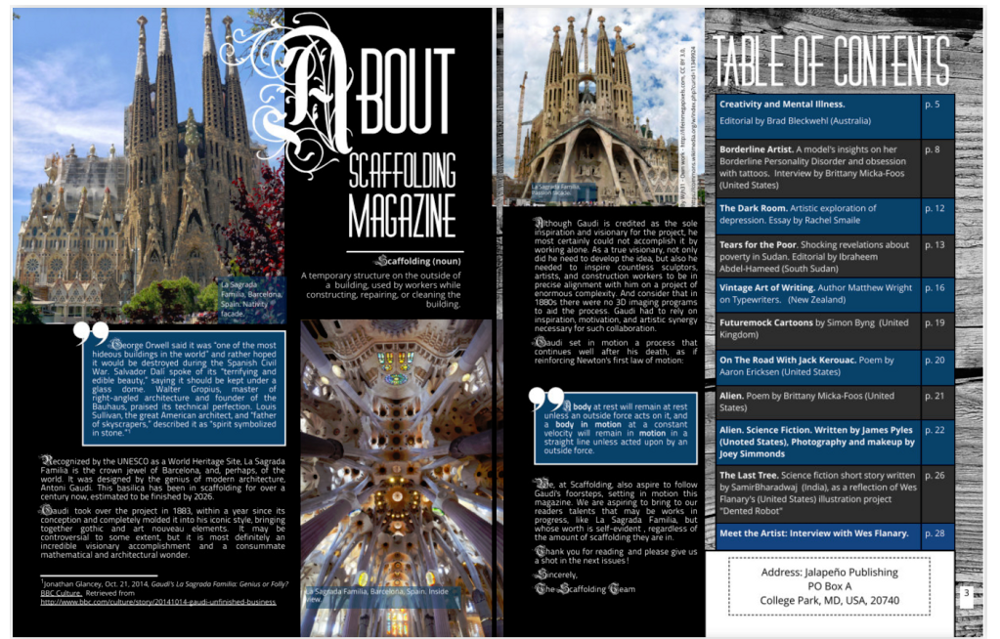
The first issue of Scaffolding Magazine

Not another infection. I can’t stand it.

I know I asked for this. I know I volunteered. But the doctors didn’t say it would be this bad. I knew I’d be giving up my life with the first injection, but they didn’t say anything about this kind of suffering.

Even when the symptoms seem to have subsided for a while, the slightest warning sign, such as a sneeze or a mild sore throat, drives my anxiety to dangerous levels.

The doctors say I need to stay calm, that emotional aggravation could make me feel even worse and endanger the success of my treatment. How can I stay calm when they’re doing this to me?

OK, I understand. Take deep breaths. What an odd sensation.

Let me go back to the beginning. Maybe it will help you, whoever you are reading this (they won’t let me post videos for obvious reasons), understand what I’m going through and why.

We are on the verge of exploring and investigating a new planet. The planet is dominated by a sentient species, which is the problem. So far, all of our monitoring has been passive and remote, listening to their communications broadcasts, observing video transmissions. Last year (their year based on a single, complete revolution of their planet around their star), we sent a shielded drone into orbit, undetectable through the specific bands of the EM spectrum they typically monitor.

But you can only learn so much that way.

This is the first part of my story published in the first issue of the new scifi and fantasy publication Scaffolding Magazine. To read the rest, click the link and purchase a copy. I promise, you won’t be sorry.

The Perfect Woman

the perfect woman

Image: shutterstock.com

Max Schmidt felt a little uncomfortable holding Aika’s hand in public, but as they were strolling past the Botanical Garden in the park she leaned into him and he felt it was the right thing to do.

“Tell me you love me again.” He felt her body heat as she nuzzled against him and he had to stop walking momentarily to regain his balance.

“I love you,” he whispered in her ear, too shy to say it louder for fear people nearby might hear him. She turned to Max and hugged him. “I love you, too,” she murmured into his chest.

Her Japanese accent was only mildly noticeable and he felt it was one of her more charming attributes. English was the only language they had in common though, and he felt a bit embarrassed that his own German accent was so thick. But then, the 34-year-old software engineer often felt embarrassed about himself.

Aika took Max’s hand again and they resumed their walk. He hadn’t meant to go this far from his flat. When Aika suggested they go out together for a while, he was thinking maybe a walk around the block. But it was a beautiful summer evening in the city, and Max enjoyed the delight he could see in Aika’s face. Everything in the world was new to her. It was like watching a small child discover the universe in a field of flowers or by the seashore.

“I’m so glad we met, Max.” She leaned her head against his shoulder.

“Me, too.” His reply was a bit stiff but she didn’t seem to notice. As much as Max enjoyed Aika’s company, he couldn’t help but be bothered by all of the barriers between them, not the least of which was the legality of her being here with him, or for that matter, the legality of her existence.

“We’d better head back.” He looked down at her. Her hair was a beautiful jet black, soft, silky to the touch, and smelled just slightly of strawberries.

She looked up with those big, gorgeous brown eyes. He watched her blink, noticed her eyelashes, her small, pert nose, her large, luscious lips. “Whatever you say, Max,” she cooed.

He was already getting aroused.

Continue reading

Searching for Life Outside the Anthill

Let’s say we have an anthill in the middle of the forest. And right next to the anthill, they’re building a ten-lane super-highway. And the question is “Would the ants be able to understand what a ten-lane super-highway is? Would the ants be able to understand the technology and the intentions of the beings building the highway next to them?”

-Michio Kaku

ants

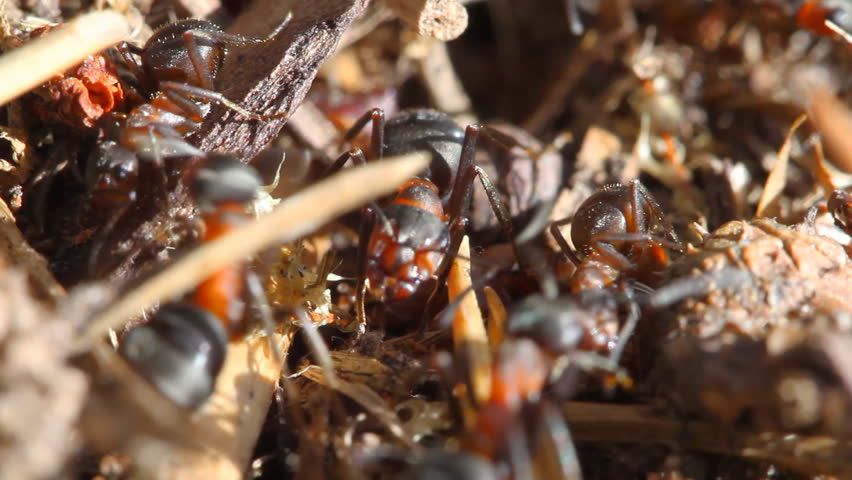
Ants building an anthill – Image: shutterstock

Commander Janice Nichols sat expectantly in front of the orbiter’s pilot console waiting for the initial report about Lyre’s Planet, the more “human-friendly” name for HD 85512 b. At 3.5 times the mass of Earth, it wouldn’t be ideal for human colonization, but it was smack dab in the middle of this star’s “Goldilocks’ zone,” and even casual observation told her that there were liquid oceans and land masses on this world, certainly indicating the potential for life, maybe even intelligent life.

Sixteen hours ago, the orbiter Elysium had detached from the FTL drive and main life support unit, together known as the Wayfarer. The drive was too valuable to risk close planet approach and she had left Clarence Ross in charge of their only hope for an eventual return home, along with Mitchell, and Smith. If something happened to the Elysium, Ross and Mitchell could either bring in the Excursion, Wayfarer’s back up orbiter, to attempt a rescue, or if deemed too risky, abandon them here and make the return trip home.

Eight hours ago, Elysium assumed a standard orbit around Lyre’s and after a thorough systems and orbital check, Nichols ordered planetary and environmental specialist Timmison Singh to deploy the sensor pod, extending it fifteen meters planet-side, below Elysium’s main hull, and then had him crawl down into the pod to perform the initial scan of the planet.

This was the sixteenth attempt, the sixteenth expedition to explore what they used to call “super earths” in the early part of the last century, the sixteenth effort to discover some form of extraterrestrial life, any form of life more advanced than a single cell organism.

The first fifteen had failed.

Continue reading

The Woman Who Fell Into Time

A particle accelerator accident creates wandering spacetime distortions that allow random people to time travel.

woman falling“Why won’t you people tell me who you are?”

Maria Calvert, Ph.D in Applied Physics, manager of Superconductivity and Magnet Circuit Systems for the Machine Protection and Electrical integrity group for the Large Hadron Collider (LHC), had been isolated in a windowless interview room in the administration building at CERN (The European Organization for Nuclear Research near Geneva, Switzerland) for the past four hours. The man seated across the table from her seemed kind but unrelenting. She hadn’t been told his name or who his two colleagues were, or even what agency they represented.

“I’ve told you Dr. Calvert, my name is unimportant. What happened to you earlier today is. Can we go over it again?”

“I’ve already told you every…”

The man, dressed professionally and generically interrupted. “Just tell us your story again, Dr. Calvert.”

She’d only been allowed out of the room once, to use the bathroom, accompanied by the lone female of the group questioning her. She felt grungy, sweaty, out of sorts, and totally betrayed by her co-workers and supervisors. Why had she been abandoned to these people? Why had the LHC collision accident done…this to her?

“Come on, Doctor. Just tell us again what happened.”

Maria closed her eyes and instantly her Daddy’s face appeared to her. No, two faces, one dying, and one very much alive.

“The first collision between two protons had just occurred in the LHC’s main ring and data was being fed to the mainframes. Then, a few seconds later, there was a vibration lasting just for a moment. After that, all hell broke loose and every alarm…”

Continue reading

The Day I Discovered Time Travel

the well

The well

After reviewing Randy Ingermanson’s time travel novel Transgression yesterday, I was reminded that I wrote my own wee time travel story just over two months ago. I decided to port it over unedited from its original version. It’s very different from Ingermanson’s vision, although given the motivation of his character Damien West, maybe not too different.

I’m no good at the fake physics of time travel, so I had to create a method of getting from now to then that didn’t require any inventiveness or understanding on the time traveller’s part. It’s probably the standard time traveller story, a tale of regrets and an attempt at redemption. Let me know what you think.

My name is Mark Miller, and when I discovered time travel, I decided to use it just like everyone else does in all those science fiction books and movies. I decided to change the past. No, not just the generic past, mine. I wanted to change history, just like Marty McFly did in “Back to the Future”.

Here’s what I want to change.

When I was five years old, I killed my brother. It doesn’t matter that it was an accident, I did it. Jason’s dead and it’s because of me. He was only three years old.

I probably should blame my Dad, but I can’t. I should probably blame him for going to the store “for just a minute” and leaving me and Jase alone. I should probably blame him for leaving a loaded 45 caliber pistol in an unlocked drawer in his night stand.

But I can’t.

I’d seen where Dad put the pistol after cleaning it and loading it. He cleaned it every couple of weeks, I think. Mom wouldn’t let me and Jase even have toy guns. Mom and Dad got divorced when I was four, and whenever we got to visit Dad, she was pretty strict about what toys we could play with at his house.

So when Dad put us in front of the TV with “Toy Story 3” in the DVD player so he could go to the store “for just a minute” (he’d run out of beer), me and Jase were alone.

I think it was because Woody was a cowboy and cowboys always have guns that made me think of Dad’s gun. I paused the movie and took Jase into Dad’s bedroom. I just wanted to show him something cool, a real gun, like what a real cowboy would have.

Continue reading

Book Review: “Old Venus”

old venusI decided to check Old Venus, an anthology edited by George R.R. Martin and Gardner Dozois, out of my local public library, because I’d already read their Old Mars anthology last fall and enjoyed it.

The premise of both books is to get together a bunch of modern science fiction authors and ask them to write stories about Mars (in the case of “Old Mars”) or Venus (in the case of the book being reviewed here) as if it were before about 1960.

In the early 1960s, we sent probes to Venus and Mars and discovered one disappointing fact: there’s no way in hell either planet could support life now or probably not even in the dim past.

But before we knew that, science fiction writers were crafting wonderfully imaginative tales about both worlds and how we, as well as native Martians and Venusians, could live together and have adventures. What would it be like to just “ignore the rules” and pretend you could visit Venus, with its swamps, rain forests, vast oceans, unending clouds, and dip into the indigenous flora and fauna?

“Old Venus” answers that, and in most stories, does so remarkably well.

I can’t say I have a favorite story. “Frogheads” by Allen M. Steele was pretty predictable, and “Botanica Veneris: Thirteen Papercuts by Ida Countess Rathangan” by Ian McDonald was too British to hook me and I stopped reading after a few pages (having a headache, slight fever, and recovering from yesterday’s nasal surgery probably didn’t help).

“Pale Blue Memories” by Tobias S. Buckell tugged at my heart the most because the racism experienced by our protagonist wasn’t (and isn’t) limited to a single world. Oh, it was also a story depicting an old-fashioned, missile shaped rocket ship, like the one of the cover. “Old Mars” had a similar ship on the cover, but not one story about such a 1950s classic design was between the covers. I was tempted to write such a tale, but got stuck on Arabia Terra, a story I’m not (yet) qualified to write. If you’re going to have such a ship on the cover, make sure one of your stories actually is about such a ship.

Continue reading

Farmbots and Inspiration

farmbot

Farmbot. Image from the Arduino blog

Although I have a pretty good idea of how I’m going to develop my novel about AI androids and their evolution, I keep coming across articles online that modify certain details.

For instance, a friend of mine named Tom just posted an article on Facebook about a new Farmbot that will soon be for sale.

According to the article:

Designed with the Maker community in mind, FarmBot is driven by an Arduino Mega 2560, a RAMPS 1.4 shield, NEMA 17 stepper motors, and a Raspberry Pi 3. What’s more, all of its plastic components can easily be 3D printed, while its flat connecting plates can be made with either a waterjet, plasma or laser cutter, a CNC mill, or even a hacksaw and drill press.

This is deffo for the DIY community. Of course, some people will still prefer to grow their vegetables in the backyard the old fashioned way, but it gave me an idea. It’s not an idea for a story, more like for a story element. As the collective of AI entities grows and expands throughout the solar system, preparing planets and moons for human colonization, someone, or rather something has to grow the food. It wouldn’t do to have a bunch of Watneys farming potatoes all the time.

Farmbot is controlled remotely and as the IoT, it can be hacked. What about “farmbots” controlled by advanced AI?