Book Review of Orson Scott Card’s “Wakers” (2022)

wakers

© James Pyles

If you like my work, buy me a virtual cup of coffee at Ko-Fi.

I finished Orson Scott Card’s novel Wakers last night. Naturally it’s the first book in a trilogy because all books have to be trilogies if not expanded series these days.

Like most people, I was introduced to Card’s writing long ago through Ender’s Game and the subsequent novels in that series. I’m glad to see that Card is still writing and still successful.

In the past twenty years or so, the current gatekeepers of science fiction determined never again to heap any sort of award upon him. This was because he had committed the grievous crime of being religious and making public statements about how his beliefs are guided by such. Between 1978 and 1995, he did win numerous accolades, but the only award post 2000 he’s been granted is the ALA Best Books for Young Adults for “Shadow of the Hegemon.”

Yes, I read “Wakers,” in part, to thumb my nose (like they even know I’m alive) at the exclusionists who run “official” science fiction and fantasy. You know, the folks who claim they want to be “inclusive” and then just shuffle around the players so certain groups are favored at the expense of others, what they say has always been done and they’re still doing it. The only difference is which groups are included and which groups are not. That’s not inclusive, that’s a shell game.

I’m a sucker for an “underdog” (Card’s doing pretty well, but still…) so I checked “Wakers” out of my local public library.
Continue reading

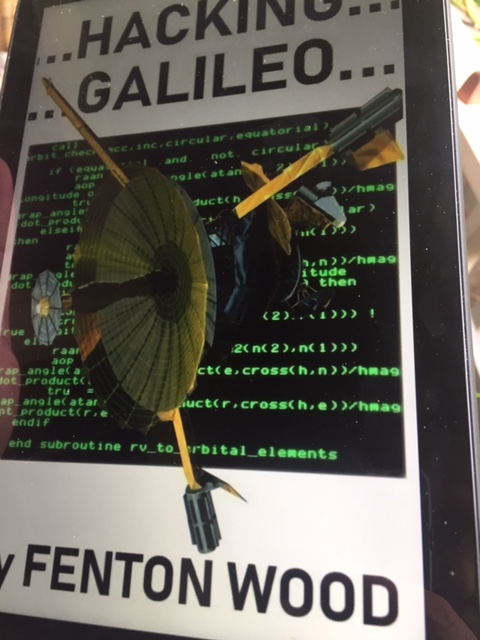
Book Review of “Hacking Galileo” by Fenton Wood

hack

© James Pyles

If you like my work, buy me a virtual cup of coffee at Ko-Fi.

I became aware of Fenton Wood (a pseudonym) when he reviewed my SciFi/Fantasy novelette Ice on twitter (but alas not on Amazon or goodreads).

Curious, I took a look at his twitter/X account, which led me to his e-book Hacking Galileo.

It had fabulous reviews, an interesting premise, and was reasonably priced, so I downloaded it onto my Kindle Fire.

The first words you read in the book after the usual preamble stuff is “This is a work of fiction.” Wood then goes on to explain the inspirations and influences for various parts of his story, the background of some of the technical details, when he “cheated,” making certain events happen at a slightly different point in history for the sake of the plot, and how security at Cray Research and Bell Telephone Company weren’t quite as lame as he depicted.

That’s really important because the rest of the book is written from the point of view of a man who, in the 1980s, was part of a teenage hacker group, really just a bunch of high school friends in Palmdale, California, who performed acts of hacking from the interesting to the fantastic.

The main character Roger O. Miller (ROM, see what he did there?) is writing and recounting events that happened thirty years ago where he and his three friends actually saved the world from destruction by an alien space probe. There’s a lot of build up to get to that point, but almost all of it is fascinating.

Continue reading

“Blood Heir” and Beyond

blood heir

Cover art for the novel “Blood Heir” by Amélie Wen Zhao

If you like my work, buy me a virtual cup of coffee at Ko-Fi

Blood Heir by Amélie Wen Zhao is not the sort of novel I’d read, but as I’ve said once, twice, and most recently a third time, I hate bullies, especially those who pretend to be workers of “justice”.

Over absolutely unjustified allegations of racism (the book hadn’t even been published yet), the author herself voluntarily “apologized” for her racism in her book and withdrew it from publication.

Horrible mistake. Grievous error.

Fortunately, not long later she realized this was all part of some ridiculous campaign against her that had nothing to do with racist themes in her story (the story was based on elements of the author’s ethnic and national past) and everything to do with the bad character of her opponents. She went ahead and released her book for publication. That was November 2019.

So how did the book do when real people read and reviewed it:

Continue reading