This Isn’t My Home Anymore

yarnspinner

© yarnspinner

It’s all changing. My home, or what’s left of it, is barely recognizable. Hard to believe I grew up here. This used to be the field where I flew kites, played tag with my friends, where we ran around pretending to be superheroes.

We sure could have used a few of those, but now it’s too late.

The K’trn didn’t make contact with Earth by radio or landing ships on our planet. We found out about them when we detected the bioweapon heading toward us from space. In spite of all the talk of building a defense against asteroid strikes, we couldn’t stop the thing in time…and it was just the first of many.

I’m sure the K’trn don’t call them bioweapons. I wonder what their word is for terraforming? That’s what they’re doing, changing Earth’s climate, atmosphere, everything, so it’s like their home planet.

They should begin colonizing their new world, the Earth, any day now.

I wrote this for the FFfAW Challenge-Week of April 4, 2017 hosted by Priceless Joy. The idea is to write a piece of flash fiction between 100 and 175 words long, with 150 being the ideal. My story comes in at 157 words.

Today, April 5th, is First Contact Day. In the 1996 film Star Trek: First Contact, April 5, 2063 is the day when Vulcans make first contact with humanity after they detect the warp signature from Zefram Cochran’s experimental warp ship, the Phoenix. I hear some Star Trek fans actually celebrate this day. I thought, in honor of the occasion, I’d write a first contact story, though mine is much more grim.

To read other stories based on the prompt above, go to InLinkz.com.

Strange Sight

cliffs

© A Mixed Bag 2012

He sat on the sandy shore and stared up at the cliff. It would be the last thing he’d ever see. His peripheral vision was closing in on him. He could see the trees, the buildings, the tower, all through a continually narrowing tunnel.

“I wish I could have seen your face one more time.” He deliberately left her, left everyone who loved him, because his going blind wasn’t something he wanted to share. He didn’t want their pity, their concern, their last second attempts at trying to cure him.

He’d been studying the alien spores brought back from the dwarf planet Ceres by the Demeter probe. They were different enough from what he expected that there was a breach, just big enough to allow the spores to travel up through the electron microscope and into his eyes. His optic nerves deteriorated in just a few weeks.

Fade to black. “I’m blind.”

Then something rippled in his visual cortex.

“I can still see.”

The spores didn’t just destroy his human sight. They gave him back something better.

I wrote this piece of flash fiction in response to the Sunday Photo Fiction – April 2nd 2017 writing challenge. The idea is to use the photo prompt above to craft a small tale of no more than 200 words. Mine weighs in at 180.

I woke up this morning with some sort of swelling in my right eyelid accompanied by discharge. It looks pretty yucky, but is most likely nothing serious. Nevertheless, it did put the idea of vision in my thoughts, so I decided to write about it.

To read other stories based on the prompt, go to InLinkz.com

Time’s Window

gale crater

Gale Crater – Mars

“Temporal Shift Unit is powered up, Commander Sharp.” Physicist Jamie Benjamin and her team had spent a week assembling the complex machinery in Gale Crater, which was believed to be one of Mars’ long dried up lakes.

“If this device works as well as it did in the tests on Earth, we could very well see what this crater looked like over three billion years in the past, Benjamin.”

“I suggest we all anchor ourselves to a specific spot, Commander.” She was speaking to the entire team who had been living out of their twin solar-powered rovers for the past ten days. “When the unit activates, it will seem like we’re 5,000 meters underwater.”

“Proceed.”

“Activating projector…now.”

The thin air around them rippled and twisted, and then it was as if they were at the bottom of the ocean, which was expected. The true marvel was that they weren’t alone.

“Life.”

The What Pegman Saw flash fiction writing challenge was an unusual one this week. Normally, writers are prompted to craft a story no more than 150 words long based on some Google Maps view on Earth. Today, J. Hardy Carroll uses a virtual reality tour to take us to the planet Mars. I ended up somewhere in Gale Crater, scanning a 360 degree view provided by the Curiosity Rover.

Approximately 3.5 billion years ago, it is strongly believed the crater was a water-filled lake. I decided to manufacture a little “virtual reality” of my own to give astronauts a look at what the crater was like all those billions of years in the past. As you can see, they found something startling and wonderful.

To read other stories inspired by this prompt, go to InLinkz.com My story is 150 words long.

One of My Stories Published in Scaffolding Magazine

ellie

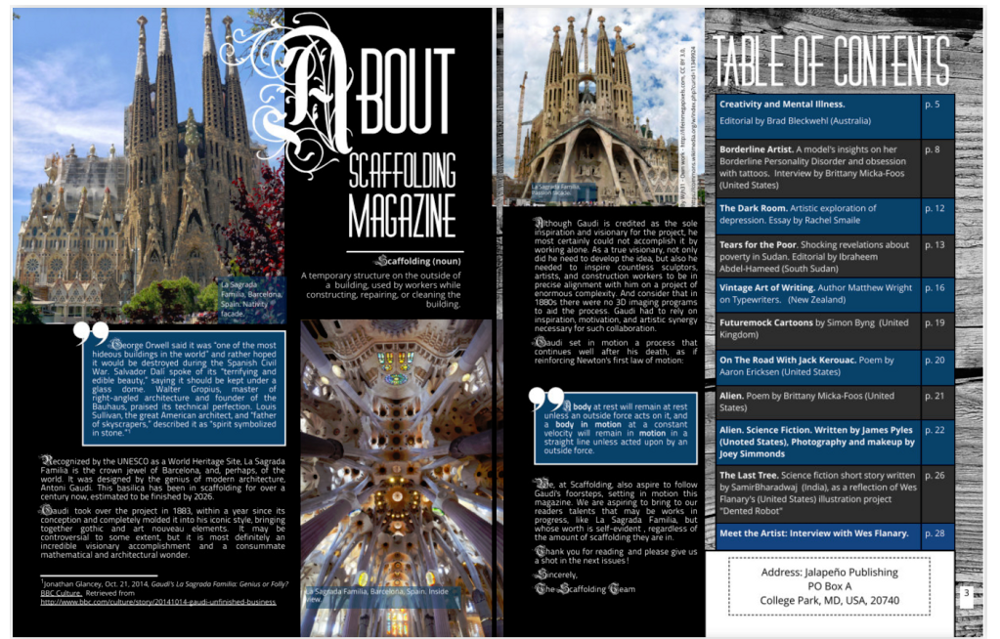
The first issue of Scaffolding Magazine

This magazine has taken some time to get off the ground, and I was pleased to see the announcement this morning that the first issue is now in print.

My short story “The Alien” is featured within (page 22) along with a lot of other terrific content by authors and artists a lot more talented than I am.

Right now, the magazine is only available in print, but there are plans for publishing it in digital and audio formats as well.

I submitted my story just like any other fledging writer and so can you. Click the link, find out what this eighty-page tome has to offer, and have a look at the submissions page

You can find a small sample of this my published story here on my blog, but the full tale is only available in Scaffolding.

Pretty exciting stuff.

Pointing Out the Road Homeward

uganda

© Google – June 2015

Thursday, April 30, 1970, Kampala, Uganda.

“Rabbi Sizomu, you have a year to get the Jews out of Kampala before Idi Amin gains power.”

“How can you be so certain of this, my friend?”

“Do you trust me?”

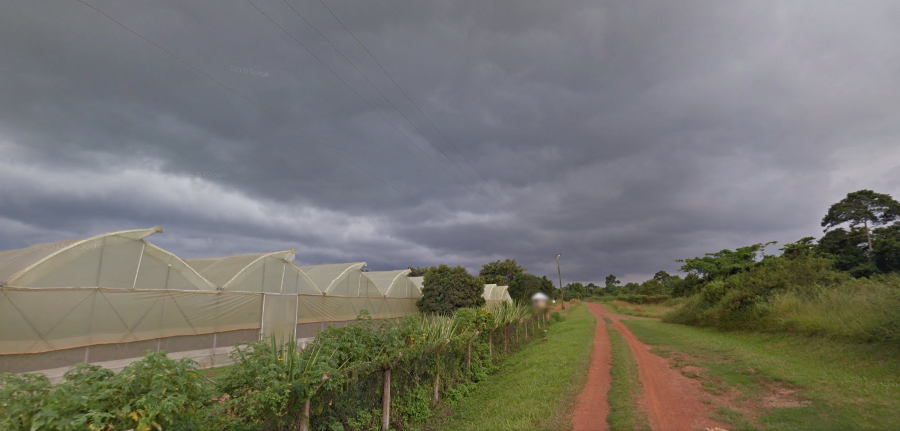
Both men were standing on a lonely road, untamed brush to the right, a large hothouse farm to the left.

“I have learned to trust you in the time you’ve spent among us. You know things I cannot explain.

“Trust me, Gershom. President Obote will be overthrown in a military coup. Amin will attack the Jews living in Kampala. Convince them to make Aliyah, emigrate to Israel.”

“Why are you warning us?”

“You wouldn’t believe me if I told you.”

“Then it’s a matter of faith. Very well, I will do as you say.”

Time Traveler Martin Fields watched Rabbi Gershom Sizomu walk back to Kampala before returning home to 2017, his mission accomplished.

I wrote this small tale in response to K. Rawson’s What Pegman Saw writing challenge. The idea is to use the image above, taken from Google maps, and craft a piece of flash fiction no more than 150 words long. Mine is 149, and it’s a difficult tale to tell in so few words. I once again employed my time traveler Martin Fields because it’s true. In 1971, Idi Amin took control of Uganda, deposing President Milton Obote in a military coup. Amin exiled all the Asians and viciously attacked the Jewish population of Kampala.

I couldn’t find any information about any Rabbis in Uganda in 1970, so I “borrowed” Rabbi Gershom Sizomu, who in February of last year, was elected to the Ugandan Parliament. You can read his story at Haaretz.com.

To read other stories based on this prompt, go to InLinkz.com.

To Fly Again

car in woods

© Tim Livingston

Every year, Norm would take a vacation from his job as an aeronautics engineer at Hughes Aircraft to go hiking in the Sierra Nevada mountains.

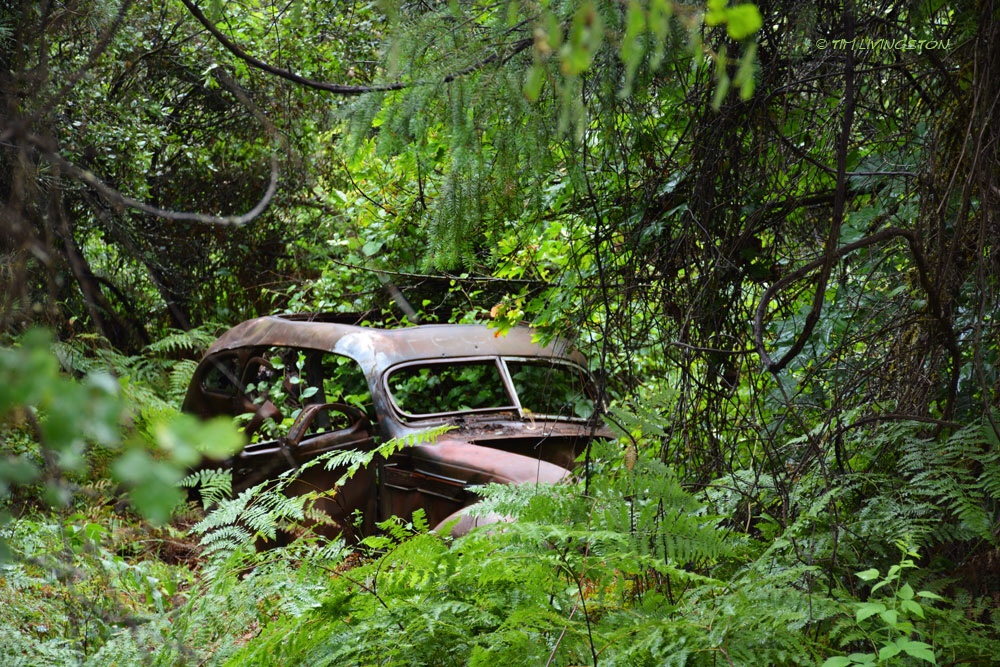
Norm liked to cut his own rough trails through the forest, which was why he was so surprised when he came across the old DeSoto. 1947 or 48 by the looks of her. His Dad owned one like it when Norm was a kid.

The trunk was half open. There was something bulky inside. Norm pulled the lid free and unwrapped the heavy, oiled canvas tarp.

“Oh my God, it can’t be.”

He remembered the old newsreels and stories his Dad told him about the hero. He wore a metal helmet, and with his rocket pack, fought the Nazis in the 30s and 40s. He’d disappeared without a trace. How his equipment got here, Norm couldn’t figure, but he knew he could get the old engine working.

With the Soviet threat looming and the race to the Moon heating up, it was time for the Rocketeer to fly again.

rocketeer

The Rocketeer – created by Dave Stevens

I wrote this in response to the FFfAW Challenge-Week of March 14, 2017. The idea is to use the photo prompt at the top to write a piece of flash fiction between 100 and 175 words, with 150 being ideal. My tale comes in at 174 words. Wish it was less, but I needed that many words to do the set up for my reveal.

To read more stories based on the prompt, visit InLinkz.com.

You can tell only by inference, but I set my story in the early 1960s. My late father-in-law worked at Hughes Aircraft, founded by the famous aviator and inventor Howard Hughes. The corporation no longer exists and Hughes is long dead, but I decided to use the company because it made a nice connection to the Rocketeer’s period in history. The comic book character was created by Dave Stevens in 1982 as an homage to the Saturday matinee serial heroes of the 30s and 40s.

In the 1991 film starring Billy Campbell in the lead role, a fictionalized Howard Hughes actually invented the rocket pack, which was stolen by gangsters and hastily stashed in stunt pilot Cliff Secord’s plane.

In both the comic book and film, Secord uses the rocket pack to become the superhero the Rocketeer. The story of this retro-hero is one of my guilty pleasures. I’d love to see the Rocketeer fly again.

The Old Astronaut

spacesuit

© A Mixed Bag 2012

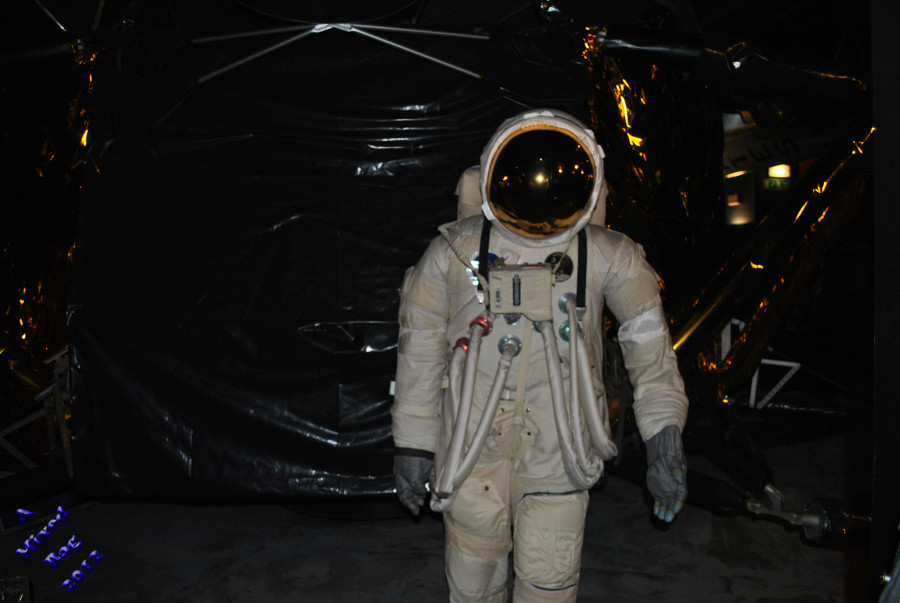
I finally made it. The Smithsonian National Air and Space Museum. Never thought I’d get the chance to visit. I always wanted to see all these exhibits. I spent my childhood, my whole life really, admiring astronauts and their accomplishments. I used to spend hours pretending I was wearing a spacesuit, just like the one I’m standing in front of now.

It doesn’t look as impressive in real life, but then, it’s just an empty suit. What makes spacesuits heroic are the men and women who’ve worn them, who were blasted into space, who walked on the Moon. I was in high school when Neil Armstrong wore this suit and declared, “That’s one small step for man, one giant leap for mankind.”

I wish I could have had my shot at even sub-orbital space. I can afford a tourist’s ride on SpaceX now, but I’m too old.

My grandson’s not, though. Next month he and five other astronauts will be launched from the Kennedy Space Center to the International Space Station, and from there, they’ll board the Ares One spaceship to Mars. I’ve got my shot into space because my grandson will always be in my heart. Thank you, boy.

I’m writing this in response to the Sunday Photo Fiction – March 12th 2017 hosted by Al Forbes. The idea is for authors to use the photo prompt above to write a piece of flash fiction no more than 200 words. My story is exactly 200 words long.

Oh, I really did grow up with the NASA manned space missions, from Mercury, to Gemini, to Apollo, and beyond. I even got a chance to see and touch (I wasn’t supposed to touch it) one of the Apollo command modules once, although I’ve never been to the Smithsonian’s Air and Space Museum (I wish). I’ll never go into space, but my grandchildren’s generation will. To the Moon, Mars, and beyond.

To read other tales based on the photo, go to InLinkz.com.

The Komodo Cure

iss

The International Space Station (ISS) | NASA

NASA took every precaution when they launched it into space. It’s destination was the International Space Station (ISS). The station’s latest life form, methicillian-resistant Staphylococcus aureus (MRSA) arrived via SpaceX’s Falcon 9 rocket on February 18, 2017.

According to the official press release:

The idea is not to weaponize space with MRSA — a bacterium that kills more Americans every year than HIV/AIDS, Parkinson’s disease, emphysema, and homicide combined — but to send its mutation rates into hyperdrive, allowing scientists to see the pathogen’s next moves well before they appear on Earth.

That was five months ago.

Continue reading

The Lost Steinway

piano

© Mike Vore

Of all places, she found it in the first floor public men’s room in a deserted hotel in upstate New York. It was Monday, September 2, 1985, 4:35 a.m. In less than two hours, the demolition crew would be here to level the place. They would have destroyed this priceless treasure.

NaCumbea placed her hand gently on the tarp covering the old Steinway. “I know a couple who would love to take care of you, beautiful.”

She expanded the field radius of her time jump suit to include the piano and set her coordinates for the distant future in a parallel quantum reality. Wyatt Ellison and Josue Hunter were protectors of rare historical artifacts. NaCumbea knew they’d take good care of the last piano Bill Evans played before he died.

It didn’t exist in their reality, but it did in hers, so she agreed to find it for them. After all, she owed them one.

I’m probably cheating a bit since these flash fiction stories are supposed to be stand-alones, but I couldn’t help leveraging not only my Martin Fields and NaCumbea time travel stories, but also a separate series involving the characters Wyatt Ellison and Josue Hunter, who I also referenced in my recent story Unraveling.

The photo prompt is from FFfAW Challenge-Week of March 07, 2017 hosted by Priceless Joy. The idea is to use the prompt above to create a story between 100 and 175 words, with 150 being the ideal target. My story is 156 words long.

To read other stories based on this prompt, go to InLinkz.com.

Unraveling

explosion

Image: giantbomb.com

A Martin Fields and NaCumbea Time Travel Story

Martin thought, “If we ever get out of this mess, I’m going to have to bring NaCumbea here. This must be the ultimate time tourist’s destination.”

The Temple of Karnak. Even the sacred enclosure of Amun alone could contain ten average-sized European Cathedrals.

“So here I am. Martin Fields, Time Traveler disguised as a priest. I’m so scared, I’ve left my jump suit’s stealth mode active so I shouldn’t be noticed. I’m in Egypt somewhere around 1958 BCE, although exact measurements get a little splashy when mapping them to a 21st century CE calendar.”

It was getting close to the climax of this year’s Opet Festival, the twenty-seven day period when Egyptians believed their gods and the earth required a recharge of chaotic energy from the cosmos.

Martin headed to the storage chamber where the accessories for the god Amun were kept. The most prized of the gold and silver jewelry used to adorn the god for the climatic ceremony that’s supposed to regenerate him are kept there. The key gold encrusted ruby is missing. The priests just don’t know it yet.

Continue reading