The Impossible Direction

woman

From p90music.com

A Martin Fields Time Travel Story

“That was exhausting,” he said in English. “I can’t believe I let you convince me to come here. It’s worse than Disneyland.”

Martin Fields sat heavily on his chair at their table. It was June in Paris and the weather was very pleasant as the sun receded into the west.

“It’s not all that bad, Martin.” NaCumbea sat lightly in her seat as if totally unaffected by the past nine hours they’d spent touring the vast number of stunning exhibits at the 1925 International Exhibition of Modern Decorative and Industrial Arts.

Continue reading

Catching NaCumbea

pearl harbor

© National Archives – Washington D.C.

“So who is she?” Martin Fields had just put on his upgraded time jump suit. He didn’t see Isis materialize behind him in the center of his bedroom, but he knew how to feel her presence by now.

“Consider it a challenge to discover that for yourself, Martin.”

“Too easy, Isis.” He turned to face her. “The new suit’s sensors can detect her jumps. I can literally be one step ahead of her and I have all the time in the universe to do it in.”

“Then please proceed.”

Isis was always smug and condescending, but he still thought she was up to something. What did she know about the other time traveler? Probably everything.

There were no more manual controls on the suit. Not since the incident with the Zodiac killer. Now the suit was virtually skin-tight and with holographic properties that allowed Martin to project any costume he needed to blend in with any period in history. He could control the suit at the speed of thought.

Catching NaCumbea should be a breeze.

Continue reading

NaCumbea

olive

© A Mixed Bag

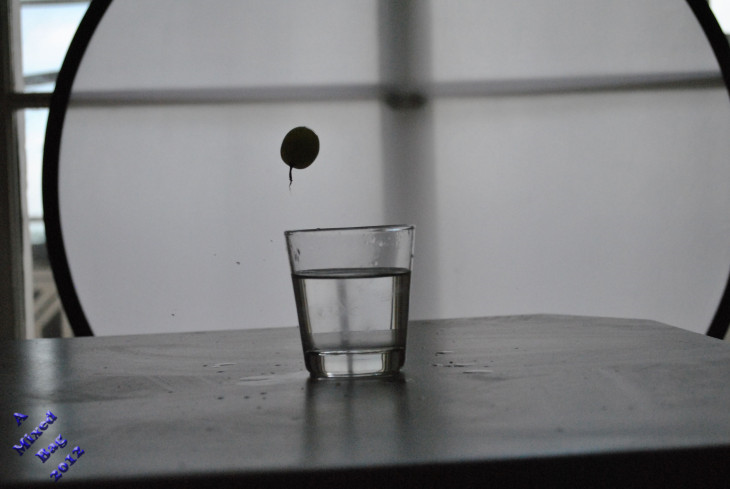
Time Traveler Martin Fields was spending Tuesday evening experimenting with the perfect vodka martini. The single olive might offend James Bond, but Martin thought it was the appropriate garnish. No time travel assignment from Isis in more than two weeks, so he mostly focused on his non-existent love life.

Martin felt nauseous, but sure it had nothing to do with his drink.

“What the hell!”

The olive and thin liquid streams were rising out of his glass.

She materialized in the center of his living room in a purplish haze. The olive and vodka returned to gravity’s control.

“Hello.” She had an enchanting smile and a time jump suit to die for, if it was a jump suit. Could have just been a freakishly futuristic skin-tight catsuit laced with photo-circuits.

I sat up. “I suppose stuff like this shouldn’t surprise me.”

“It shouldn’t, Martin.”

Great. She knows my name and where (and when) I live.

“Name’s NaCumbea.” She didn’t extend her hand by way of introduction. “I thought now that you know the ropes, you should know you’re not the only one.”

Before I could respond, the purple haze around her brightened. “Come get me.” The chase had begun.

Written as part of Sunday Photo Fiction for February 26th 2017. The goal is to write a piece of flash fiction no more than 200 words long. Mine is 199.

To read other stories based on the photo prompt above, go to InLinkz.com.

Again, I’m using my recurring time traveler Martin Fields, who first started training for this job in the story On Wednesday The Time Traveler Got Wet.

This story concludes in Catching NaCumbea.

The Ancient Amazon Awaits

amazon

© Google 2013

The dock master at Manaus warned us against our trek up the Amazon with the clouds threatening in the west. Even Miguel, our guide, refused to accompany us. But I only had three days left to show my high school science students at least a few more of the Amazon’s wonders before our field trip to Brazil ended. Now as the strange glowing clouds descend, I feel I’ve made a terrible mistake.

“Dr. Chambers. What’s wrong with the air?” 15-year-old Billy is the youngest of my students. We’re all coughing. It’s not the cloud. That’s vanished. The entire river and surrounding jungle are suddenly unfamiliar. The river’s wider..and running backwards! I know enough paleontology to realize the impossible has happened.

There’s a ferocious roar coming from near the left bank. It’s getting closer. Sarah is the first to see it. “Look!” She’s screaming in horror.

I wrote this for the What Pegman Saw photo writing challenge. Based on the Google Maps image above, authors are supposed to write a piece of flash fiction no more than 150 words long. Mine’s a solid 146.

To read other stories based on the prompt, go to InLinkz.com.

I did a little research on the area of the photo and on the river itself. Manaus is the capital city of the state of Amazonas situated on the Negro River in Northwestern Brazil.

The Amazon is only 11.8 million years old and achieved its present shape about 2.4 million years ago.

However, the ancient version of this water way was thought to have run backward, from east to west sometime in the mid-Cretaceous period about 130 million years ago.

Mr. Chambers and his high school science students are in a lot of trouble.

Youth

aging

Found at InternetMedicine.com

Friday, September 2, 2016, 6:15 p.m.

Stupid old woman! Why didn’t she use the elixir on herself? She was damn near a hundred. She’d have died of old age soon if I hadn’t killed her.

I don’t understand. Ever since I first heard the rumors, investigated, tracked down obscure sources, and finally found her, she continually refused to share any of it, even when I offered her the most obscene amounts of money. I could have made her rich. I’d have given her half my wealth for the stuff.

She kept saying, “It’s too dangerous” and “It’s a curse, not a blessing,” and nonsense like that.

Well instead of getting rich, she got dead, and I’ve got the cure for everything. I’d better. I have stage four liver cancer and I’m eighty-one. Not much time left.

Continue reading

Cyrille

brave

Photo: Provided by Kristen Johnson / KTVB.com

“Cyrille, we always knew there was something a little different about you, but we didn’t think it was this.”

Mr. and Mrs. Johnston were sitting on the sofa in their living room confronting her. They were always kind, but a bit reserved. Cyrille had been renting a room from them for a little over a year. She was three months away from graduating with her bachelor’s in mechanical engineering.

“I promise that it doesn’t make any difference in our relationship. I’m still the same Cyrille who’s lived here for the past year.”

“Well, that’s the problem, Cyrille.” Mr. Johnston was like one of those sitcom Dad’s from the late 1950s, always playing the role of straight man to utter seriousness. “We don’t think we can continue to rent a room to you.”

“But why not?” Cyrille started to get out of her chair, but then realized they might see it as an aggressive act.

Continue reading

A Last Look At Home

chuo tokyo

© Google 2016

“I never thought I’d see Chūō-ku again.”

“Does it look that different, Hiro?”

“I miss the waterways. It’s different, but it’s home.”

“I’m almost sorry I brought you here, given what’s about to happen to you.”

“You said what happens to me happened over seventy years ago.”

“You’ll still have to return.”

“And die, I know. But I’m curious why your Isis had you bring me here to the ward where I was born.”

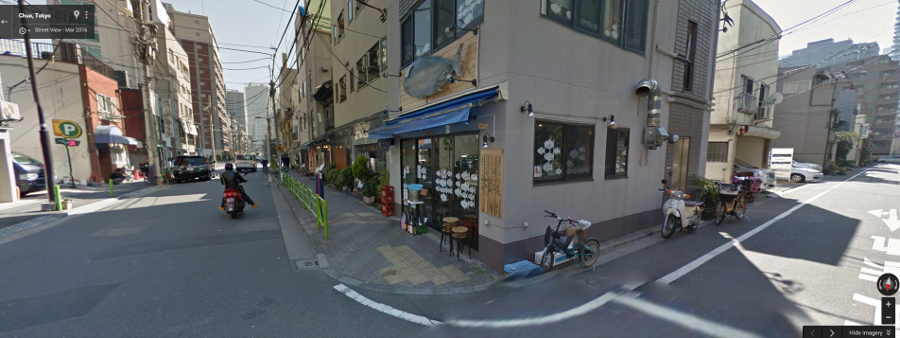
“Look there.” The Time Traveler pointed to the fish market on the corner. A family, three generations of them, were just opening up.

“Your son, his children, and their children.”

Hiro’s eyes moistened. “They survived.”

“One last look at home, Hiro.”

“Thank you, Martin. Now I can die in peace, knowing my family lives on.”

“It’s time for me to take you back to Hiroshima.”

“Back to my present, Monday, August 6, 1945. I’m ready.”

I wrote this in response to the What Pegman Saw photo challenge. The goal is to use the photo at the top of the page as a prompt to write a piece of flash fiction no more than 150 words long. Mine came in at 147.

To read other stories based on the prompt, go to InLinkz.com.

The photo prompt is a 2016 street view of a ward of Tokyo called Chūō-ku, which literally means “Central Ward”. I looked it up on Wikipedia, and among other things, found out that after World War II, much of Chuo City was rebuilt and many of its numerous waterways filled in to make space for more buildings and roads.

I leveraged time traveler Martin Fields, who I featured in a seven-part series beginning with On Wednesday, The Time Traveler Got Wet, in order to give a Japanese man from 1945 a chance to see what had become of his family after seventy years. He gets a look at them in the 21st century before returning to his fate in Hiroshima the day the Atomic Bomb was dropped.

Why the other-worldly being known as Isis would have given this gift to a single individual is not revealed, but it’s enough that it was given.


The Man Who Walked On Venus

Venus

Artist’s concept of Venus’s forbidding surface. (ESA/MPS/DLR/IDA)

“How’s the weather down there?” Jeremy Howard heard Amy Jefferson’s voice in his ears accompanied by just a hint of static.

“Hot.” He chuckled. “472 degrees Celsius. Atmospheric pressure equivalent to being 900 meters under the surface of the ocean. The wind speed is 710 kilometers per hour with gusts up to 750.”

“Sounds like a wonderful vacation spot.”

“You’re welcome to come down and join me, Jefferson.”

“Not a chance, Howard. This one’s all yours.”

So far it was light banter, but Jefferson was monitoring Howard’s telemetry and she was starting to get worried.

Continue reading

Bee Drones

robobee

© Eijiro Miyako

It had been forty years since Eijiro Miyako and his colleagues at Japan’s National Institute of Advanced Science and Technology developed the first generation robo-bees. Pesticides, land clearing, and the effects of climate change had resulted in a steady decline in the bee population. Without bees, many plant species, including crop plants from apples to almonds, could not be pollinated and reproduce.

By the tenth generation of the tiny drones, they were self-replicating, self-repairing, solar-powered dynamos. They did not replace the natural bee population, but they greatly enhanced pollination efforts, allowing flowering plants to survive and finally to thrive again.

Each individual robo-bee’s AI formed a collection of nodes, which, when linked to the population of drones as a whole, formed an intelligence that was arguably sentient.

The problem was finding a way for the natural bee population to either develop an immunity to what was killing them so they could increase their numbers to a viable level, or eliminate the causes of their die off.

The drone AI quickly realized the cause of the die off of bees, and many other environmental problems, was the human race. Robo-bees could go even where the natural bees could not, so the almost complete extinction of humanity was ensured by swarms of millions of these tiny assassins.

I read a story yesterday called Robotic bee could help pollinate crops as real bees decline at “New Scientist,” and thought there could be another side of the story.

This is a pretty grim outcome, and hardly superversive, but if you push your biosphere too far, the biosphere will push back.

A Sky Filled With Hope

israel from space

Photo credit: NASA/Barry Wilmore – Israel from space

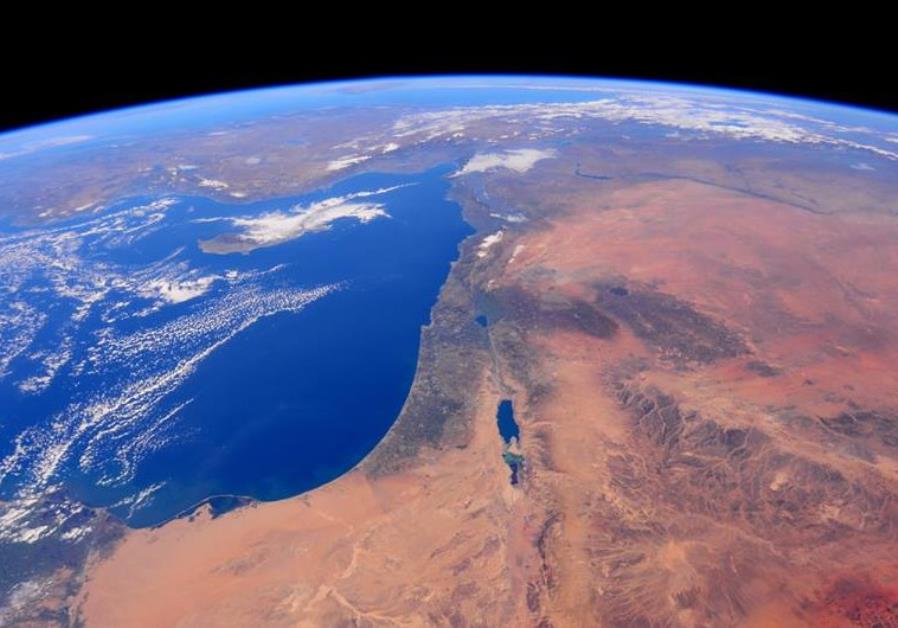
Each of the 1,038 nanosatellites that launched from the Satish Dhawan space port in India was hardly larger than a milk carton, but these small, inexpensive spacecraft, originally designed at Israel’s Ben-Gurion University, were the hope of mankind.

Avi Salomon and Havah Tobias stood in Mission Control and watched the monitors as the nanosats reached their initial orbits. The “father” of the project, Professor Dan Blumberg, received a remote feed at Ben-Gurion in Beer-Sheva.

“It’s looking very good, Professor.” Tobias spoke into her microphone. “I think we will be successful.”

Continue reading