Book Review of Harlan Ellison’s “Dangerous Visions” (1967)

Dangerous Visions

© James Pyles

If you like my work, buy me a virtual cup of coffee at Ko-Fi.

I must have originally read Harlan Ellison’s landmark SF/F anthology Dangerous Visions (1967) sometime in the mid-1970s, but I remembered nothing about it when I picked up the book again. I only decided to re-read “Visions” because it was mentioned by a publisher as part of their open submissions call.

When a publisher throws their gates open and allows any and all (with certain caveats) authors (would be or established) to submit a story to them (usually in an anthology), they sometimes offer hints or ideas as to what kind of stories they are (and are not) looking for.

One such strategy is to suggest the author read some of the stories they’ve already published. Another is to ask the writer to read other novels and anthologies they favor.

Recently, I read an open submission call that suggested, among other books, Ellison’s original “Dangerous Visions.” I can’t say whether I submitted to that publisher or not. I step away from a certain percentage of them for a number of reasons. This can include them being just too darn picky (too many hoops to jump through), they are only open to a certain population (usually those they believe are marginalized), or they’ve rejected everything I’ve ever thrown at them in the past and I’m resigned to that publisher never liking my writing.

So I checked out a copy of “Dangerous Visions” from the public library to see what I could see.

Continue reading

Book Review of Isaac Asimov’s “Gold” (1995)

gold

© James Pyles

If you like my work, buy me a virtual cup of coffee at Ko-Fi.

I discovered the existence is the Isaac Asimov collection Gold (named for one of the fictional stories therein) from an online source I have since forgotten. It is advertised as Asimov’s Final collection and I had never heard of it before (the usual Science Fiction fandom gatekeepers can take note and castigate me accordingly).

The book was published in 1995, three years after Asimov’s death. It is divided into three portions: Final SF Stories, Essays on Science Fiction topics, and on the matter of Writing Science Fiction.

I imagined that I’d be most interested in the stories themselves and was disappointed to find I was wrong. The stories weren’t particularly strong examples of his work, at least as I remember his work. I can’t recall the last time I read anything by Asimov, especially something I hadn’t first read in my adolescence of early adulthood, but it was certainly years if not decades ago.

Continue reading

Book Review of Jim Butcher’s “Grave Peril” (2001)

grave peril

© James Pyles

If you like my work, buy me a virtual cup of coffee at Ko-Fi.

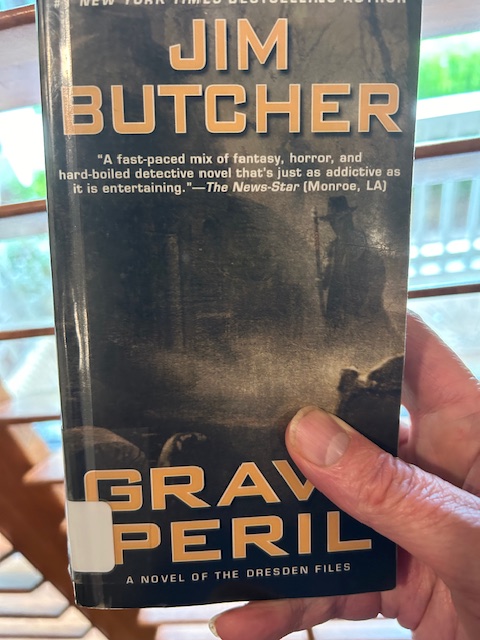
I just finished reading Jim Butcher’s fantasy/horror novel Grave Peril, book number three in the Dresden Files series.

Harry Dresden is the only professional wizard listed in the Chicago phone book. He’s like a private detective, but the mysteries he’s called to solve always involve the supernatural and usually something very, very nasty.

While he’s on retainer with the Chicago P.D. “Special Crimes” unit, he often goes out on his own when something deadly threatens the community, or often himself and those he knows and loves.

“Grave Peril” started differently than the previous two books I’ve read. Harry was in the middle of confronting a hostile ghost with a very unlikely ally, Christian and Knight Michael Carpenter (the last name is especially cheesy given his faith).

Something has stirred up the spirit world and weakened the barrier between our reality and the Nevernever, the realm of ghosts, demons, fairies, and darkness. Ghosts are being brutally tormented by a mysterious “Nightmare,” something from Harry’s past. He and Michael confront the spirit of a maniacal nurse from Chicago’s 19th century in the maternity ward of Cook County General, and unless Harry and Michael can stop her, she will murder scores of newborn infants.

Continue reading

Book Review of “Half Past Human” by T.J. Bass

half past human

© James Pyles

If you like my work, buy me a virtual cup of coffee at Ko-Fi.

Half Past Human is a dystopian novel by T.J. Bass (Thomas Joseph Bassler) that I found recommended on social media by science fiction writer Neal Asher. The prolific Asher seems to read as much science fiction as he produces and I’ve followed a number of his suggestions in the past.

This 1971 story starts out as a typical “after-the-end-of-the-world” dystopic tale where much of humanity lives in a series of worldwide underground cities collectively known as “the Hive.” They follow an ultimate authority called the “Big-ES” and their lives are programmed by that authority for various functions. They only reproduce when Big-ES sanctions certain citizens to be “polarized” or to develop sexually as male and female. Otherwise, they are neutered four-toed Nebishes.

On the surface, vast crops are grown to support the Nebish population, tended to and harvested by intelligent machines. Also on the surface are large groups of five-toed “Buckeyes” who live a stone age level of existence. Where the Nebishes value community and compliance above all else, the Buckeyes cherish individuality and freedom (you see where this is going?).

Continue reading

Book Review of “House of Suns” (2008)

house of suns

Cover art for the Alastair Reynolds novel “House of Suns.”

If you like my work, buy me a virtual cup of coffee at Ko-Fi.

I just finished Alastair Reynolds’ 2008 science fiction novel House of Suns. The book’s scope in time and space is vast, so it’s difficult to summarize let alone absorb.

Warning: Spoiler Alert!

Hundreds of thousands of years ago, a few individuals including one Abigail, decide the only practical way to explore the galaxy is to replicate themselves (almost) into a vast number of copies or “shatterlings.” Eventually, these shatterlings organize into Houses (such as the House of Moths and the House of Flowers) and inside the Houses family lines, such as the Gentian Line. This Line has emanated from Abigail, a person who was kept in childhood medically for decades before being allowed to become an adult and lead her family.

We get glimpses into Abigail’s early life up to her decision to create the shatterlings and to become one herself. These events parallel what occurs much, much later involving the shatterlings Campion and Purslane.

These two travel with each other albeit in their own spacecraft. Shatterlings, through a combination of relativistic speeds and stasis chambers, travel throughout the Milky Way and only have reunions with the other members of their Line once every “circuit” of the galaxy.

Continue reading

Book Review of “Fool Moon” (2001) by Jim Butcher

Fool Moon

© James Pyles

If you like my work, buy me a virtual cup of coffee at Ko-Fi.

If you read my review of Jim Butcher’s novel Storm Front, you know I love not only his writing, but the beginning of his “Dresden Files” series.

Last night, I finished off book two in the series Fool Moon. As you might imagine, the primary “baddies” are werewolves, but it’s not that simple. Nothing is ever simple in the life of the world’s only openly active and investigative wizard Harry Dresden.

We pick up about six months after the first novel when once again, head of the Chicago P.D. Special Investigations unit Karrin Murphy calls Dresden in on a series of particularly gruesome murders, ones that look to have been committed by wolf-like creatures.

The victims again throw Harry in the path of the city’s most dangerous gangland boss “Gentleman” Johnny Marcone.

Murphy is in plenty of hot water with internal affairs after the events of the previous novel and to make matters worse, the FBI have an interest in the “Lobo murders.” Special Agent Phil Denton leads a team of federal investigators which includes Deborah Benn, who upon first meeting Murphy almost shoots her.

Continue reading

Book Review of “Replay” (1986)

replay

© James Pyles

If you like my work, buy me a virtual cup of coffee at Ko-Fi.

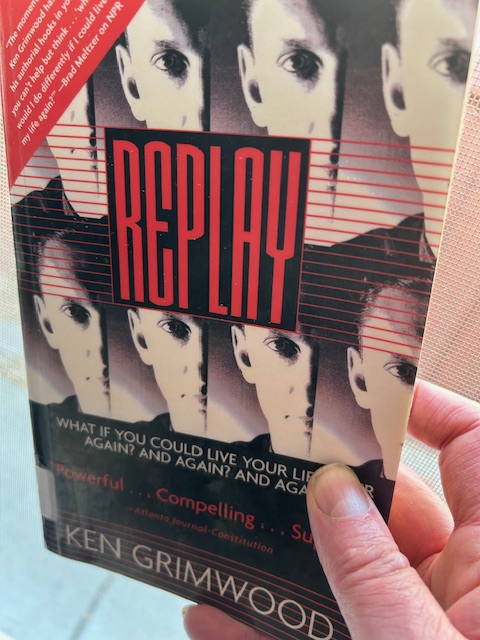
I forget where I saw Ken Grimwood’s 1986 novel Replay promoted, but it sounded like an interesting story, so I picked up a copy at my local public library. It’s a highly unusual and compelling time travel story.

Jeff Winston is a radio news producer in this late 40s. His job is lackluster as is his childless marriage. He’s at work and gets a phone call from his wife. As she starts speaking, he has a sudden heart attack and dies.

Jeff wakes up in his dorm room, an eighteen-year-old college freshman in the early 1960s. He has all of the memories of his life up to the moment he died twenty-five years in the future. Except that none of that has happened yet. Does it have to happen at all?

The first quarter of the book follows Jeff as he reconstructs his life based on what he knows of the future. In this case, he makes himself fabulously wealthy. Of course he drops out of college. Still feeling like a middle-aged man, the prospect of going through another four-year drudge as an undergraduate looks so depressing. But he does know a lot about major sporting events and which companies are going to be successful in the 1960s and beyond.

Continue reading

Book Review of “Storm Front” (2000)

storm front

© James Pyles

If you like my work, buy me a virtual cup of coffee at Ko-Fi.

When I was seven years old, I got a bad case of strep throat and was out of school for a whole week. During that time, my sisters bought me my first fantasy and sci-fi novels: the boxed set of Lord of the Rings and the boxed set of the Han Solo adventure novels by Brian Daley. I devoured them all during that week.

My first love as a fan is swords-and-horses fantasy. After Tolkien, I went after C.S. Lewis. After Lewis, it was Lloyd Alexander. After them came Fritz Leiber, Roger Zelazny, Robert Howard, John Norman, Poul Anderson, David Eddings, Weis and Hickman, Terry Brooks, Elizabeth Moon, Glen Cook, and before I knew it I was a dual citizen of the United States and Lankhmar, Narnia, Gor, Cimmeria, Krynn, Amber — you get the picture.

-Jim Butcher from the Acknowledgements section of his 2000 novel Storm Front

If you’re a regular reader of this blog, you’ll know that I’ve become a fan of Jim Butcher’s Cinder Spires series, having reviewed both The Aeronaut’s Windlass and The Olympian Affair.

Continue reading

Book Review of “The Last Templar” (2005)

templar

© James Pyles

If you like my work, buy me a virtual cup of coffee at Ko-Fi.

I just finished reading The Last Templar (2005) by Raymond Khoury. It’s not the usual sort of thing I consume, but every once in a while, I’m attracted to these conspiracy theories, Catholic church conspiracies, historical and archeological mysteries.

It started out great. Strange goings on in Jerusalem in the late 13th century with the city under siege and the Christians about to be overrun. An escape to sea with a mysterious package that contains all the wealth and hopes of the Templars.

In present day, the Metropolitan Museum in New York City is displaying rare artifacts from the Vatican including one little-known encoding device. Four men dressed like knights (later identified as Templar) raid the Met, kill a security guard by beheading, and steal a bunch of wealth as well as the encoder.

Archeologist Tess Chaykin is attending with her mother and her nine-year-old daughter. She’s close enough to the fourth horseman to hear him say a phrase in Latin which translates “The truth will set you free.”

Continue reading

Review of “The Olympian Affair: Book Two in the Cinder Spires Series” (2023)

olympian

© James Pyles

If you like my work, buy me a virtual cup of coffee at Ko-Fi.

Yesterday, I finished reading Jim Butcher’s 2023 novel The Olympian Affair. It’s the second in his Cinder Spires series and the sequel to The Aeronaut’s Windlass which I read and reviewed.

Butcher doesn’t disappoint. This is another terrific adventure novel set (supposedly) in the far-future where our own civilization has long-since fallen. People live in floating cities called “Spires” ruled by various presidents, kings, and such. Trade is conducted by skyships powered by fantastic crystals. Those, and many other things, including meat, are grown in vats ruled over by powerful (and not-so-powerful) family houses.

The central character in these tales is Captain Francis Grimm, commander of the light-trader “Predator.” He was once in the Albion Navy but sacrificed his career and his honor for a close friend.

Continue reading