Book Review of “The Andromeda Evolution” (2019)

AS3

© James Pyles

If you like my work, buy me a virtual cup of coffee at Ko-Fi.

I heard about Daniel H. Wilson’s novel The Andromeda Evolution almost by accident and found that my local public library had a copy.

I read Michael Crichton’s 1971 novel The Andromeda Strain way, way back in the day and I’ve seen the 1971 movie adaptation a number of times and enjoyed them both.

But fifty years later and written by another author, even with the Crichton family’s blessing, how would this turn out?

A lot better than I expected.

The book started out very slowly and I was afraid it would be a hard slog all the way through. On top of that, Wilson sometimes decided to lecture the reader on the evils of colonialism and how bad white people and civilization is for indigenous people (the main action takes place in a protected reserve in the Amazon). I thought if this was going to be the tone of the book, it would be tedious and I almost stopped reading it once or twice.

Fortunately, Wilson didn’t belabor the point too much and then things began to pick up.

Continue reading

Book Review of “Star Wars: The Last Command” (1994)

last

Cover of the novel “Star Wars: The Last Command.”

If you like my work, buy me a virtual cup of coffee at Ko-Fi.

I just finished reading the third book in Timothy Zahn’s “Thrawn Trilogy,” The Last Command. Oh “spoiler alert,” it is Thrawn’s last command because he dies, which I didn’t see coming.

Grand Admiral Thrawn having acquired the “Katana fleet” in the previous book and with a massive army of clones to man them, proceeds to press the offensive, even to Coruscant.

Leia has her twins and cares for the infants with the help of her aide Winter, but that doesn’t keep her out of the action as the story progresses.

The clone of Jedi Master Joruus C’baoth goes further off the rails, claims the Empire, galaxy, and the whole universe for his own, and is still raving about having Luke, Mara, Leia, and her babies as his apprentices. He decides to leave the Grand Admiral’s ship for the planet Wayland, which is where Thrawn originally found him. Thrawn grants this, but turns the tables. He makes C’baoth his prisoner in the Emperor’s own throne room in the mountain fortress where the clone factory and all of the Emperor’s other secrets are hidden.

Continue reading

Book Review of “Star Wars: Dark Force Rising” (1993)

dark force

Cover of the novel “Star Wars: Dark Force Rising”

If you like my work, buy me a virtual cup of coffee at Ko-Fi.

I finished reading Star Wars: Dark Force Rising, book 2 in the Thrawn trilogy and I have to say I’m having a blast.

It doesn’t quite nail down the original film trilogy, but it comes close. I suppose because more details can be packed in a novel than a two-hour film, those details take a little away from its “Star Wars-ness.”

The race is on to find the derelict Katana fleet, a group of Dreadnoughts dating back to the Clone Wars. Both the New Republic and the revitalized Empire are in desperate need of ships.

Supposedly Talon Karrde, head of the smuggler’s guild, knows the secret location and might be persuaded to tell the New Republic, but then there are others.

Following her promise in the last novel, Leia, Chewbacca, and Threepio meet with their Kashyyyk contact in orbit around Endor. Leia and the rest leave the Millennium Falcon and travel with their companion Khabarakh to his home world in an attempt to convince this warrior race to abandon the Empire and join the New Republic. Eventually, she finds evidence of the Empire having poisoned their planet during the clone wars, rather than the Rebellion, convincing them they have been betrayed by the Empire.

Continue reading

Book Review of “Fire Time” (1974)

fire time

Cover for Poul Anderson’s 1974 novel “Fire Time”

If you like my work, buy me a virtual cup of coffee at Ko-Fi.

I wish I could say I liked Poul Anderson’s 1974 novel Fire Time. It was being offered from Amazon at a pretty low price and wasn’t available at my local public library. I’d read and liked other books by Anderson. I figured what the heck?

The novel begins with several prisoners being transported to a judge’s private residence on Earth. They had been charged with what seemed to be war crimes, and the judge, who was elderly and infirm, was the only one willing to hear their side of the story. The book proceeds from this point as testimony which could either be really good or really bad.

I couldn’t get past the sort of “muddiness” of the narrative. I tried, but as much as I wanted, the story didn’t pull me in. I never lost myself in this world. It’s a world describing a difficult orbit around three different starts sometimes resulting in “Fire Time,” a catastrophic heating up of the planet’s northern hemisphere that collapses civilization.

You’d think that would be enough.

Continue reading

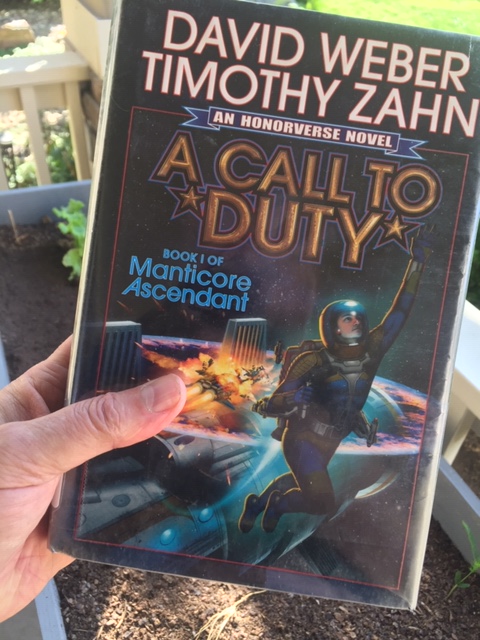
Book Review of “A Call to Duty”

call to duty

Cover for the Weber and Zahn novel “A Call to Duty”

If you like my work, buy me a virtual cup of coffee at Ko-Fi.

After I returned my previous book to the library, I was wandering the stacks trying to decide if anything looked interesting. I eventually came across A Call to Duty (2016) by David Weber and Timothy Zahn. It’s the first book in the four-part Manticore Ascendant series which, in turn, is part of the much larger Honorverse published by Baen Books.

I should say that I’m particularly fond of Baen, not just because of the quality of titles they publish, but because they are a truly egalitarian science fiction/fantasy publisher. They don’t hold your politics or social views against you if you happen to be a tad bit conservative (as opposed to many other publishing houses and official SciFi organizations).

That said, I haven’t specifically targeted a disproportionate number of novels from Baen for my reading list. I tend to read whatever gets my attention at the moment.

A few years back, I did read and review Weber’s flagship Honorverse novel On Basilisk Station. I had the same issues with Basilisk as with Call to Duty, they tend to drag.

Continue reading

Book Review of “Hauser’s Memory” (1968)

hauser

Photo credit: James Pyles

If you like my work, buy me a virtual cup of coffee at Ko-Fi.

I finished my re-read of Curt Siodmak’s classic novel Hauser’s Memory a few days ago but this is the first chance I’ve had to write about it. I know I originally read the book some decades ago but remembered very little. I also watched the 1970 made-for-TV movie starring David McCallum and Susan Strasberg, but remember just a little more.

This book wasn’t part of my local public library system so I had to buy a used hardback. The copyright says 1968 so I imagine it could be a first edition, especially since the page stock is so wonderfully thick. I really love old books.

What strikes me about this novel more than anything else is the writing. Normally, when I review a piece of science fiction, I’m assessing (among other things) the quality of the science fiction writing. In Siodmak’s case, his writing is that of a wonderful author and storyteller regardless of genre. Taking out the SciFi aspects, his knowledge of humanity is wonderful. I could read his descriptions of even the most mundane aspects of the lives of his characters and still be fascinated.

Continue reading

Book Review of Joe Haldeman’s novel “Camouflage” (2004)

cam joe

Photo credit: James Pyles

If you like my work, buy me a virtual cup of coffee at Ko-Fi.

I just got done reading Joe Haldeman’s novel Camouflage. I used to read Haldeman a lot back in the day. I loved classics such as The Forever War and All My Sins Remembered. It was after reading his novel The Accidental Time Machine that I said I’d never read him again (more on that later).

But a friend suggested giving him another try, so I found “Camouflage” at my local public library.

It’s generally a good book and a very easy read. I shot through it in just a few days. In spite of the title, the protagonist is an alien being simply called “Changeling.” We find out early on that Changeling came to Earth from over 10,000 light-years away and evolved in a very different environment. Apparently life is rare in the galaxy and Earth is where it found life.

Its ship landed in the Pacific Ocean, specifically the Tonga Trench about a million years ago. The narrative made it seem that Changeling is a subset of the life form in the ship that separated itself to explore. For the vast majority of that million years, Changeling was various forms of sea life swimming around, primarily an Orca and a Great White Shark.

But by-the-by, Changeling started observing human beings on ships and became curious. It came on shore in California in 1931 and superficially imitated a human being.

Continue reading

The Last Goodnight

dale

PHOTO PROMPT © Dale Rogerson

If you like my work, buy me a virtual cup of coffee at Ko-Fi.

The rental was one of several identical row houses, one bedroom plus a loft, one-and-a-half baths, small kitchen and dining area. The neighborhood was quiet. It was a perfect place to finish his last novel. It would also be his first novel, but the publisher said it was a sure bestseller.

At seventy-one, his first and only bestseller after laboring for over forty years. It cost him his marriage, any connection to his family, and certainly his sobriety.

He could have it done and submitted in a few months. Once published, then the long, drunken descent into his last goodnight.

Continue reading

My Book “The Aliens” Has Been Accepted Into the Starry Eyed Press Series “Galactic Treks”

featured author

Promotional image for the “Galactic Treks” series from Starry Eyed Press

If you like my work, buy me a virtual cup of coffee at Ko-Fi.

I’ve had a number of my works published by Starry Eyed Press before, but this one is different. A little while ago, they announced an open submission of a series called “Galactic Treks” The title is on purpose.

The general theme is “space opera,” but the word count can be anything from 5,000 up through novel length.

Wow. To be able to plot a story without worrying about exceeding a word count.

But that’s not all. Here are the specifics:

It should come as no surprise to hear that Gene Roddenberry’s Star Trek franchise is one of the most endearing and enduring pieces of quality space opera in the world.

There was even a time, many years ago, when anybody was allowed to write a Star Trek novel and submit it to Simon and Shuster for review!

Sadly, those days are long gone and Paramount would prefer to work only with authors and writing staffs of their choosing in developing Star Trek novels, comics, episodes and films.

So where does that leave the rest of us aspiring Trek writers? We’re glad you asked.

The Galactic Treks line is your time to shine. We’re seeking novels, shorts and series that center on space exploration, optimism, a protagonist or a crew as members of something bigger (a fleet perhaps), and an emphasis on thinking one’s way to final resolve over simply blowing everything up.

So write a “Star Trek-type” story without literally writing Star Trek.

Continue reading

2022: A Very Brief Summary

2022

© James Pyles

If you like my work, buy me a virtual cup of coffee at Ko-Fi.

As you can see, compared to 2021 and before, my productivity this past year has waned considerably, at least of you count actual, published short stories and novelettes. Of course, I had two of those novelettes published in the same year by the same publisher for the 224-verse. Most of the other short stories, except for the one I have featured in “Shoot the Devil” were published the previous Spring.

So what have I been doing?

Continue reading