A Little Fallout: Bias and the “Humanities”

fallout

Graphic depicting nuclear fallout – image credit unknown

Several days ago, I posted a link to my essay Concealment: Should I Have Used a Pen Name? in a private writers group on Facebook. The admin always holds links in mediation prior to approval. Usually the process takes a few minutes to an hour, but after a day went by, I figured I’d gone too far and he wasn’t going to approve it.

However, 24 hours later it appeared. Either he was too busy to approve of it prior to that time (doubtful, since he’d been active in the group all along), or he was pondering whether or not to approve it, maybe even consulting others.

Well, it was approved, and discussion in the group was pretty interesting and generally positive. That is, until this one, offered by an admin of another writers group to which I do not belong (and I don’t plan on asking to join):
Continue reading

Quoting: How to Give Advice

Giving positive advice to people who are open to hearing it, is one of the greatest acts of kindness you can do.

Be careful not to give advice when it is unwanted, even if you are well-meaning. A prerequisite for giving advice is to have the humility not to give advice unless you are certain it will have a positive outcome.

How you give advice is often a key factor in whether or not it will be appreciated. Giving positive advice takes great skill.

Sources: For a series of probing questions on this topic, see Rabbi Zelig Pliskin’s “Gateway to Self Knowledge,” pp.104-6

Quoting: Boost Your Confidence

When you are confident that you can do something, that itself mobilizes more of your talents and skills.

Increase your appreciation for the Almighty’s power and how He can give you the Divine assistance to succeed. This is the ultimate way to increase your level of confidence.

See Rabbi Zelig Pliskin’s “Gateway to Self Knowledge,” pp.171

Quoting: Feel the Joy of Being Alive

If we truly appreciate the gift of life that the Almighty gave us, we will constantly say, “No complaints, I’m alive.”

When you experience joy for being alive, these positive feelings create a context that free you from the thoughts and feelings that create complaints.

Sources: For a series of probing questions on this topic, see Rabbi Zelig Pliskin’s “Gateway to Self Knowledge,” pp.164-7

Quoting: Be Objective About Your Actions

There is a strong tendency for an evil person to consider himself good, and for a truly good person to consider himself bad. The rationale behind this is simple: Their criteria of good and bad differ greatly.

A good person desires to help others, and when unable to do as much as he idealistically wishes, considers himself “bad.”

An evil person considers himself “good” if he refrains from beating someone up after taking their money.

The lesson: Be objective about your actions.

-Sources: Imrai Binah, p.45; Rabbi Zelig Pliskin’s Gateway to Happiness, p.132

Not sure I totally agree with this person. I think a person can consider themselves good if they use the group’s mindset of good without weighing the pros and cons within themselves. A lot of folks automatically label things “good” and “bad” and never give it another thought because some authority tells them that’s how things should be defined. The truly “good” person will struggle with the moral issues, even when it’s painful, because that’s when they actually take ownership and responsibility for their own attitudes, decisions, and actions.

Quoting: Overcome Fears Blocking Action

When trying to influence someone and you find that your first approach is not effective, try to figure out what specifically is holding him back from accepting your position. For example: What fears might he have? What obstacles might he be focusing on that would make it difficult for him? Then show the person why he has no reason to be afraid and that the potential obstacles will not be a problem.

Today, think about what fears are holding you back from taking some positive action that you know is in your best interest. Imagine that you have been given the gift of tremendous courage and confidence. Let this empower you – and resolve to take action!

Sources: see Ralbag – Shaar ahavas rayim, no.12

Quoting: A Soft Reply Turns Away Anger

“A soft reply turns away anger.” (Proverbs 15:1)

When you communicate to others in a soft manner, this will calm someone who is already angry at you. This refers to both your tone of voice and the content of what you say. Be mentally prepared to apply this to someone who is likely to speak to you in anger.

When the person who is angry has a valid complaint against you, admit that he’s right – and this will calm him down.

Sources: see Vilna Gaon – Proverbs 14:30 and 15:1; Rabbi Zelig Pliskin – “Consulting the Wise”

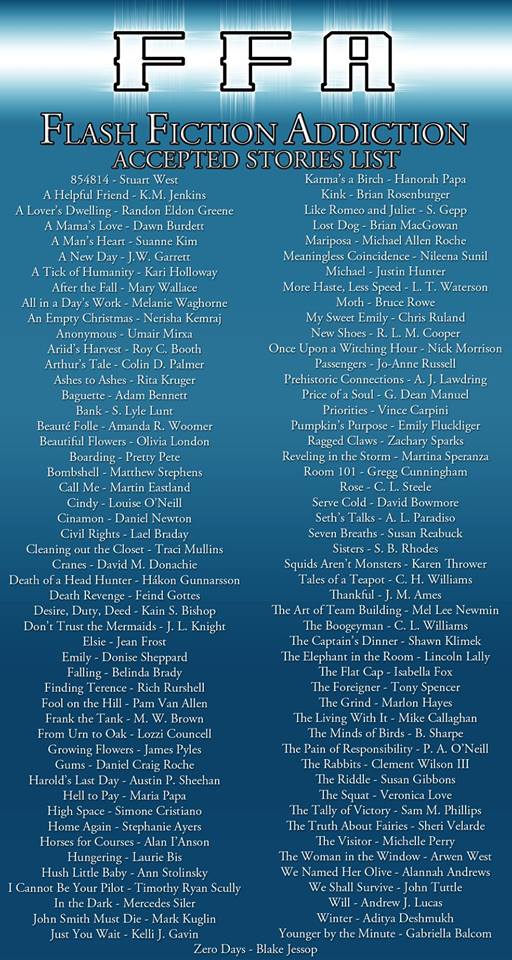
“Flash Fiction Addiction” Anthology and a lot of Authors

Do you want to see a lot of names, because this is a lot of names. 101 authors and stories selected for this anthology out of a pool of nearly three times as many. If each writer maxed out the word count of their wee missives at 750, the total would be 75,750, or the size of a novel. Here they all are. I’m in there somewhere. πŸ˜‰

Look for it on April 15, 2019.

ffa

Flash Fiction Addiction table of contents

Quoting: Choose Your Thoughts to Avoid Worry

Worry is when you choose from millions of possible thoughts, only the few which deal with a potential misfortune or problem.

Once you accept your worrying as the act of choosing specific thoughts, you can consciously make an effort to avoid those thoughts that cause you needless pain and choose more constructive, positive thoughts.

-from Rabbi Zelig Pliskin’s Gateway to Happiness, pp.157-8

Quoting: Show Concern Instead of Anger

Rabbi Yitzchok Blauser’s daughter once went to the cupboard, and all the glasses, cups and dishes fell and broke. He did not get angry at her, and he did not even ask her why she wasn’t more careful.

Rather, his only concern was that she should not be upset or frightened. He said to her, “Don’t worry. There’s not need to get upset. It’s all right.”

Sources: Hosair Kaas Mailibecho, p.185; Rabbi Zelig Pliskin’s Gateway to Happiness