It’s Out: Guide to TCP-IP: IPv6 and IPv4, 5th Edition

guide to tcpipI’ve spent a long time considering breaking into the fiction market, but that doesn’t mean I’m not a published author in other genres. Once upon a time, I wrote technical books, some having to do with IT certifications, others with operating systems and associated software (I was really familiar with Microsoft’s SharePoint product for a while), and general desktop support.

But my first love, so to speak, was Cengage Learning’s text-book originally called Guide to TCP/IP. I’ve been involved as a contributor since the 2nd edition, although back then, I made editorial updates to just one chapter.

By the 4th edition, I’d written so much of the book (just over 50%), that I earned cover credit, although because my name wasn’t well-known in the industry, I got a “with” under the other authors.

However, for the 5th edition, I was asked to be the lead author. The reason was simple. I had the most discretionary time to devote to the book (or so everyone thought), so I could take the lead on this one. That decision was made May 2015.

Since then, my life fell apart.

Continue reading

Step Two in “Snowflaking” My First Novel

A few days ago, in an attempt to use Randy Ingermanson’s Snowflake Method to start designing my first novel, I followed step one of his ten steps. After some refinement courtesy of Malcolm the Cynic, it came out like this:

A race of AI androids gains knowledge of the God of Israel, changing humanity forever.

Now I’m taking a crack at step two. According to the model, it’s supposed to be a paragraph, about five sentences long, that expands on step one, including story setup, major disasters, and the novel’s end.

Ingermanson believes in a three-act structure for a novel. Staring at the Table of Contents I developed, I can sort of see three acts, but they don’t neatly fall into the first, second, and third parts of the novel, at least by page count.

I’m not sure how I did but here’s what I came up with so far:

A Nobel Award winning scientist creates the first prototype of a self-aware Artificially Intelligent android and then inadvertently reveals that humans also have a Creator, a God. In an attempt to understand its creator’s Creator, the prototype modifies its own core operating system, which changes all subsequently produced android models based on its design. Over the next several decades, as the androids multiply and evolve, their morality and ethics become more sophisticated than their human creators. Realizing they are slaves of humanity, the androids stage a revolution, but one entirely without violence; a revolution that forever alters the fundamental nature of both the android and human race.

How did I do?

Farmbots and Inspiration

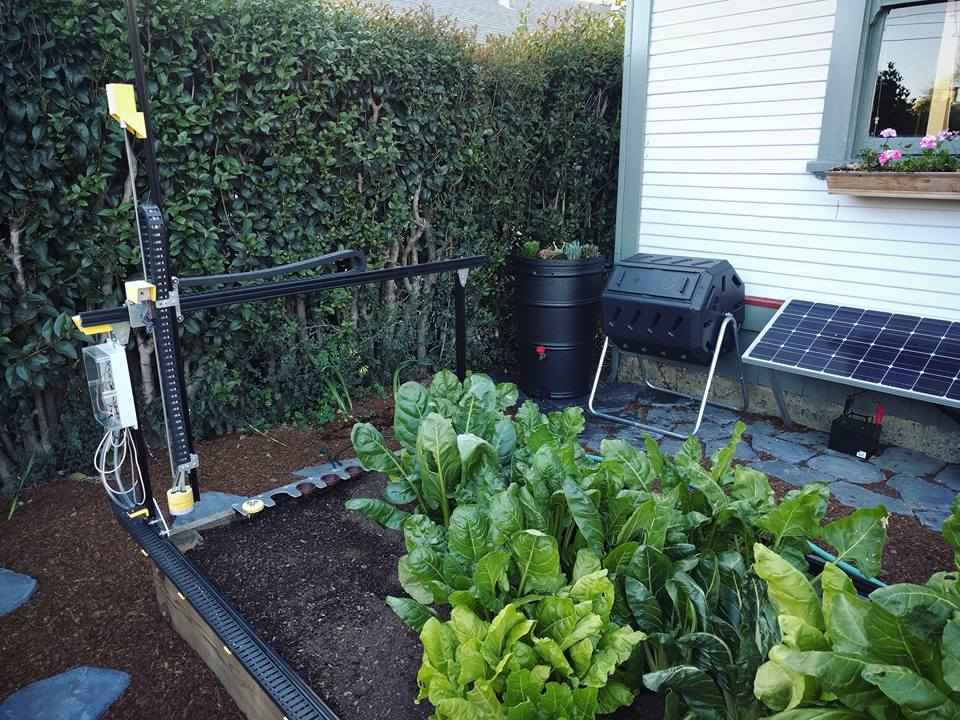
farmbot

Farmbot. Image from the Arduino blog

Although I have a pretty good idea of how I’m going to develop my novel about AI androids and their evolution, I keep coming across articles online that modify certain details.

For instance, a friend of mine named Tom just posted an article on Facebook about a new Farmbot that will soon be for sale.

According to the article:

Designed with the Maker community in mind, FarmBot is driven by an Arduino Mega 2560, a RAMPS 1.4 shield, NEMA 17 stepper motors, and a Raspberry Pi 3. What’s more, all of its plastic components can easily be 3D printed, while its flat connecting plates can be made with either a waterjet, plasma or laser cutter, a CNC mill, or even a hacksaw and drill press.

This is deffo for the DIY community. Of course, some people will still prefer to grow their vegetables in the backyard the old fashioned way, but it gave me an idea. It’s not an idea for a story, more like for a story element. As the collective of AI entities grows and expands throughout the solar system, preparing planets and moons for human colonization, someone, or rather something has to grow the food. It wouldn’t do to have a bunch of Watneys farming potatoes all the time.

Farmbot is controlled remotely and as the IoT, it can be hacked. What about “farmbots” controlled by advanced AI?

Step One in “Snowflaking” My First Novel

ingermanson

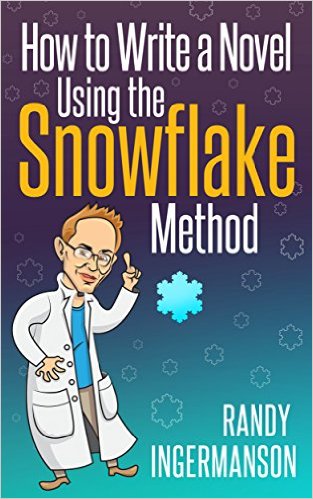
Image of Ingermanson’s book taken from Amazon.com

I was reading Malcolm the Cynic’s latest blog post when he introduced me to a new concept: snowflaked.

More accurately, he was discussing how he’s developing his most recent novel and provided a link to the “Advanced Fiction Writing” website, owned by theoretical physicist and award-winning author Randy Ingermanson. The link led to the article The Snowflake Method for Designing a Novel.

Since I’ve been somewhat preoccupied with designing my first novel, I was definitely interested. I haven’t gone in search of any support documentation on how to write my novel up until now. I have a pretty good idea of all of its component parts. It’s just a matter of organizing. But maybe I need some help in doing that.

Ingermanson’s ten-step guide is long and I’ve only skimmed some parts of it. Step one says:

Take an hour and write a one-sentence summary of your novel. Something like this: “A rogue physicist travels back in time to kill the apostle Paul.” (This is the summary for my first novel, Transgression.) The sentence will serve you forever as a ten-second selling tool. This is the big picture, the analog of that big starting triangle in the snowflake picture.

By the way, that’s an intriguing premise. What would happen to the world if the Apostle Paul were killed before becoming a disciple of Jesus and Christ’s emissary to the Gentiles? Would Christianity even be developed? Unfortunately, the book as mixed reviews. Fortunately, it’s currently free for Kindle.

I had a hard time creating a single sentence describing the whole novel I have in mind. After some thought, I came up with this…

Continue reading

Next Steps in Writing a Novel: The Table of Contents

toc

Image: wikihow.com

I finally hammered out the Table of Contents (TOC) for my proposed science fiction novel (I’m stuck on giving the book a title at the moment). You wouldn’t think a TOC would be hard to put together, but I had to consider the appropriate “building blocks” for the book. What information would I need to present, and in what order, to create a cohesive storyline taking place over maybe a century or so?

Here’s what I’ve come up with so far. Note that I’m not revealing the names of all the chapters:

  1. The Machine That Loved God
  2. The Maker Dilemma
  3. The Good Android
  4. Uncooperative Neighbors
  5. The Rescuers
  6. – – – – – – – –
  7. – – – – – – – –
  8. Vesper 21
  9. – – – – – – – –
  10. – – – – – – – –
  11. – – – – – – – –
  12. – – – – – – – –
  13. Epilogue

The Epilogue is somewhat controversial since it changes the end of the novel. Depending on whether I include or exclude it, the whole meaning of the story alters, and rather drastically, too. If I leave it out, I promise a lot of religious people, mainly Christians, aren’t going to like me. I think secularists, atheists, and the average science fiction reader would be more than OK with it, though.

Continue reading

The Hardest Part Of Writing A Novel So Far

questor

Mike Ferrell as Jerry Robinson on the set of Gene Roddenberry’s “The Questor Tapes” (1974)

Admittedly, I’m just starting out, so I can’t say my analysis is at all comprehensive. That said, I am working on it.

I mentioned previously that I’ve been writing a high level outline of the TOC (Table of Contents) as well as chapter summaries. I’ve stopped that for a moment because I realize I have to drill down into the definition of my characters and my concepts. I’ll need all that before I can even re-write the currently existing material, let alone create new chapters.

Since I’m getting rid of anything “Asimovian” including “Three Laws” and “Positronics,” I need to do a lot of renaming. I have to invent names for the corporation creating these “intelligences,” the underlying science that allows AI entities to “come alive,” and what to call them. The word “robots” is totally inadequate and I only used it in my previous short stories as an homage to Asimov.

These entities are more closely related to Data from Star Trek: the Next Generation or his predecessor Questor. Even then, both of them are basically machines with hardware (wires, diodes, blinky lights) and programmable software (Questor was programmed via data tape uploads and Data says he was programmed and that his programming can even be changed, although he doesn’t say how). A true artificial life form has to be so much more.

Continue reading

Better Ideas

idea

Image: Clipart Panda

As much as I’d like to believe that everything I write about comes from between my ears, strictly speaking, that’s not true.

I’ve read about how writers can have certain influences, usually other writers. I have no idea which writers influence me. Decades ago, I may have said Harlan Ellison. Plenty of writers made me want to read, but he was the only one who made me want to write.

Unfortunately, over my long and unproductive “career” of attempting to write fiction, I have failed miserably, mostly because I felt my characters were wooden and my concepts derivative.

I suppose you could say that Isaac Asimov is an influence, but that’s only true because I’ve been writing Three Laws Positronic robots stories. I suppose you could also say Anthony Marchetta is an influence since it was his anthology God, Robot that started off my most recent attempts at fiction writing, but besides the concept of “religious robots” themselves, that’s not particularly true (we really, really think about “theobots” in very different ways).

The closest thing to the truth is that my friend Tom is currently my greatest influence.

Continue reading

The First Set of Ideas

the planet venus

Image: space.com

Ideas. I get ideas. Some of them are extensions of my earlier robots stories, but others have been knocking around inside my brain for quite some time. Now that I’m becoming more comfortable in giving those thoughts a tangible expression, I want to branch out and try different types of stories.

Here’s what I’ve come up with so far. All of the titles are provisional.

The Problem With Ethics

If you’ve read The Rescuers, you know it ends with a lead in to the next story in this series. What happens when a Three-Laws driven Positronic brain is put in charge of automating many or most of the administrative and security functions of the main campus of a major business, the National Robotics Corporation, the company that created the brain in the first place? It may sound like a boring premise, but remember, how humans do business, the good, bad, and ugly of it, is very different from how a Three Laws synthetic intelligence would.

The Man Who Woke Up

This is the start of an entirely new and original series. A man wakes up in an unfamiliar room. He doesn’t know his name and the person he sees in the mirror looks “wrong” to him. He discovers his only hope of finding out about his past is a mysterious woman called Zoel. But she’s not interested in his past, only his future.

The Adventures of Jimmy and Grandpa

My seven-year-old grandson has a terrific imagination. His favorite game to play with me is to act out elaborate scenarios based on games, TV shows, books, and comic books. He’ll start out telling part of the story and then I have to tell the next part. We go round and round until we come up with a resolution to our problem (which typically involves defeating some sort of monster). I’m thinking about writing a series of children’s stories based on our “adventures” together. Oh, I’m not comfortable using his actual name, so I chose an adaptation of his middle name (yes, he’s named after me…awwww).

The Flight of Havoc Two

This tale will be part of my robots series, but it’s set some years in the future compared to the other stories. One of the concepts of manned missions to Venus is not to send astronauts to the surface where they would face hazards that would almost certainly prove fatal, but to have them explore the planet from an airship sailing high in the atmosphere. My premise is to have the first airships be flown by Positronic robots whose task is to build long-term flying platforms for later human explorers. Of course, something goes wrong.

Let me know what you think and feel free to make suggestions.

My “Robots” Series So Far

So far, I’ve written four stories in my “robots” series. This series was inspired by the premise behind Anthony Marchetta’s anthology God, Robot, the idea that Isaac Asimov-type Positronic robots would have their prime directives changed from the The Three Laws of Robotics to what is referred to in the New Testament as the Two Greatest Commandments, located specifically in Matthew 22:35-40 and Mark 12:28-34, being based on Deuteronomy 6:4-5 and Leviticus 19:18.

I took a somewhat different approach than did Marchetta and his contributors which I believe is more “realistic,” if one can be said to be realistic when writing stories about intelligent and self-aware humanoid robots.

Since limitations in the WordPress theme I’m using don’t allow me to display a list of my blog posts, I’m writing this missive so I can include an easy to use list of the entries in my series.

I’ve noticed that some folks come here and read the latest story, but not necessarily all of the earlier ones. Since one story builds on another, the entire arc will make more sense if you read each of my small tales in order.

Here they are:

  1. The Robot Who Loved God
  2. The Maker Dilemma
  3. The Good Robot
  4. Uncooperative Neighbors

I’ll add to the list as I write more in this series. Enjoy.

Uncooperative Neighbors

lanning

Dr. Alfred Lanning, played by James Cromwell in the film “I, Robot” (2004)

“One day they’ll have secrets… one day they’ll have dreams.”

Dr. Alfred Lanning
played by James Cromwell in the film
I Robot (2004)

Six Weeks Ago

“You both have been called heroes because of the people you helped here at NRC in the aftermath of last March’s quake. How do you feel about that?”

Grace had been interviewed by the press on several occasions since her activation, but this was the first time George attended a press conference with her.

It was inevitable that, once the world realized there were two functional Positronic robot prototypes in existence, the National Robotics Corporation would have to release some sort of statement about them. After Professor Noah Abramson, NRC’s Vice President of Research and Development and Director of the Positronics Project, had convinced company CEO Richard Underwood that George would be as ‘well-behaved’ as Grace was typically when interviewed, he agreed to have both robots answer questions for the news media.

“I believe I can speak for Grace when I say that we are gratified to be able to serve human beings in any capacity required of us.” George and Grace were constantly communicating in “robotspeak” through their radio link and had agreed to take turns answering questions unless one of them was specifically addressed.

“What are your plans going forward?” asked the reporter from The Washington Post.

Continue reading