Book Review of “Star Wars: Heir to the Empire” by Timothy Zahn (plus a few extras)

heir

© James Pyles

Yes, this is a book review, but I need to lay a little groundwork first.

If you like my work, buy me a virtual cup of coffee at Ko-Fi.

When online strife over what “Star Wars” as a franchise has become gets to be too much, I always return to watching the original trilogy. Nothing seems to capture what “Star Wars” is to me like those films.

I haven’t watched the prequels in some time. I’d probably enjoy them. I did when I first watched them. At the same time, the thrill wasn’t the same. For one thing, Anakin’s eventual fall to the dark side didn’t have the same horrific tone as did Luke’s final battle with Vader in Return of the Jedi (1983). After all we expect Anakin to become Darth Vader. No one knew for sure what would happen to Luke until it did.

As far as the sequel trilogy, I won’t even get into it. It was too flawed from the beginning to be able to carry the legacy of Lucas’ vision. The fact that Disney in general and Kathleen Kennedy in specific were in charge didn’t help.

I haven’t watched any of the Disney+ shows although I have heard all the angst about them on social media.


Continue reading

Review of “Bad Dog: Military Science Fiction Across A Holographic Multiverse” (2017)

bad dog

Cover art for Ashley Pollard’s 2017 book “Bad Dog”

If you like my work, buy me a virtual cup of coffee at Ko-Fi.

Yesterday, I finished reading Ashley R. Pollard’s book Bad Dog: Military Science Fiction Across A Holographic Multiverse. It’s book one in the Gate Walkers series.

I’m acquainted with Pollard on social media including her commenting periodically on this blog. Like so many other people I “know” on social media, I don’t remember how we connected in the first place. I was aware she was a science fiction author, so when I got the chance to buy and download this series onto my Kindle Fire, I jumped at it.

The protagonist is Sgt. Lara Tachikoma, senior NCO leading a group of Marines who go into combat wearing specialized “mech” suits called “Dogs.” The story is set in 2071 so although the Marine culture she operates in is very familiar to me (my son served in the USMC), she works for the Confederated States Marine Corps.

On board the CSN Hornet, the Marine contingent receives orders from CIA operative Anderson to rescue a group of mechanized Army soldiers who were lost in an area of Afghanistan a week ago. Also, if they just happen to encounter a strange magnetic anomaly, to investigate.

Yeah, it’s a setup.

Continue reading

Review of “Shoot the Devil 2: Dark Matter”

ginger

Screenshot from the internet.

If you like my work, buy me a virtual cup of coffee at Ko-Fi.

I woke up this morning to find a wonderful review of the Christian SciFi anthology Shoot the Devil 2: Dark Matter by Ginger Nuts of Horror. “Dark Matter” features my short story “The Heavens Shall Declare His Glory.”

Tales by Richard Paolinelli, Frank B. Luke, and L. Jagi Lamplighter received high honors. That said, there was one drawback the reviewer found with the book:

Continue reading

Review of “The Soldier: Rise of the Jain, Book One” (2018)

soldier

The cover of Neal Asher’s 2018 novel, “The Soldier.”

If you like my work, buy me a virtual cup of coffee at Ko-Fi.

Last night I finished Neal Asher’s novel The Soldier: Rise of the Jain, Book One (2018). This one was harder for me to get into than some of the others.

I’ve read a number (but only a fraction of those published) of Asher’s novels, both series and stand alone.

One of the challenges in general is keeping track of all the different characters. It’s not just the Polity and Prator, but now we have the Species, the android Angel, the haiman Orlandine, various AIs including Earth Central (EC), not to mention the mysterious Dragon and the more mysterious Librarian.

Continue reading

Book Review of “Fire Time” (1974)

fire time

Cover for Poul Anderson’s 1974 novel “Fire Time”

If you like my work, buy me a virtual cup of coffee at Ko-Fi.

I wish I could say I liked Poul Anderson’s 1974 novel Fire Time. It was being offered from Amazon at a pretty low price and wasn’t available at my local public library. I’d read and liked other books by Anderson. I figured what the heck?

The novel begins with several prisoners being transported to a judge’s private residence on Earth. They had been charged with what seemed to be war crimes, and the judge, who was elderly and infirm, was the only one willing to hear their side of the story. The book proceeds from this point as testimony which could either be really good or really bad.

I couldn’t get past the sort of “muddiness” of the narrative. I tried, but as much as I wanted, the story didn’t pull me in. I never lost myself in this world. It’s a world describing a difficult orbit around three different starts sometimes resulting in “Fire Time,” a catastrophic heating up of the planet’s northern hemisphere that collapses civilization.

You’d think that would be enough.

Continue reading

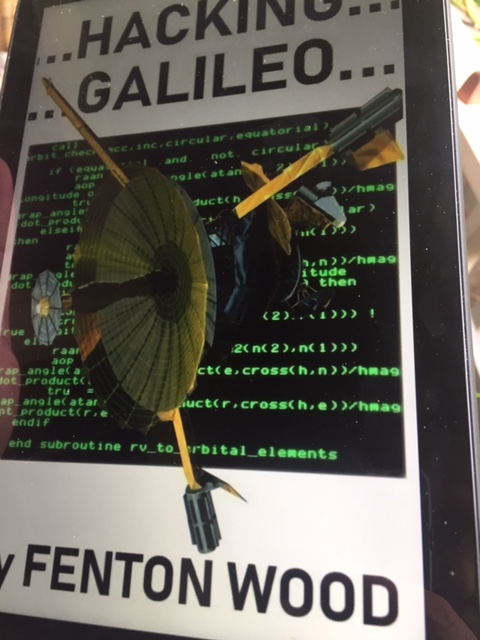
Book Review of “Hacking Galileo” by Fenton Wood

hack

© James Pyles

If you like my work, buy me a virtual cup of coffee at Ko-Fi.

I became aware of Fenton Wood (a pseudonym) when he reviewed my SciFi/Fantasy novelette Ice on twitter (but alas not on Amazon or goodreads).

Curious, I took a look at his twitter/X account, which led me to his e-book Hacking Galileo.

It had fabulous reviews, an interesting premise, and was reasonably priced, so I downloaded it onto my Kindle Fire.

The first words you read in the book after the usual preamble stuff is “This is a work of fiction.” Wood then goes on to explain the inspirations and influences for various parts of his story, the background of some of the technical details, when he “cheated,” making certain events happen at a slightly different point in history for the sake of the plot, and how security at Cray Research and Bell Telephone Company weren’t quite as lame as he depicted.

That’s really important because the rest of the book is written from the point of view of a man who, in the 1980s, was part of a teenage hacker group, really just a bunch of high school friends in Palmdale, California, who performed acts of hacking from the interesting to the fantastic.

The main character Roger O. Miller (ROM, see what he did there?) is writing and recounting events that happened thirty years ago where he and his three friends actually saved the world from destruction by an alien space probe. There’s a lot of build up to get to that point, but almost all of it is fascinating.

Continue reading

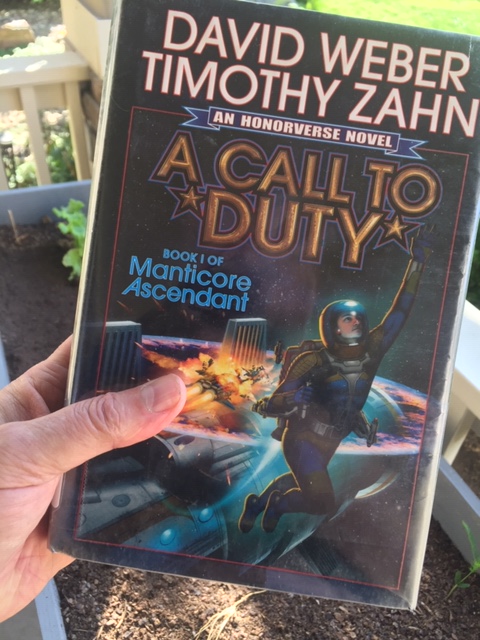
Book Review of “A Call to Duty”

call to duty

Cover for the Weber and Zahn novel “A Call to Duty”

If you like my work, buy me a virtual cup of coffee at Ko-Fi.

After I returned my previous book to the library, I was wandering the stacks trying to decide if anything looked interesting. I eventually came across A Call to Duty (2016) by David Weber and Timothy Zahn. It’s the first book in the four-part Manticore Ascendant series which, in turn, is part of the much larger Honorverse published by Baen Books.

I should say that I’m particularly fond of Baen, not just because of the quality of titles they publish, but because they are a truly egalitarian science fiction/fantasy publisher. They don’t hold your politics or social views against you if you happen to be a tad bit conservative (as opposed to many other publishing houses and official SciFi organizations).

That said, I haven’t specifically targeted a disproportionate number of novels from Baen for my reading list. I tend to read whatever gets my attention at the moment.

A few years back, I did read and review Weber’s flagship Honorverse novel On Basilisk Station. I had the same issues with Basilisk as with Call to Duty, they tend to drag.

Continue reading

My Fantasy Adventure Novelette “Ice” has been Reviewed on twitter/X

ice

Cover art for my fantasy novelette “Ice”

If you like my work, buy me a virtual cup of coffee at Ko-Fi.

I have exactly one book that is self-published on Amazon; Ice. My short description blurb says:

At the end of time, the world is hot and men travel the vast oceans in merchant sailing ships. Captain Ki-Moon Yong of the Star of Jindo has discovered a new horror at the bottom of the Earth. Can he and the Star escape disaster long enough to warn a disbelieving world?

Ice is set at the end of time when supposedly runaway climate change has melted all or the vast majority of Earth’s ice. Most of the land masses continue to exist (contrary to popular myth) but coastlines are very different and the actual continent of Antarctica is exposed, including it’s terrifying secrets.

Continue reading

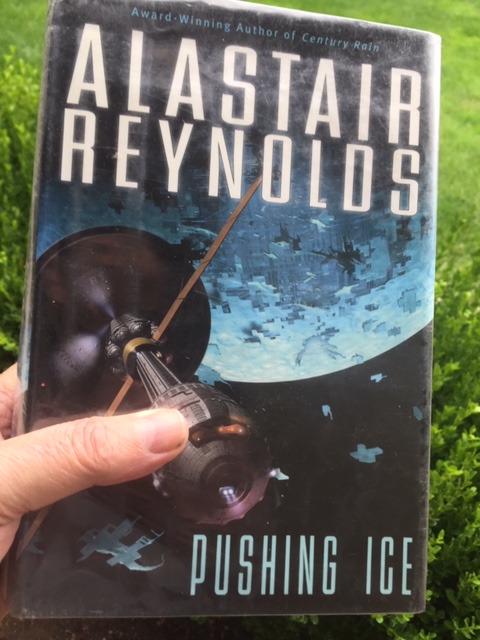
Book Review of “Pushing Ice” (2005)

pushing ice

Photo Credit: James Pyles

If you like my work, buy me a virtual cup of coffee at Ko-Fi.

It’s been over five years since I read and reviewed one of Alastair Reynolds’ books so I guess reviewing Pushing Ice is long overdue.

I actually keep a list of books I want to read. Which books I read and when depends somewhat on whether or not I can find them in my local public library system. I mean chances are, I’ll only read the book once (so many books, so little time), so I can hardly afford to buy them all (one wonders how people afford to buy all of the brand new SciFi books being put out just to be able to vote on them for the Hugos, Nebulas, or other much vaunted awards?).

This book started off slowly. I didn’t expect that. After all, in the beginning of the tale, humanity has moved out into the solar system, so much so, that they’re mining comets for ice (water). Then, to everyone’s shock, one of Saturn’s moons Janus breaks orbit and starts accelerating toward interstellar space. Turns out it wasn’t a moon at all but some sort of alien scout or observation post.

The people with all the money, the United Economic Entities (UEE) offers the closest ice mining ship, the Rockhopper, commanded by Bella Lind, a lot of money if it will chase, catch up to, and study Janus for the few days they can before the moon outruns them. After much angst and voting, they agree to. But that’s not the beginning of the story.

Continue reading

Book Review of “Hauser’s Memory” (1968)

hauser

Photo credit: James Pyles

If you like my work, buy me a virtual cup of coffee at Ko-Fi.

I finished my re-read of Curt Siodmak’s classic novel Hauser’s Memory a few days ago but this is the first chance I’ve had to write about it. I know I originally read the book some decades ago but remembered very little. I also watched the 1970 made-for-TV movie starring David McCallum and Susan Strasberg, but remember just a little more.

This book wasn’t part of my local public library system so I had to buy a used hardback. The copyright says 1968 so I imagine it could be a first edition, especially since the page stock is so wonderfully thick. I really love old books.

What strikes me about this novel more than anything else is the writing. Normally, when I review a piece of science fiction, I’m assessing (among other things) the quality of the science fiction writing. In Siodmak’s case, his writing is that of a wonderful author and storyteller regardless of genre. Taking out the SciFi aspects, his knowledge of humanity is wonderful. I could read his descriptions of even the most mundane aspects of the lives of his characters and still be fascinated.

Continue reading