Book Review of Joe Haldeman’s novel “Camouflage” (2004)

cam joe

Photo credit: James Pyles

If you like my work, buy me a virtual cup of coffee at Ko-Fi.

I just got done reading Joe Haldeman’s novel Camouflage. I used to read Haldeman a lot back in the day. I loved classics such as The Forever War and All My Sins Remembered. It was after reading his novel The Accidental Time Machine that I said I’d never read him again (more on that later).

But a friend suggested giving him another try, so I found “Camouflage” at my local public library.

It’s generally a good book and a very easy read. I shot through it in just a few days. In spite of the title, the protagonist is an alien being simply called “Changeling.” We find out early on that Changeling came to Earth from over 10,000 light-years away and evolved in a very different environment. Apparently life is rare in the galaxy and Earth is where it found life.

Its ship landed in the Pacific Ocean, specifically the Tonga Trench about a million years ago. The narrative made it seem that Changeling is a subset of the life form in the ship that separated itself to explore. For the vast majority of that million years, Changeling was various forms of sea life swimming around, primarily an Orca and a Great White Shark.

But by-the-by, Changeling started observing human beings on ships and became curious. It came on shore in California in 1931 and superficially imitated a human being.

Continue reading

Book Review of “Cowl” by Neal Asher

cowl

Photo © James Pyles

If you like my work, buy me a virtual cup of coffee at Ko-Fi.

I just finished reading Cowl (2004), a science fiction novel by Neal Asher. Of the seemingly endless supply of books he’s written, I chose “Cowl” because A) it is a stand alone novel where most of his works are bound to series and B) it was available through my local public library system.

Okay, the third reason is that it is specifically a time travel story, and I’m a sucker for time travel stories.

Most of the books of Asher’s I’ve read thus far (the reviews are elsewhere on my blog) are set off Earth, well outside the solar system, and so far in the future that anything that even vaguely refers to Earth is incredibly removed.

So it was odd to start out with the protagonist Polly, a teenage prostitute and drug addict in the 22nd century. Through an association with the sister of a soldier who had access to odd technology, she ends up in the crosshairs of a “U-gov” assassin named Tack. She sees the soldier Nandru killed by something called the Torbeast while Tack is trying to kill her.

Continue reading

Book Review of “Second Stage Lensman,” Book Five in the Lensman Series

Cover art for “Second Stage Lensman” by E.E. “Doc” Smith

If you like my work, buy me a virtual cup of coffee at Ko-Fi.

It has been almost a year-and-a-half since I reviewed E.E. “Doc” Smith’s Gray Lensman the fourth book in the “Lensman series” following Triplanetary, First Lensman, and Galactic Patrol.

Today, I’m reviewing Second Stage Lensman. While the Lensman series of books was first published in mass market paperback in the mid to late 1960s when I was in Junior High (and when every boy I knew was reading them), as a hardback book, it first came out in 1953. It had been published serially in “Astounding Science Fiction” from Nov 1941-to-Feb 1942.

Keep that in mind for the entire series since it is not only absolute classic science fiction and the emergence of the “space opera” but it really old.

That part is important, especially if you are used to more contemporary works “updated for modern audiences.” The 21st century progressive SciFi industry has little tolerance for it’s own past.

In this case, as with the others in the series, I can sort of see it, at least a bit.

For instance, slang. After all, from the 1940’s perspective, this is the future, but how would “future people” express themselves, especially when excited and agitated? How about:

Continue reading

Book Review: “Pines” (2012) by Blake Crouch

pines

© James Pyles

If you like my work, buy me a virtual cup of coffee at Ko-Fi.

I found out about the SciFi/Mystery novel Pines by Blake Crouch when I was looking up something totally unrelated. I had watched (again) the pilot episode to the 1966 Irwin Allen TV show The Time Tunnel and was wondering why the government would want to invent time travel.

Time travel, contrary to popular fiction, isn’t easily weaponized. If you want to change the past and say prevent anyone else besides the U.S. acquiring nuclear weapons, it would be incredibly complicated. Unforeseen variables could cause all kinds of unanticipated results, assuming you could change your own timeline at all.

It gets complex and it’s not the focus of this review. In one article I read, Blake Crouch said that changing time would most likely not be possible. If you tried to, as in the Back to the Future movies, prevent Marty’s Mom and Dad from meeting in 1955 so they couldn’t get married and ‘make” Marty, time would find another way for them to get together and sustain history.

I became curious about Crouch and looked up his books, finding the Wayward Pines novel series. My local library had a copy of “Pines,” so I checked it out.

Continue reading

Book Review of “Minecraft: The Island” (2017)

the island

© James Pyles

If you like my work, buy me a virtual cup of coffee at Ko-Fi.

Minecraft: The Island (2017) isn’t a book I’d choose to read. My wife actually read it to our grandson three times when he was much younger and more into the game. Now my eight-year-old granddaughter loves Minecraft.

Some background. When my grandson was about five or six, we started playing “the game.” It started out as teasing each other. He’d make up a character and say it was doing something to my character to which my character would respond. A very simple, adversarial, totally verbal, roleplaying game.

Eventually, it became more sophisticated, kind of like Dungeon and Dragons, but with only two players and no dice, just our imaginations. The games were largely centered on his interests at the time, which included Minecraft. It also included whatever he was watching or reading. I’d add my virtual two cents worth and plug in anything from my imagination and childhood.

His sister wanted to play with us, but there’s a six-year age gap between the two of them and she was too young.

Our games ended up fueling about two-and-a-half years of stories on my blog (you can still look them up) as well as my first two published short stories. It was loads of fun.

Continue reading

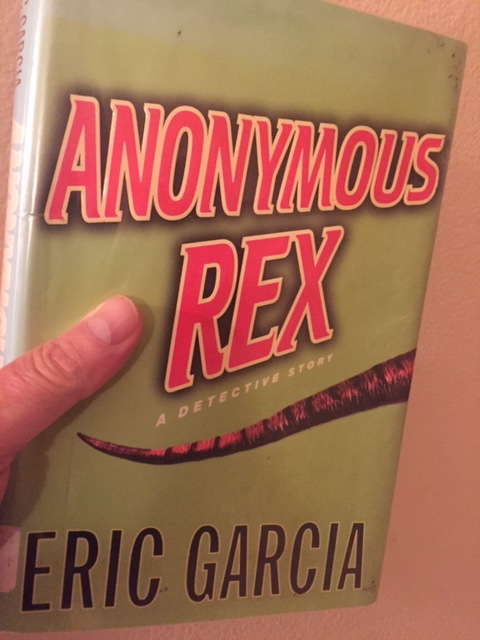
Book Review of “Anonymous Rex” by Eric Garcia (2000)

dino

© James Pyles

If you like my work, buy me a virtual cup of coffee at Ko-Fi.

I only heard about the novel Anonymous Rex by Eric Garcia (2000) because the anniversary of the TV movie’s release happened recently (actually, the movie was based on the prequel Casual Rex). The film’s plot seemed like a thinly-veiled attempt to cast the hidden dinosaur society (I’ll get to that in a minute) as the LGBTQ community if it were still closeted. Since I had just finished a rather huge and pondering tome, I thought a little light reading might be in order.

Fortunately, Garcia’s book was in my local public library system and I was soon in the business of reading. Also fortunately, the plot was quite a bit different than the film’s.

This will take a bit to set up. In this world (the book was published in 2000), some twelve or so dinosaur species have survived the extinction event 65 million years ago. Over the long haul, they’ve evolved just enough so that, with the proper complicated costuming, they can pass successfully as human beings. The decision to peacefully co-exist with us was made a few million years ago rather than the dinos destroying a nascent human race when they had the chance.

Continue reading

Book Review of “The Way of Kings” (2010)

way

© James Pyles

If you like my work, buy me a virtual cup of coffee at Ko-Fi.

A few months back, my teenage grandson loaned me his copy of Brandon Sanderson’s The Way of Kings (2010). My grandson is a huge fan and wanted to share his enjoyment with me. I really like that.

The first thing I noticed is the book is long, really long. I tend to read novels in the 300-500 page range (or so), but Sanderson’s tome weighs in at 1252 pages. Yikes!

I didn’t read any of the reviews or summaries so I could come at it fresh.

It’s a hard book to get into. For the first several hundred pages, the action switches between a number of players who seemingly have nothing to do with each other beyond living in the same universe. What the heck?

I mean after the mysterious prologue, we see the assassin Szeth-son-of-Vallano executing a king and then he disappears until somewhere in the middle of the book (he does play a pivotal role in the climax).

At one point, Kaladin is a soldier, but when next we see him, he’s a slave.

Continue reading

Book Review of “Ancillary Justice” (2013) by Ann Leckie

justice

Cover of Ann Leckie’s novel “Ancillary Justice”

If you like my work, buy me a virtual cup of coffee at Ko-Fi.

I first heard about An Leckie’s flagship novel Ancillary Justice by reading an article at Tor called Power, Responsibility, and Revenge: Ancillary Justice Ten Years On by Adrienne Martini. The book is now ten years old, but I’ve never been known as being on the bleeding edge of whatever’s new and fresh in science fiction.

This part of the article got my attention:

In that early scene, Leckie efficiently sets up one of the key features of this world: the Radchaai language doesn’t gender people. Breq defaults to she/her pronouns for everyone unless she is speaking the language of the colonized. We only know Seivarden is a “he” because a bartender on Nilt refers to him that way. Frequently, Leckie shows Breq struggling with finding the right pronouns for the languages that require them.

Oh, good grief. If there are two words associated with this novel that are bound to set my teeth on edge, it’s “justice” and “gender,” both of which have taken on rather magnified meanings in the 2020s, at least in social media.

Martini gushes glowing praise upon Leckie’s book. In fact, her debut novel has the distinction of having won a Hugo Award, Nebula Award, BSFA Award, Arthur C. Clarke Award, and Locus Award for Best First Novel. That’s some novel.

Continue reading

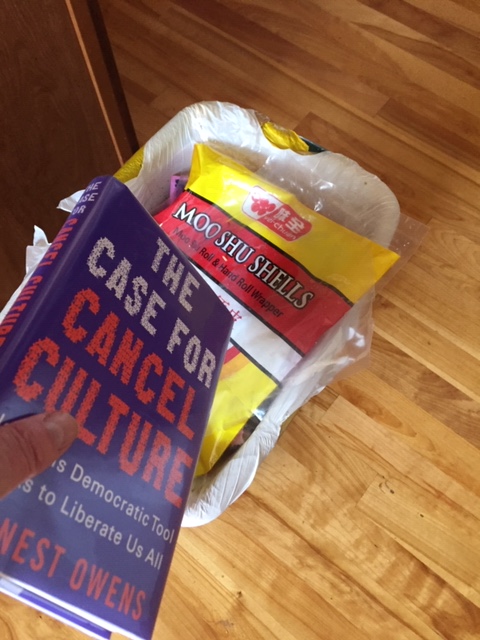
Book Review of “The Case for Cancel Culture” by Ernest Owens

cancel culture cover

© James Pyles

If you like my work, buy me a virtual cup of coffee at Ko-Fi.

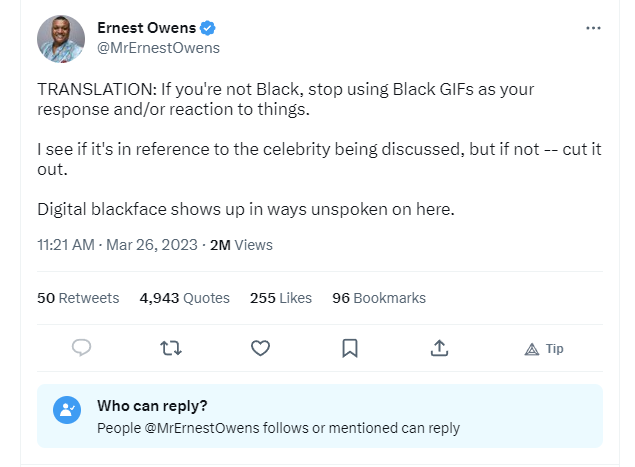
I don’t normally review books such as Ernest Owens’ The Case for Cancel Culture: How this Democratic Tool Works to Liberate Us All on this blog, but having inadvertently encountered one of the author’s tweets on twitter, I was intrigued.

blackface

Screen capture from twitter

Note that general replies are disabled on that tweet, and this from an author who wants to “liberate us all.”

At first, I thought this was a gag. I mean, these are gifs, for crying out loud. But in reviewing his twitter stream, I saw he was absolutely serious. Looking up his official bio gave me a clue as to why:

Continue reading

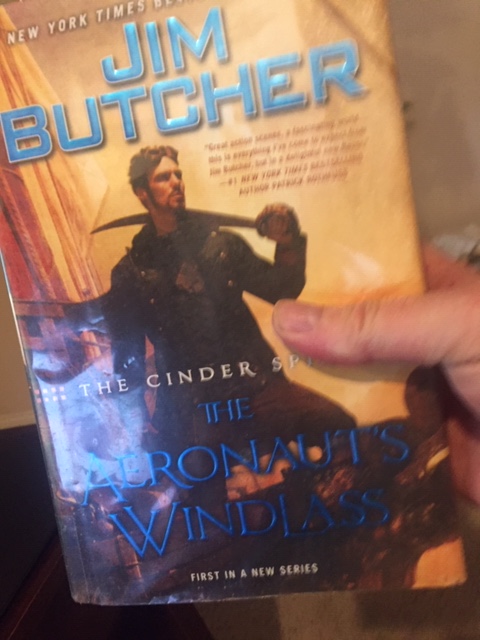
Book Review of “The Cinder Spires: The Aeronaut’s Windlass”

aeronaut

© James Pyles for photo

If you like my work, buy me a virtual cup of coffee at Ko-Fi.

I was at the public library weeks ago looking for another book when I came across Jim Butcher’s novel The Cinder Spires: The Aeronaut’s Windlass. It was published in 2016 as the first of a series, but according to Butcher’s website, the second in this collection will probably be published this year.

I’d never heard of Butcher before, but he’s been Hugo nominated more than once and has written the well-known (to everyone but me) Dresden Files novel series. I’ve been criticized by “real science fiction fans” that I’m not a “true fan” because I don’t have an encyclopedia-like  knowledge of all things SciFi. Oh well.

At 630 pages, it took me a while to read, especially since I can’t always find large blocks of time for reading. So after renewing it once, I finally finished it off this morning. I’m really glad I came across it. I was attracted to the cover mainly and checked it out on a whim.

Continue reading