Reading about “Palestine + 100” (2019). Was This Really A Good Idea?

palestine

Cover image for the science fiction anthology “Palestine + 100”

I found a link to the book review Palestine + 100′ Explores Contested Territory, Past And Future at Mike Glyer’s File 770 and was intrigued. Apparently, Palestine + 100:

…poses a question to twelve Palestinian writers: what might your country look like in the year 2048 – a century after the tragedies and trauma of what has come to be called the Nakba?

The reviewer, Amal El-Mohtar is the Hugo-award winning author of “The Honey Month” and writes the Otherworldly column for the New York Times Book Review according to the blurb on NPR. Among other things, she states:

The choice of subtitle — “stories from a century after the Nakba” — exemplifies this, drawing attention to the fact that for Palestinians (and many Israelis), May 15, 1948 is not a date to celebrate, but to grieve.

In case you didn’t know, May 15, 1948 was the date when Israel declared it’s independence from British rule and was established as a Jewish state.

The book hasn’t yet been reviewed at Amazon.co.uk, but received two favorable reviews on the U.S. site for Amazon.
Continue reading

One More Commentary on the Dragon Awards

dragon

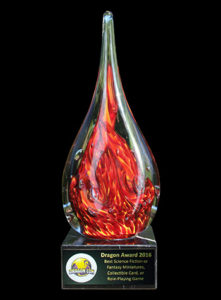
Image found at DragonCon.org

I’m new to the whole hype over awards for science fiction and fantasy, well, ever since last year when I learned about the controversy involving the Hugos and the so-called Sad Puppies and Rabid Puppies.

However, I’ve been paying attention to the Dragon Awards. Unlike most other awards of this type, anyone who has internet access can register for no cost and be able to vote for their favorite authors, books, television shows, and so forth (in other words we mere mortals). I even voted myself, but unlike others, the purpose of this blog post isn’t to share who I favored.

I discovered at least three other commentaries on the Dragons: File 770‘s Mike Glyer, Camestros Felapton‘s, an apparently associated blog which I’ve just started following, and Richard Paolinelli’s SciFiScribe.

They all had slightly different takes.

Continue reading

Film Review of “Beneath the Planet of the Apes” (1970)

Promotional image for the 1970 movie “Beneath the Planet of the Apes” featuring James Franciscus and Linda Harrison

I’m a huge fan of the 1968 movie Planet of the Apes starring Charlton Heston, Kim Hunter, and Roddy McDowell. Unfortunately, my local branch of the public library doesn’t have the film available in DVD, so I’d have to request it from a different branch. It does have three copies of the 1970 sequel Beneath the Planet of the Apes starring James Franciscus and Kim Hunter. It’s a horrible movie.

Okay, good things first. James Franciscus is heroic as hell. He’s a great looking guy, especially with his shirt off. Interesting side note. In the film’s beginning, his character Brent is seen nursing his skipper (no name given but played by Tod Andrews) outside their crashed spaceship. The skipper dies subsequently after having been blinded in the accident. The following year, Franciscus starred in a television show called Longstreet. The title character is a blind insurance investigator in New Orleans. No, I’m not kidding.

Continue reading

The Hugo Award Will Not Be Renamed and Why Are All Conservatives (seemingly) Called Alt-Right?

gram

Author Anthony Gramuglia – found at Goodreads

I recently wrote three related blog posts: Jeannette Ng’s Campbell Award Acceptance Speech and Here We Go Again, Science Fiction, Opinions, and Why It’s Okay to Disagree, and especially The Sins of John W. Campbell Revisited. That last one started something of a minor storm in the comments section at File 770, Mike Glyer’s popular SciFi fanzine.

Although I’m still following that site, I haven’t commented there again since, what’s the use? Most people there ignored me (which is fine), one disagreed with me but was pretty civil about it, and two called me “dishonest” and “racist.” I ignored one and actually had to block the other on twitter since he looked me up just so he could continue to troll me.

File 770 does what they call Pixel Scrolls which I gather are collections of all the latest SF/F news, including noteworthy birthdays and such.

I slowed down when I saw a link to Steve Davidson’s article On Renaming Awards. I had previously mentioned that if John W. Campbell’s name was to be removed (and it has been), that perhaps all other awards named after people should be examined, just in case the person in question had a “difficult” past. I pulled Hugo Gernsback’s name out of a hat since the famed Hugo Award is named after him. Lo and behold, Davidson seems to have been thinking the same thing, but in his case, explained why Gernsback’s rather checkered past (in terms of his allegedly shady business dealings) won’t result in the Hugos being renamed.

Continue reading

Science Fiction, Opinions, and Why It’s Okay to Disagree

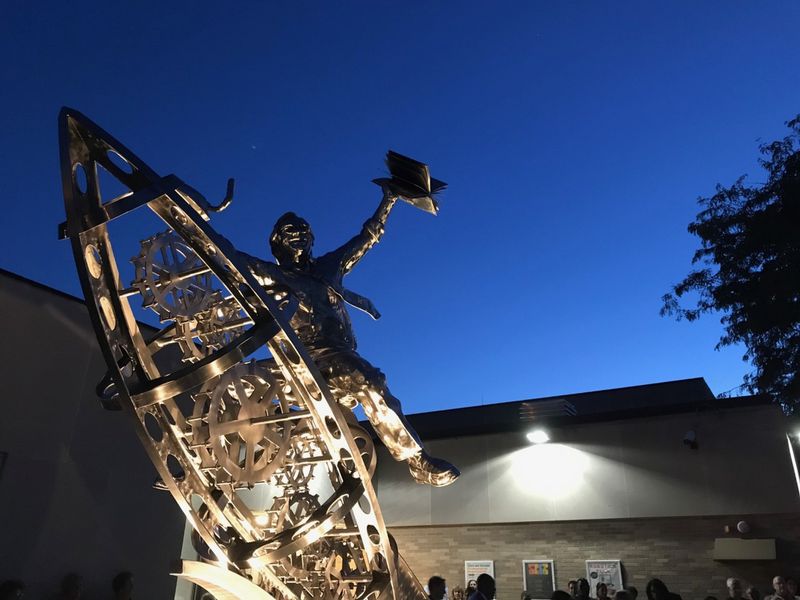
A statute honoring Ray Bradbury was unveiled outside the Waukegan Public Library just after sunset on Aug. 22, 2019, the 99th anniversary of the late author’s birth. (Dan Moran / Lake County News-Sun)

I just read an article at File 770 called Waukegan Public Library Unveils Ray Bradbury Statue (click the link and read, the story’s pretty short). Waukegan was Bradbury’s hometown and I’m thrilled to see that he is being honored. He is a truly timeless writer, and I can prove it, since my 33-year-old son Michael just read Something Wicked This Way Comes.

Over a year ago, I wrote my own wee Bradbury essay titled Should We Burn Ray Bradbury’s Books?. I crafted my missive in response to Katie Naum’s essay at Electric Lit called The New ‘Fahrenheit 451’ Movie Fails to Reckon with Bradbury’s Racism.

I seriously doubt he was a racist, at least in the dictionary definition sense, but assuming Bradbury had character flaws and perhaps some dated beliefs given that he was born in 1920, that doesn’t change his influence on the field of science fiction, nor make him unworthy of being honored.

Of course, we’ve seen this sort of thing before.

Continue reading

The First 500 Words

From the comic strip “Peanuts” by the late Charles Schulz

Something new happened when I tried to submit a short story to a publisher via the platform Submittable. There was no option to upload my Word file. There was only a field to paste in up to the first 500 words of the story.

I looked at the publisher’s specifications again and they said they’d respond to submissions of the first 500 words in a few days, and then the entire story in a few months.

Of course I submitted the first 500 words (491 actually so I wouldn’t have things cut off in the middle of a sentence) and a day later, got this back:

Thank you for sending us the first 500 words of “XXX.” Your writing caught our attention and we would like to read your entire story. Please upload your full story and complete the requested fields in ‘Step 2’ under the Forms tab that now appears in your Submittable dashboard for this submission. We look forward to reading it in consideration for XXX.

I have since uploaded the file, but I think this illustrates an important point.

Continue reading

My Interview as Author of “The Recall” at Dark Fringe Radio

podcast

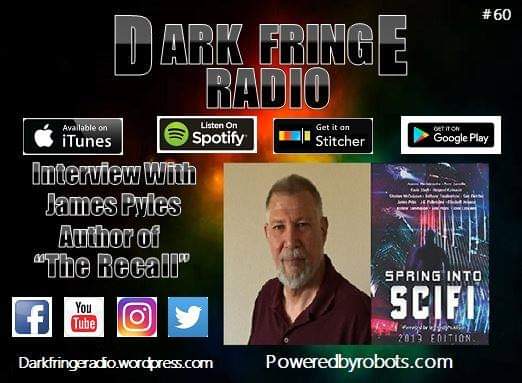
Screen capture of the Dark Fringe Radio promotional image for my interview.

It’s here.

I probably mentioned that I was interviewed by William Martinez at Dark Fringe Radio. We previously discussed my then unpublished short story “The Recall,” which is now featured in the Cloaked Press science fiction anthology Spring into SciFi: 2019 Edition. He said if my wee tale ever saw the light of day, he’d like to interview me for one of his podcasts.

Well, it was published and I was interviewed and now, #60 in DFR’s series is available online. As my four-year-old granddaughter would say, “Ta-Da!”

Continue reading

Review of “Blade Runner: The Director’s Cut” (1982)


blade runner

Promotional image for the film “Blade Runner: The Director’s Cut

Blade Runner: The Director’s Cut (1982) is the only version of this film I’ve seen, so I have no real idea what the original theatrical movie was like. On Amazon, I found this explanation:

When Ridley Scott’s cut of Blade Runner was finally released in 1993, one had to wonder why the studio hadn’t done it right the first time–11 years earlier. This version is so much better, mostly because of what’s been eliminated (the ludicrous and redundant voice-over narration and the phony happy ending) rather than what’s been added (a bit more character development and a brief unicorn dream). Star Harrison Ford originally recorded the narration under duress at the insistence of Warner Bros. executives who thought the story needed further “explanation”; he later confessed that he thought if he did it badly they wouldn’t use it. (Moral: Never overestimate the taste of movie executives.) The movie’s spectacular futuristic vision of Los Angeles–a perpetually dark and rainy metropolis that’s the nightmare antithesis of “Sunny Southern California”–is still its most seductive feature, an otherworldly atmosphere in which you can immerse yourself. The movie’s shadowy visual style, along with its classic private-detective/murder-mystery plot line (with Ford on the trail of a murderous android, or “replicant”), makes Blade Runner one of the few science fiction pictures to legitimately claim a place in the film noir tradition. And, as in the best noir, the sleuth discovers a whole lot more (about himself and the people he encounters) than he anticipates…. With Sean Young, Edward James Olmos, Daryl Hannah, Rutger Hauer, and M. Emmet Walsh. –Jim Emerson

I first watched this DVD (the director’s cut, as explained above, was released eleven years after the original) years ago, and found certain sequences so violent, that I haven’t had the nerve to view it since. However with the recent death of actor Rutger Hauer (who was so good in so many different roles) who played replicant Roy Batty, I felt compelled to borrow the disc back from my son.

Continue reading

Review of Octavia E. Butler’s Novel “Parable of the Sower” (2000)

sower

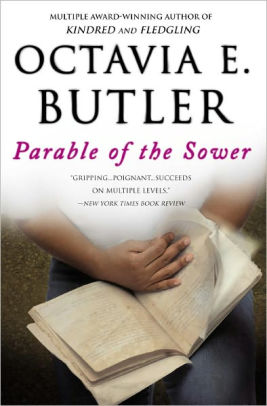
Cover art for the novel “Parable of the Sower”

“THERE ISN’T A PAGE IN THIS VIVID AND FRIGHTENING STORY THAT FAILS TO GRIP THE READER”.

— SAN JOSE MERCURY NEWS

GRIPPING…POIGNANT…SUCCEEDS ON MULTIPLE LEVELS

— NEW YORK TIMES BOOK REVIEW

This highly acclaimed post-apocalyptic novel of hope and terror from award-winning author Octavia E. Butler “pairs well with 1984 or The Handmaid’s Tale” (John Green, New York Times)–now with a new foreword by N. K. Jemisin.

I’ve heard the name Octavia E. Butler for some time now, and have been meaning to read one or more of her books. She has an interesting background and is generally considered one of the most important science fiction authors of her generation, particularly as a woman of color. Sadly, she passed away in 2006, although the cause is attributed either to a stroke or a head injury acquired during a fall.

Here’s more about her:

Continue reading

Are the Science Fiction “Culture Wars” Still Alive and Well?

dragon

Image found at DragonCon.org

I’ve tried to steer this blog away from the more controversial and/or political topics I’ve covered in the past, but then I read Richard Paloinelli’s missive Wikipedia or WikiPravda?. Richard and I share some similar viewpoints, but I lack many of the wounds and scars he’s received in the past, such as those attributed to Mike Glyer at the File 770 science fiction fanzine. I think I was contended with there exactly once. It actually impressed me, since relative to Glyer’s readership, I’m pretty much a nobody.

In the recent past, I’ve heard that Wikipedia, Patreon, and YouTube have been accused of attempting to shut out politically and socially conservative creative voices through censorship and defunding. Since I’m merely a consumer of Wikipedia and YouTube and wouldn’t know what to do with Patreon, I’ve had no personal experience, but on the other hand, I have no trouble believing they are all biased left, either.

Continue reading