Across the Hell Land

apocalypse

Post apocalyptic art by Albert Goodwin, 1903 – a work in the public domain

Gray-haired, burnt-skinned Santos had forgotten the number of times he had appealed to the Glow for an end to his journey through the hell lands. He couldn’t fool himself with the placebo anymore, and so as he put out the campfire and slipped on his rucksack, the dull pain in his right knee became his rough companion with each step, thanks to the oblique scar left by the direwolf last Fall.

The old woman he encountered in one of the shelters reclaimed from a flatlands hell crater had tried to minister to him, but the scar tissue had already formed, and her potions were far too weak to repair damaged cartilage. Being maimed didn’t bother him as much as the fact that having to leave her alone again, she died two days hence, probably by the same pack that had struck at him, as evidenced by the sign of the carrion birds circling above her hut.

But heartstrings weren’t something he could afford. She had refused to go with him when he asked. The reluctant ranger told her the plague to the East was spreading by rats and sand hares, had consumed his community, and that the only safety was his destination, the half-mythical city beyond the western foothills. But she said she’d made her peace with the high desert and the hell lands. Her husband and five sons had died during the first disaster, and being of prairie stock, she chose to stay, to tend their graves, living off of a meager garden, wearing sackcloth and ashes.

She never said her name or how long she’d been alone, but he kept seeing her face, cut and grooved with wrinkles like a river delta as step by step, limping, praying to the Glow with each gasp of pain, he kept walking.


Continue reading

Quoting: Don’t Despair

Even if a doctor says there is no chance of recovery, one should not despair. There are an extremely large amount of cases when doctors have given up hope and nevertheless the patient recovered. While it is irresponsible to disregard reliable medical advice when something practical can be done, doctors are only human and are fallible. It is important for doctors themselves to realize this and even when the situation appears bleak, they should realize that while we cannot rely on miracles, medical miracles do occur.

Whenever Rabbi Yehoshua Leib Diskin was told that a doctor had given up hope on a patient, Rabbi Diskin would comment, “A doctor has a right to heal, but who gave him the authority to despair?”

Sources: Amud Aish, p.158; Rabbi Zelig Pliskin’s Gateway to Happiness, p.377

A Hero in Harare

movies

Sterkinekor Lusaka Arcades Centre in Lusaka, Zambia – found at afrotourism.com

“I want to meet this Miles Morales,” twelve-year-old Miriro murmured spontaneously as he and his eleven-year-old sister Anesu did their maths homework at the kitchen table, warm afternoon sunlight streaming in the western window.

“What are you talking about,” she replied in irritation. “He doesn’t even exist. He’s a cartoon.”

“Uncle Tongai took me and my mates to see Spider-Verse over the weekend. The movie said anyone could wear the mask and be Spider-Man.” He was grinning, his mind completely diverted from his textbook.

“You’re daft. This isn’t Brooklyn, America. It’s Harare, Zimbabwe. Just because black Americans look like us doesn’t mean we’re all the same. Our lives are different.”

“Anybody can be a hero, Anesu.”

“Be a hero and finish your studies before Mama comes back from the market and we both get in trouble.”

But it was too late. Miriro was already thinking about his new costume.

I wrote this for the What Pegman Saw flash fiction challenge. The idea is to use a Google Maps location/image as the prompt for crafting a piece of flash fiction no more than 150 words long. My word count is 149.

Today, the Pegman takes us to Harare, Zimbabwe.

Yesterday, I saw the film Spider-Man: Into the Spider-Verse (2018) with my son and my nine-year-old grandson. I subsequently published my review online and obviously still have the movie on my mind.

One of the things I’ve been considering, both with this movie, and especially with the Marvel Studios film Black Panther (2018) is that in the African nations, culturally, black people have widely varying cultures compared to African-American audiences, so the differing populations may not have as much in common with each other as people in the U.S. might imagine.

Having said that, the central message of “Spider-Verse” is that anybody can wear the mask. It was meant as a commentary about how historically, superheroes have been white, but it doesn’t automatically have to be that way. Any kid, no matter who they are, can be a hero.

I decided to put a spin on the message and say that any kid anywhere in the world also can aspire to be more than who they are, mask or no mask, even a twelve-year-old boy living in Harare.

To read other stories based on the prompt, visit InLinkz.com.

Quoting: Courage Builds Self Respect

Courage builds self-respect. When you sacrifice for principles and ideas, you increase your self-respect. When you face a painful situation and react with dignity, you increase your self-respect.

When you say, “No,” to temptation even though others will try to persuade you to say, “Yes,” you increase your self-respect. When you don’t allow opposition to stop you from doing what you know must be done, you increase your self-respect.

In short, every act of courage makes you feel better about yourself.

-from Rabbi Zelig Pliskin’s book, “Courage”

Film Review of “Spider-Man: Into the Spider Verse” (2018)

spiderverse

Promotional image for the 2018 film “Spider-Man: Into the Spider Verse”

About an hour ago as I write this, my son, grandson, and I were walking out of the theater after watching Spider-Man: Into the Spider-Verse (2018). This animated film chronicles the coming of age and origin of the Miles Morales Spider-Man (voiced in the film by Shameik Moore), who, in the movie, looks about 13 or 14 years old.

I know I just put up a link, but I haven’t read the page yet, so don’t know much about the Morales “Spidey.” I didn’t want to find out more about him before I watched the movie, and for years, I have only been tangentially aware of him. I have to admit, when I first heard of that version of Spider-Man, I figured it was Marvel taking a highly popular franchise and just inserting a person of color in order to attract progressive readers as well as pull in long-term, hardcore Spidey fans.

This movie changed all of those misconceptions.

Continue reading

Quoting: Better Than Duct Tape

One person who frequently lost his temper, finally learned to control it with the following method:

Whenever he felt angry at someone, he would take a sip of water and hold it in his mouth for five minutes. Only after the five minutes passed would he criticize someone.

During this time his anger subsided and he was able to talk calmly.

Sources: Erech Apayim, p. 85; Rabbi Pliskin’s Gateway to Happiness, p.211

The Sacrificed

alternate universes“I can’t do it, Erickson. I’m no killer.” Rafael Isaiah Johnson had traveled back in time 172 years to stop a global extinction event and save the human race, but the man he hoped to enlist as an ally, Austin Randolph Erickson had another idea, a murderous one.

The two men, one a Hispanic-African-American who wouldn’t be born for another 135 years was standing in the other man’s kitchen between the refrigerator and the stove, the exit to his back, while the opposing person, a white American man of Scandinavian ancestry was facing him and holding out the butt of a loaded semi-automatic Glock 20. The drawer to his left and second from the top was still pulled open.

“You’ve got to do it, Johnson. I believe you. I believe all of the holographic evidence you brought with you, that my unborn son is the key in time, the critical element in preventing the reversal of the effects of climate change. Take the gun. If I don’t exist, then he won’t be born.”

Continue reading

Book Review of “The Strange Affair of Spring Heeled Jack: A Burton and Swinburne Adventure”

jack

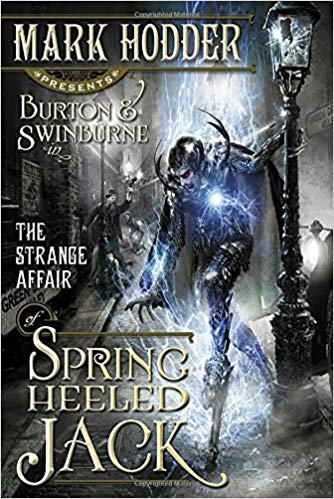
Cover image for Mark Hodder’s 2010 novel The Strange Affair of Spring Heeled Jack

Some months ago at work, a friend of mine and I got to talking about steampunk as a sub-genre of science fiction, and, long story short, he recently lent me his copy of Mark Hodder’s 2010 novel The Strange Affair of Spring Heeled Jack: A Burton and Swinburne Adventure.

Basically, Hodder takes real places (London specifically) and actual historical figures, such as Sir Richard Burton, poet Algernon Swinburne, Charles Darwin (yes, that Charles Darwin), and Florence Nightingale, and transforms them into bizarre, distorted, “steampunkish” versions of themselves in a much larger than life adventure set against a highly improbable background.

The result is an amazing romp that could never have happened (time travel notwithstanding) but is nevertheless, is a lot of fun.

Recently, I said that I’d be making a concerted effort to read more recently produced science fiction novels and stories as defined by those having been published within the last ten years or so. Mr. Hodder’s novel certainly qualifies, so here we go.

Continue reading

Quoting: The Mistake is to Not Try

Try to become as great as you can. Some people are afraid to accomplish because they might make mistakes — and those mistakes will be more serious than if they remained simple!

This is not valid reasoning. Each person is obligated to develop himself to the best of his ability. The smallest person has potential for greatness if he utilizes all that is within him.

Sources: Rabbi Yosef Leib Bloch – Shiurai Daas, vol.3, p.130; Rabbi Zelig Pliskin’s Gateway to Happiness, p.131

The Girl Who Could Do Anything

clouds and sky

© Sue Vincent

“Come on, Grandpa. Over here.” Three-and-a-half year old Jillie ran ahead of sixty-three year old Robert, who was starting to feel the icy talons of fear clutch his heart as his migraine interfered with his control.

“Coming, Angel.” Wiping moisture off of his forehead and locks of long, graying hair, he knew the migraine would not let him tolerate trying to run, but he walked as fast as he could, blue jeans and boots catching in the cheat grass, sweat clinging to his checkered flannel shirt and denim jacket. If she should stray too far ahead while he couldn’t concentrate, there’s no telling what would happen.

The blond child, dressed for the winter weather in dark blue jeans, a snug, long-sleeved shirt, and her favorite turquoise jacket with Elsa and Anna on it, dashed forward toward a copse of trees. Sunlight was streaming through a partially cloudy sky, rendering the barren branches of the tall maples ahead in silhouette.

She and her older brother Tyler had stayed overnight at Robert and Maggie’s house, and while his wife and grandson were making pancakes for their breakfast, he had taken the always active, rambunctious toddler into the field out back to run off some energy. Unfortunately, the migraine struck suddenly, and as the light around him haloed and nausea swept through his gut, he knew it was too late to get her back home.

Continue reading