Quoting: Get Beyond the Mask

pliskin

Rabbi Zelig Pliskin – Found at the website promoting the book “The Light From Zion.”

It’s easy to be intimidated by mean people. See through their mask. Underneath is an insecure and unhappy person. They are alienated from others because they are alienated from themselves.

Have compassion for them. Not pity, not condemning, not fear, but compassion. Feel for their suffering. Identify with their core humanity. You might be able to influence them for the good. You might not. Either way your compassion frees you from their destructiveness. And if you would like to help them change, compassion gives you a chance to succeed.

-from Rabbi Zelig Pliskin’s book Happiness,p.179

The Last Frontier

forest

© Sue Vincent

“What am I doing here? I wanted to get away from it all, but the smoke’s even worse here.” Gary Flowers didn’t hike often anymore, but life in the city and suburbs had been wearing him down over the last decade or so. Married, three children, two grandchildren, divorced, semi-retired, he had in his grasp what people used to refer to as the American dream. Of course, all those who didn’t have the opportunity to seize that dream resented people like him, or maybe they just weren’t in the right place in history he had been when he was up and coming.

Yes, he had grasped the American dream, but then slowly let it slip away. Life had become dull and meaningless. His children were grown and didn’t need him anymore, and besides his grandchildren, he couldn’t say that anything mattered to him these days.

And every summer there were these fires. The governor blamed global warming and the utilities company, and the news agencies blamed the governor’s poor wildfire planning, and his emphasis on social reforms over thinning the overgrown forests.

Continue reading

Quoting You Are Not At Risk

pliskin

Rabbi Zelig Pliskin – Found at the website promoting the book “The Light From Zion.”

Fear of failure is a prime cause of anxiety. People think, “If I don’t succeed, I am a worthless failure.”

Someone who fears failure is not willing to take the risks that are an essential ingredient in every new undertaking. This prevents him from taking action in many situations in which he could accomplish a great deal.

If someone accepts that his intrinsic worth as a person is never at risk ― even if he does not succeed at a given task ― then he is likely to try much more to accomplish.

-from Rabbi Zelig Pliskin’s book “Gateway to Happiness,” p.131

Every morning, I get an email from the Jewish educational organization Aish.com containing, among other things, quotes like this one. Although I’m a Christian, I tend to “resonate” more with Jewish theological perspectives. Since lately, I’ve been discussing some rather negative trends in the world of SF/F relative to events at the recent WorldCon convention in San Jose, I thought I should provide a counterbalance. We should define ourselves by our best qualities, not by who or what we oppose.

So I thought I should start providing a quote from Rabbi Zelig Pliskin on this blog every morning that I’m able (next week, I’ll be taking a trip and may be offline for a few days). This is probably more in line with my religious blog My Morning Meditations, but I think it’s needed here.

Perhaps it will convince some people that the world of religion isn’t always evil or hateful, and that there may be a profound wisdom, kindness, and joy inside the hearts of many who have faith in a power greater than human beings.

Peace on Earth

tribute lights

© Carla Bicomong

We launched the candles. The tribute was organized by telephone and mail so it was really hard, but we did it.

“Hi. I’m Jill.” She startled me. I’d been listening to other people talk, but I assumed they were already friends, I mean real life friends.

“I’m Dave. Pleased to meet you.” We shook hands and I started to blush. “Sorry. I’m a little nervous.”

“Me too.”

“Everyone’s so much nicer than I expected.”

“That’s the point. twitter, Facebook, Instagram turned us all into opinionated monsters.”

“But now that we destroyed them, there’ll be peace between people.”

I wrote this for the Rochelle Wisoff-Fields flash fiction challenge. The idea is to use the image above as the prompt for crafting a piece of flash fiction no more than 100 words long. My word count is 97.

After yesterday’s “challenging” series of conversations on twitter (which admittedly, I asked for), I decided that the people I briefly sparred with are most likely much nicer human beings in person than they are on twitter. Libertarian commentator and Orthodox Jew Ben Shapiro even admitted that he’s more snarky on twitter than he is in real life. I suppose it’s the nature of the beast, the “beast” being social media, and particularly twitter.

So in my wee fantasy, I killed twitter, Facebook, and the rest of them. Would that bring peace to mankind? Probably not, but it wouldn’t be so easy to insult and slander people we don’t know if they didn’t exist.

To read other stories based on the prompt, visit InLinkz.com.

Part 2 of “This is the World of Science Fiction and WorldCon?”

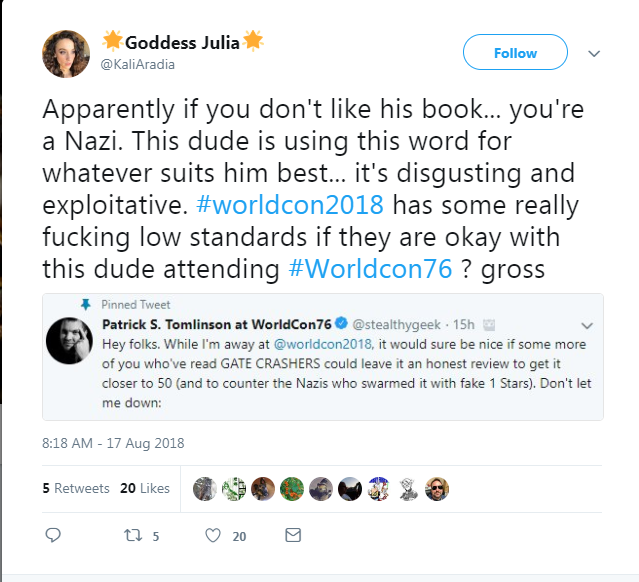
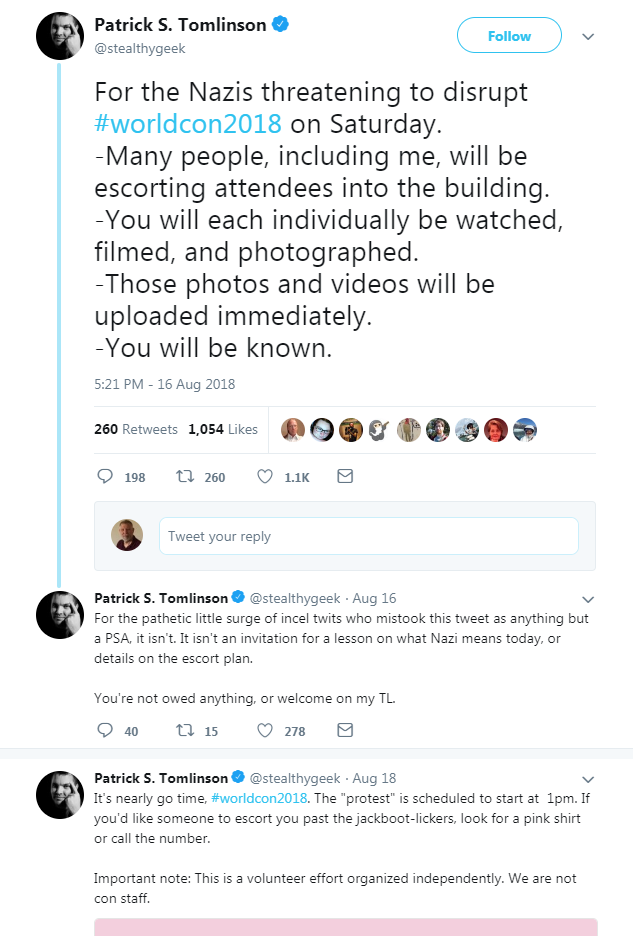
Okay, so in doing research to respond to some of the readers of my flash fiction story We Don’t Want Your Kind Here, I had to revisit my essay Who is a Nazi and Why Should I Care?. This led me to search the #WorldCon76 and #WorldCon2018 twitter hashtags for any mention of Nazis, which led me to this twitter conversation by Patrick S. Tomlinson (here’s one of his books on Amazon), and the screenshots below:

nazi1

twitter screenshot

nazi2

twitter screenshot

nazi3

twitter screenshot

Yeah, what a great guy, huh (However, if the allegation that the protesters deliberately were blocking access to a bloodmobile was true, I’d have a problem with it, too)?

Continue reading

We Don’t Want Your Kind Here

no entry

© yarnspinnerr

The sign said “No Entry” in two languages, but Allen saw the young couple approach the main doors from the side and go in any way. He knew the sign was directed at him, not him personally, but you had to be a member in good standing of the Party to even be considered.

The event was held in a different city each year, and today it was in Mumbai, but the administrators lived in the U.S., and their influence was everywhere.

Officially, segregation didn’t exist, but when “his kind,” as they often referred to non-Party members, tried to petition for even ancillary status, they were rebuffed. Since they’d taken control of the political structure, entertainment, all news venues, they hadn’t felt it necessary to use him as a punching bag anymore, but they still called him a “Nazi” from time to time.

His kind wasn’t allowed at any of the popular venues including WorldCon. They didn’t think it was possible for a cisgender, white male from Montana to be a science fiction fan.

I wrote this for the 179th FFfAW Challenge hosted by Priceless Joy. The idea is to use the image above as the prompt for crafting a piece of flash fiction between 100 and 175 words long. My word count is 175.

I’ve been chronicling the whole WorldCon 76 meltdown and recovery, as well as the latest shots fired at conservatives who, for some reason, are not only thought of as “Nazis,” but not considered worthy of being science fiction fans. So I thought I’d write yet another tale of the dystopia where prejudice is alive and well and running the world.

Yes, I know. I rant about this a lot, but now that this year’s WorldCon is officially over, I’ll find something else to focus my attention on.

To read other stories based on the prompt, visit InLinkz.com.

This is the World of Science Fiction and WorldCon?

Well, the progressives running the SF/F industry, including WorldCon, like to think of themselves as the “good guys” and on the “right side of history,” but there doesn’t seem to be any shortage of hate of anyone who might even be slightly conservative. I guess not being inclusive is okay as long as the groups you are bigoted against are on the “Nazis” list (though maybe they should actually look up the definition of Nazi before slinging around their own brand of hate.)

worldcon progressive hate

Screenshots from twitter

Trust me, if these people are typical of WorldCon and the science fiction conventions in general, I want nothing to do with them. At the end of the day, all I want to do is write a good story. At the end of the day, all they want to do is hurt people.

Here’s a fictional story based on this blog post and Part 2 of my rant, which I didn’t believe I’d be writing while authoring Part 1.

The New Dragon Saga: Wargames

pork chop hill

Painting of the 45th Infantry Division at Pork Chop Hill in 1952 – Found at Wikipedia

Chapter 2: War, except the Master didn’t call it war, he called it “the Games.” Games, but these games were deadly.

It had been weeks, no…months ago when seventeen-year-old Landon had stood in the main Arena at training camp with the other recruits, all kidnapped as he was, from all over the Earth, and from all over time. They had one purpose: to represent this realm in the Games, to fight, battle after battle, war after war, and if they won, the realm gained territory. If they lost, so did the realm, and that meant they died.

They still wore their collars, for cowardliness or defection to the other side would not be tolerated. At the first sign a soldier’s betrayal, there would be a warning pain. At the second, the collar’s charge would be fatal.

For Landon, and some of the others, the collar had a secondary effect: it cancelled the ability to perform any form of sorcery, a skill for which the teen had trained since he was a child.

Today’s game was “Flanders Field,” reminiscent of the trenches and killing grounds of Earth’s First World War, except the other side had styled their troops not only from the early 20th century, but from the first century Roman Empire, the eighteen century American Revolutionary War, and one platoon carried plasma rifles from the twenty-second century Cyborg Wars.

Continue reading

Future Tension

marigolds

Photo by Surachai Piragsa – Bangkok Post – 2017

Adam had to look up the word Hemmablind to find out what his wife meant. Yeah, it described him pretty well. He just didn’t notice all of the little imperfections in and around the house. The tear in the back screen door, the weeds growing in the flowerbed, they were all the same to him, and her constant pestering about them was a pain in his pinfeathers.

Yet, as oblivious as he was to all the chores she set before him each morning, he was able to carry himself in a decorous fashion, even when she said the leaf-filled rain gutters and the clogged bathroom sink were the final straw.

Oh, he had attempted to summon up a token effort or two, but it wasn’t enough to draw her attention away from his overall pattern of inactivity. He used his bad back as a crutch, but that didn’t hold up as an excuse, and certainly did not hold their marriage together.

Continue reading

It’s Not a Scarecrow

scarecrow

© Anurag Bakhshi

“You know, I don’t think the flower bed is in danger from crows, Lindsey.” Kurt stood with his six-year-old daughter admiring their handiwork.

“I know that, Daddy. I just thought the flowers could use some company when we’re not around.” She stood, hands on hips, pride written all over her face.

“Well, you sure made good use of those old clothes we were going to donate to the thrift store.”

When she didn’t answer, he looked down and saw tears in her eyes. Kneeling, he put his arms around her and Lindsey held onto him tightly. “I know you miss her.”

“Why did Grandma have to die?”

“That’s why you wanted to make this, didn’t you? So we wouldn’t give away her clothes.”

“I miss her.”

“It’s okay. I miss her, too. We’ll keep anything of hers you want. I promise.”

I wrote this for the August 19th edition of Sunday Photo Fiction. The idea is to use the image above as a prompt for crafting a piece of flash fiction no more than 200 words long. My word count is 141. I know. I usually push the word count to the limit, but I didn’t need so many this time around.

To read other stories based on the prompt, visit InLinkz.com.