Review of Denton Salle’s Novel “Black Earth Rises, Hall of Heroes Book Three”

black earth

Cover art for Denton Salle’s novel “Black Earth Rises”

Black Earth Rises is the third book in a series by Denton Salle, but it stands very well on its own since I haven’t read the first two novels.

Denton asked me to review his book and was aware of recent difficulties I’ve had reviewing books by people I know. He assured me that he’d understand me being forthright and fair about my review, and I have been.

For being a supernatural urban legend thriller, the story is pretty standard, up to a point. Two college buddies from very different backgrounds, the women in their lives, coming up against frat jerks, all seems normal.

Then the frat jerks turn out to be werewolves and there is a sinister school being operated by an evil sorceress in the bowels of a Texas university near Dallas. But this school also has an old graveyard haunted with the unexpected, both evil and good.

A good Catholic boy named Jim gets pulled by his frat friend Mike into an Orthodox religious group (most of which are Mike’s family) of an ancient order sworn to protect our existence from occult dangers. They live an uneasy peace with the “Otherworld” by a compact signed untold centuries ago…but not all of the Otherworld creatures are obedient, or perhaps they just didn’t sign on the dotted line.

Continue reading

Book Review: “Prador Moon” by Neal Asher

Prador Moon cover art

I’ve previously read and reviewed Neal Asher’s “Polity series” novels Dark Intelligence (2015) and War Factory (2016), both part of the “Transformation” trilogy.

Frankly, Asher has written so many novels, just within this one series, that I was stumbling blind when I read those two, and although I enjoyed them, I couldn’t figure out how everything fit together.

I needed some sort of context to make sense of the universe I was experiencing. Although it’s not the first “Polity” book Asher (metaphorically) penned, Prador Moon records the first encounter between humans and AIs in the Polity and the Prador.

It’s not a complex novel, but it does introduce some of the key elements presented in all of these stories, including “Augs,” “AIs,” “Golems,” “runcibles” (basically stargates), and of course, the utterly ruthless, crab-like Prador.

Continue reading

Some Book Reviews Will Not Go Unpunished

What a pain in the pinfeathers. I recently reviewed a book, mistakenly believing the author, who I know on Facebook, wanted me to. Okay, I’ll own up to the misunderstanding, but when the book review (which I gave 4 our of 5 stars on Amazon and now have deleted along with my review on this blog) was published, he gave me a ration of heck about how I had gotten things all wrong and that my review was a “sales killer.”

I decided to let it go and just not respond hoping it would all blow over. It didn’t.

He went on and on and on all over Facebook and to some degree MeWe about this, that, and the other thing. He tried to contact me on Facebook Messenger, but at that point, I didn’t feel like responding. Then he got on a post and complained that I was ignoring him.

Continue reading

Book Review of Galactic Patrol

Image captured from Amazon

In some ways, E.E. “Doc” Smith’s third Lensman novel Galactic Patrol feels like the first “real” Lensman novel. I suppose that’s largely due to the character Kimball Kinnison having a central role in the book. He is the Lensman hero I think all of my friends looked up to when these books were popular when I was in Junior High in the late ’60s. Of course I also think these novels were better consumed over 50 years in the past by boys between the ages of 12 and 14 than they are by a fellow in his late 60s today.

It also hung together a bit better than the previous two (“Triplanetary” and “First Lensman”). That said, most of the book felt incredibly episodic. It was like a television show where the season hadn’t been plotted out cohesively from start to finish. A great deal of the action bounced all over the place, introducing seemingly random characters, planets, and events throughout the first two-thirds of the story.

Eventually, Smith was able to tie (most) things together showing relationships in the last third, but even that seemed rushed.

Continue reading

Review of The World of Science Fiction 1926-1976: “But What Good Is It?”

Cover image of Lester Del Rey’s “The World of Science Fiction 1926-1976

Finally finished The World of Science Fiction 1926-1976 by Lester Del Rey and I must say it is both very informative, and for long stretches, pretty boring.

This is one of two (probably) reviews, and today’s write up is the most “controversial” of the two.

The book was published in 1980 so 40 years of science fiction have passed since Del Rey opined “But What Good Is It?” in the 34th chapter. To Del Rey, the purpose of science fiction was to entertain, but then he remarked on page 348:

What disturbs me more is the whole concept of purpose as applied to any literature. To the Marxists, intent upon subordinating everything to the good of the state, the arts must serve a direct purpose of life — usually propaganda, I’m afraid. But why people in this country accept such Marxist ideas is a puzzle.

Del Rey died on May 10, 1993, about 13 years after penning this tome, and I’m glad he didn’t see what’s happening to field of science fiction today.

Continue reading

Lyla El Fayomi’s “Terminum” Revisited

terminum

Cover art for the novel “Terminum” by Lyla El-Fayomi

You may have read my review of Lyla El-Fayomi‘s novel Terminum about ten days or so ago. As I mentioned in the original review, I wrote it for Reedsy Discovery at their invitation. Today, my review went live. I was surprised at the response.

Ms. El-Fayomi made her name unavailable on the review and presumably in Discovery. She wrote this comment by way of an explanation:

IMPORTANT MESSAGE: Despite the large area it occupies, the lengthy review of Terminum featured on the Reedsy book page WAS NOT written by a professional in the field. It is simply one man’s opinion. Please treat it as such. You may find your reading experience to be entirely different from his.

In spite of her obvious intelligence and education, I don’t think she understands what a book review is.

Continue reading

Book Review of “Terminum”

terminum

Cover art for the novel “Terminum” by Lyla El-Fayomi

Disclosure: This is my first review of an indie SciFi book for Reedsy Discovery. In exchange for a free digital copy of a book, they ask that the writer craft a review of between 300 to 400 words in length and have it published on their site prior to a specific date. Basically, it’s free promotion for the book, Reedsy, and the reviewer.

I chose Lyla El-Fayomi’s Terminum to review because the premise was compelling. An experimental virus stops people from aging but at random points in their lives. However, the darker side is that some of those infected will be abruptly killed by an unknown side effect called Sudden Death Syndrome.

In investigating a cure, scientists Yasmine Holloway and Leo Genix suddenly become fugitives, being hunted down both by law enforcement and bounty hunters. They are thrust into the shadowy realm of a group of covert operatives who have, perhaps for decades, been aware of a conspiracy to hide the truth about the virus and to prevent them from ever delivering a cure.

Continue reading

Review of “Mission: Outbreak by Michael Gilwood

mo

Cover art for Michael Gilwood’s novel “Mission: Outbreak”

Starting Mission: Outbreak by Michael Gilwood, when I read that 200 year old human remains are found on one of Neptune’s moons, I was somewhat reminded of James P. Hogan’s novel “Inherit the Stars,” which I’d consumed some decades ago and remembered enjoying.

But afterward, there was a significant section of exposition which, I suppose, was necessary to cover a long stretch of history in a shorter span of pages.

After that, I found Gilwood’s novel was a sort of mix between the original Star Trek television series, and something written by E.E. “Doc” Smith.

That’s not necessarily bad as far as it goes, but not only did it seem familiar, but too often repeated as a science fiction trope.

Captain Philip Wakefield and our heroes on the starship Excelsior visit an alien planet in search of clues of perhaps humanity’s origins, as well as evidence that the Earth has been visited before by extraterrestrials.

Continue reading

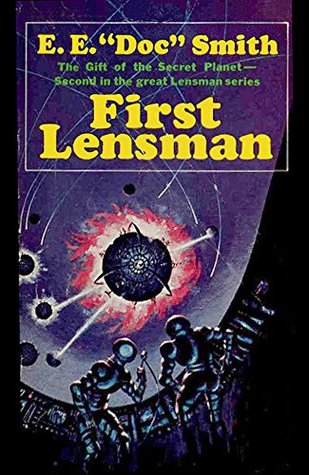
Book Review of “First Lensman”

first

Cover art for the 1968 edition of “First Lensman”

I’ve been reading the legendary E.E. “Doc” Smith‘s Lensman series recently. After Triplanetary (1948 – originally published as a serial in 1934), which really wasn’t about the Lensmen, but did introduce a few key characters, came First Lensman (1950) which still gave off more of a 1930s flavor.

While readers get their first real glimpse into the lives and power of the Lensmen, the tale reveals itself as terribly dated. The “good guys” are very “North American” centric, women don’t have minds compatible with interacting with the lens, and our guys are scrupulously honest and forthright.

As with “Triplanetary,” I sometimes found it difficult to keep track of scene changes and figure out where I was in the story from one point to the next.

Along with the purely space opera aspects, there were heavy political overtones, no doubt reflecting Smith’s actual viewpoints.

Continue reading

My Amazon Review of John Scalzi’s “The Collapsing Empire” Refused

amazon

Screen capture of an email from Amazon.

I know, right?

To be fair, Amazon has the right to accept or refuse reviews posted on their site because, after all, it is their site. If I did unintentionally violate their standards, I guess that’s that.

On the other hand, if you don’t like a book that’s supposed to be popular (and I did like the book for the most part), or say anything critical of it when you shouldn’t, does Amazon tip the scales in favor of “popular” works or “popular” authors?

Continue reading