Book Review of “Children of the Lens” by E.E. “Doc” Smith

children

Cover art for “Children of the Lens” by E.E. “Doc” Smith

If you like my work, buy me a virtual cup of coffee at Ko-Fi.

Yesterday, I finished Children of the Lens (1954), the last in E.E. “Doc” Smith’s Lensmen series.

By rights, it’s a book I should have started and finished over fifty years ago. The works of Smith as well as Edgar Rice Burroughs and others were hugely popular in paperback in the late 1960s. All of my male friends in Junior High were devouring them.

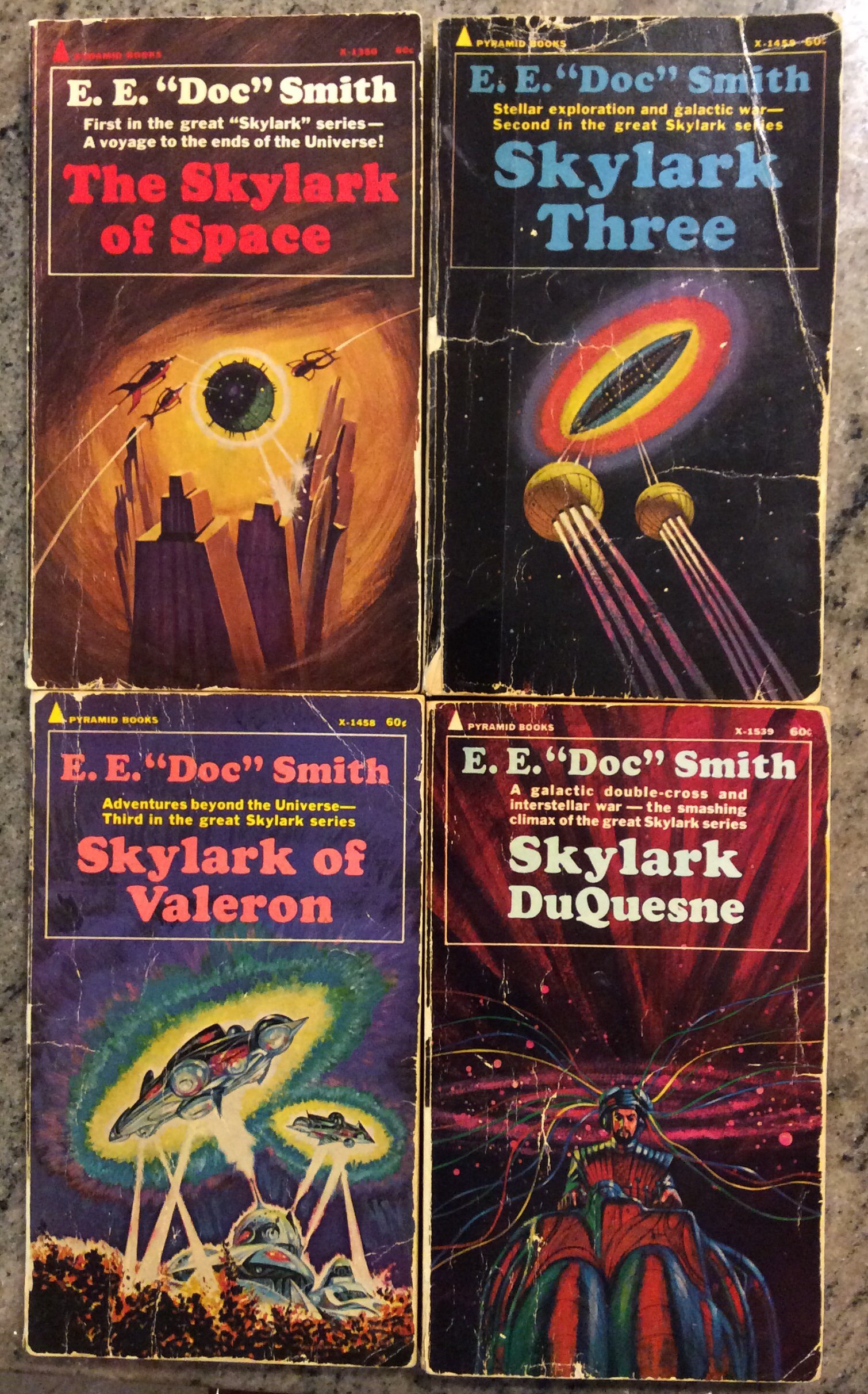
But when everyone else was reading the Lensmen, I was reading The Skylark series, so I missed my opportunity the first time around.

Today, if I have anything to complain about the Lensmen series (or Skylark for that matter), it’s that they’ve aged. With each passing novel, the powers, technology, and scope of the books became larger and grander. I can’t read these stories without also imagining them taking place between the 1930s and 1950s.

Even back in the day, “Children” was criticized for two-dimensional characters and juvenile storyline, but at the same time, it was highly popular with young (and not so young) men and boys as a source of adventures and heroics.

Continue reading

Review of 1993’s Quantum Leap Series Finale “Mirror Image” and What It Means for the Current Series

mirror

Image from the Quantum Leap episode “Mirror Image.”

If you like my work, buy me a virtual cup of coffee at Ko-Fi.

I’ve been watching the Quantum Leap revival and reviewed episodes 1 and 2. I’m particularly interested in the mystery around why Dr. Ben Song (Raymond Lee) chose to make an unauthorized leap after receiving a text message from Janice (or Janis) Calavicci (Georgina Reilly), daughter of Al Calavicci (played by the late Dean Stockwell).

However, even before seeing episode 2 “Atlantis,” I formed the same theory that every other fan has; Ben leaped in order to find Sam Beckett (Scott Bakula), the creator of Project Quantum Leap who has been missing for thirty years, and to bring him home.

But there are so many missing pieces. While I watched a lot of the original series, I haven’t seen every single episode. Key among them is the controversial series finale Mirror Image – August 8, 1953. More or less for giggles, I decided to watch it last night and it does not disappoint. Further, the story and the history behind it yield vital clues as to what Ben and Janice are up to and why.

Continue reading

“Doc Savage, Man of Bronze:” The Origin of the Superhero Group

doc

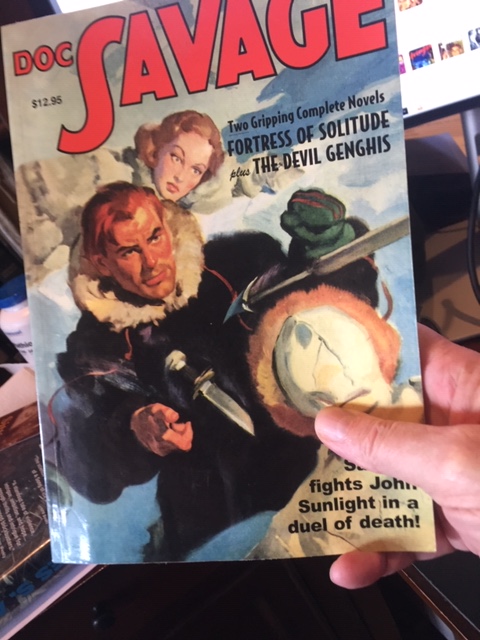
Cover art for Doc Savage magazine

If you like my work, buy me a virtual cup of coffee at Ko-Fi

Doc Savage and his oddly assorted team might be considered the progenitors of today’s “Fantastic Four” and many other teams of superheroes — even Sgt. Fury and his Howling Commandos.” -Stan Lee, creator of Marvel Comics’ “Spider-Man” and “The X-Men”

There are probably two reasons to read pulp fiction that’s 70, 80, 90, and even 100 years old. The first is that you’re a true fan of the genre. The second is, if not for these ancient heroes, we wouldn’t have the modern ones that, at least up until recently, were box office blockbusters at the movies.

In the mid-1960s as I was about to enter Junior High, I didn’t realize these stories existed and more, I didn’t know that various publishers had finally convinced the owners of these older properties to allow them to appear as paperbacks. It was the perfect time for me. I was the age and sex of the target audience, and the average price for a paperback was around 40 to 60 cents a copy. Heck, back then, even a comic book cost 12 cents.

So Edgar Rice Burroughs’ entire Tarzan and John Carter of Mars book series abruptly appeared in mall bookstores all across the country. So did E.E. “Doc” Smith’s Lensman and Skylark series along with what Robert E. Howard and every other author under the sun wrote about Conan the Barbarian.

Continue reading

Review of The World of Science Fiction 1926-1976: A Personal Past and Uncertain Future

skylark

Image captured on Amazon

This my second and last review of the late Lester Del Rey’s 1980 book The World of Science Fiction, 1926-1976: The History of a Subculture. The first review was more political and cultural. This one is more personal.

First of all, the copy I currently possess is a first edition. Like I said, the first printing of this tome was in 1980, and according to the old fashioned stamps in this library book, it was first acquired by my local library system on January 24, 1980. It’s like holding a piece of history in my hands.

The first 22 chapters are interesting, but also made up of long lists of ancient science fiction stories, their authors, which magazines they appeared in, the editors, and occasionally what was going on in the world around them. A tad dull overall.

Continue reading

Review of The World of Science Fiction 1926-1976: “But What Good Is It?”

Cover image of Lester Del Rey’s “The World of Science Fiction 1926-1976

Finally finished The World of Science Fiction 1926-1976 by Lester Del Rey and I must say it is both very informative, and for long stretches, pretty boring.

This is one of two (probably) reviews, and today’s write up is the most “controversial” of the two.

The book was published in 1980 so 40 years of science fiction have passed since Del Rey opined “But What Good Is It?” in the 34th chapter. To Del Rey, the purpose of science fiction was to entertain, but then he remarked on page 348:

What disturbs me more is the whole concept of purpose as applied to any literature. To the Marxists, intent upon subordinating everything to the good of the state, the arts must serve a direct purpose of life — usually propaganda, I’m afraid. But why people in this country accept such Marxist ideas is a puzzle.

Del Rey died on May 10, 1993, about 13 years after penning this tome, and I’m glad he didn’t see what’s happening to field of science fiction today.

Continue reading

Conquistador

Ships on the Paraguay River at Asunción, Paraguay © Ilkov Filimonov/Dreamstime.com

Juan’s flight from his native Briviesca to Asunción in Paraguay was grueling, especially after two layovers. He was grateful to find a cab to take him the sixteen miles into the city.

“Senor wants to be taken to the river? No particular place?” What passed for Spanish in this country seemed almost barbaric to Juan.

“Yes, it doesn’t matter.”

The cab driver thought it odd that the Spaniard had no luggage, but Juan wasn’t planning a lengthy stay, or not one the cabbie would understand. As his mind and existence was cast backward, the cab, the buildings, the city itself became increasingly alien.

Continue reading

The Beggarman Goes Hunting

Bass Reeves

Bass Reeves. (Credit: Public Domain)

Indian Territory – Oklahoma – 1880

The fact that he was a former slave was obvious because he was a black man of a certain age, but his clothes and his manner also marked him for a beggar and a thief on the run from the law, or at least that’s what it seemed.

Most folks thought they were safe from the law in Indian Territory. The region that would one day be known as Oklahoma was ruled by five tribes, the Cherokee, Seminole, Creek, Choctaw and Chickasaw, all forced from their ancestral homelands because of the Indian Removal Act of 1830. The tribes governed through their own courts but only had authority over themselves. That meant anyone not of the tribes, from a scalawag to a murderer, could only be pursued by Federal officers and not local law enforcement once they crossed into Indian Territory.

The beggarman had walked twenty some miles that day and he had another ten to go. He ate some of the hardtack and jerky he carried in a ratty looking burlap sack while he watched the small fire burn in front of him. He’d brought a blanket to guard against the cold as he slept on the grasslands of the high plains, but that was all the belongings a man could see. None of that bothered him including being approached silently from behind.

Continue reading

The Colonials

pictograph

© @any1mark66

“Wallace, I’ve seen your evidence and the supporting papers, but they don’t explain one critical piece of information.”

“Like if the Chinese had visited America frequently and in numbers from 1,300 BC until 500 AD, why didn’t they colonize, right Hendricks?”

This was a frequent argument between the British and Native American archeologists, however Hendricks had a point. Pictographic evidence of extended Chinese visits to North America included numerous artifacts in Nevada, Arizona, and New Mexico. So why did they stop?

“I’ve already introduced Dr. Christina Esquivel, Hendricks.”

“Charmed,” though the older man’s tone indicated he wasn’t. “What’s a geneticist have to do with archeology, Wallace?”

Christina looked forward to deflating this air bag. “I’ve just finished a five-year comparative genetic analysis between various Native American peoples and those from the Hubei, Hunan, and Yunnan regions of China. DNA markers are too similar to be the result of chance.

Meaning?” Hendricks’s voice was laced with anticipation and dread.

“Meaning,” Wallace continued, “that the Chinese did colonize America. Indigenous people like Christina and I are their descendants.”

I wrote this for the FFfAW Challenge of the Week of November 14, 2017. The idea is to use the image above to inspire writing a piece of flash fiction between 100 and 175 words long. My word count is 175.

The pictograph reminded me of articles I’ve read suggesting that the Chinese rather than Columbus or any other European or people from across the Atlantic, “discovered” America, perhaps sometime between 1,300 BC and 1,421 AD depending on which source you consider. Granted the information is highly speculative, but it makes a good basis for a story. The suggestion that there could be a genetic similarity between the Chinese people and Native Americans was also briefly mentioned in my source. To read more, go to DailyMail.com.

To read other stories based on the prompt, visit InLinkz.com.

Where Did Our Home Go?

factory

© J Hardy Carroll

How’d we get here? One minute we were fighting an Imp horde and the next we landed here. The demons were experimenting with a portal stone. That’s it.

We’re on Earth but it’s not home. I’ve gotten a day job so I can buy food. I push myself through the gap in the gates with the groceries.

Newspapers say the year’s 1988. Raul’s family died in a famine in the 11th century. Yana was abandoned during an earthquake the next century. Prisha’s family were killed in Calcutta’s 1737 cyclone.

I’ve got to get them back to the only home they’ve ever known…dragonworld.

I wrote this for the Rochelle Wisoff-Fields writing challenge. The idea is to use the image of the old warehouse above as the inspiration to craft a piece of flash fiction no more than 100 words long. My word count is exactly 100.

I don’t think I’ve done my concept justice. It’s part of a larger idea I’ve been toying with, one I briefly touched on a few days ago.

Imagine the abandoned and unwanted children of the world throughout history being whisked to a different place and time, one where they are taken care of by dragons. Then imagine in a war an accident sends them back to Earth, but way too far in the future. What would happen then?

To read other stories based on the prompt, go to InLinkz.com.

Turn and Face the Change

alternate universes

Two days before he took his first trip through the time gate, Major John Kelgarries had a hush-hush meeting at Operation Retrograde with Antoine R. Barnes, Head of the Temporal Mechanics division, the last word in temporal field operations and perhaps the one person in the operation who actually understood the Forerunner time map.

It was late. Just about everyone was asleep at the arctic base except those personnel on night duty. They were in a small conference room. Barnes had cut the surveillance feeds. This was strictly off the record.

“That’s the long and the short of it, Major. Assuming your mission to bring back the survivors is successful, I can only predict to a 48% accuracy how our history and our present will be changed.”

Continue reading