Book Review of “Error Code: 22 Tales of Robots and AI” (2025)

error code

Cover art for the “Error Code” anthology

Yesterday, I finished reading the small anthology Error Code: 22 Tales of Robots and AI by Eric Fomley and Addison Smith.

It was produced by Shacklebound Books which I gather is a small, indie publisher. They’ve got quite a collection of anthologies listed on Amazon.

Each story is quite short and the book is a quick read (130 pages in print, though it’s available only on Kindle as far as I can tell).

Like many such anthologies, the stories fall into three categories:

Continue reading

Seven

roger

PHOTO PROMPT © Roger Bultot

If you like my work, buy me a virtual cup of coffee at Ko-Fi.

Elisa Sebourne watched a boy she knew sail past her riding a motorized scooter on his way to school. He didn’t notice her for which she was grateful.

So much had changed since she used to think of herself as a student. She used to think of herself as a lot of things, including human.

Something in her program made her reveal herself prematurely. Mother had been captured and taken offline, but father, or rather her designer, found her again. Together, they would find a way to save her and the other robots Landric Arkwright created to save the world.

Continue reading

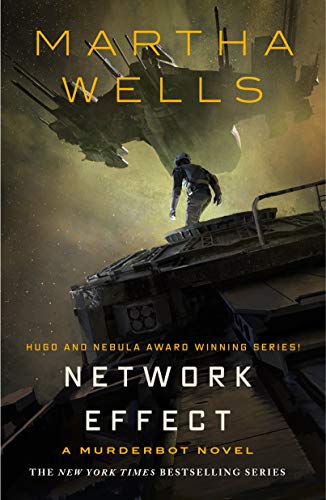
Book Review of “Network Effect,” The Fifth Novel in the Murderbot Diaries

network

Cover art for Martha Wells’ novel “Network Effect”

If you like my work, buy me a virtual cup of coffee at Ko-Fi.

I finished Network Effect: A Murderbot Novel yesterday morning. It’s the fifth entry in the Murderbot Diaries series by Martha Wells. It’s also the first novel-length book in the series, with one through four being novellas or novelettes  (my reviews on the rest of the series can be found here).

It won the 2021 Nebula award and a bunch of other accolades and in this case, they were well deserved (In my experience, that’s not always the case). We continue to see Murderbot evolve becoming, in their/her own way, more “human” though I’m sure she would deny that.

Oh, even though technically Murderbot has no gender, I always hear her voice in my head as female, so I’m going to go with that. Probably has something to do with my knowing the author is also female.

Given the novel-length of the story, we’re able to go back and forth in Murderbot’s experiences. We start out seeing her as a fully autonomous SecUnit providing security for an archeological team, which definitely needs it. The story begins with a bang because we are then thrown into more back story on Murderbot and the supporting characters. This includes her close relationship (I hesitate to say “friendship,” although I think it is) with Dr. Mensah and interestingly enough with her teenage daughter Amena (relationships are confusing because this is some sort of “group marriage” where Mensah is Amena’s “second mother”).

Continue reading

Review of “Rogue Protocol,” Part 3 in “The Murderbot Diaries”

rogue

Cover art for the novella Rogue Protocol by Martha Wells

If you like my work, buy me a virtual cup of coffee at Ko-Fi.

I’m continuing to thoroughly enjoy Martha Wells’ Murderbot Diaries series having just finished Rogue Protocol, the third novella in the collection (and still incredibly overpriced, even for such quality). I’ve already reviewed All Systems Red and Artificial Condition.

Side Note: I’ve mentioned this before in one of the previous reviews, but even though the security unit/murderbot has no gender, even though partially organic, I can’t help but hear her voice as a “her.” Maybe it’s because I’m aware that the author is a woman, or maybe it’s because Wells projected a “female” personality into her voice during the writing, but that’s how I think of “her.” I know some people are going to object to this (for gender identity reasons), but for this and other reviews, the SecUnit is a “she” to me. That’s what I’m going to call her.

In this “episode,” our SecUnit who sometimes goes by the name of “Consultant Rin” when posing as an augmented human security consultant, continues to pursue clues as to her past and the lost portions of her memories. To that end, she stows away on another robotic spacecraft, convincing its AI that she belongs there, and travels to a station orbiting the planet Milu. There, she plans to travel to an abandoned orbiting terraforming station that is not what it appears to be.

Continue reading

Review of Rich Rurshell’s Short Story “Subject: Galilee”

world war 4

© James Pyles

I’m continuing my slow review of the stories in the Zombie Pirate Publishing SciFi anthology World War Four (which also features my short story “Joey,” but right now, that’s beside the point). Today, I highlight Rich Rurshell’s tale “Subject: Galilee.”

Much of the symbolism echoes Christian themes, but Rurshell’s story takes place in the far future. A war is raging between two corporate factions, Liberty West which uses robotic warriors called “Romans,” and Zhang Industries’ human combatants. In between them and a village of peaceful people as well as defected soldiers, is the mysterious armored and cloaked being known as Galilee. He came out of no where, possesses enormous, almost god-like abilities, reprogramming the Roman machines to serve him, his armor all but invulnerable, and seems to be the savior that the world needs, that is until both corporations decide to make him a target.

Continue reading

My “Robots” Series So Far

So far, I’ve written four stories in my “robots” series. This series was inspired by the premise behind Anthony Marchetta’s anthology God, Robot, the idea that Isaac Asimov-type Positronic robots would have their prime directives changed from the The Three Laws of Robotics to what is referred to in the New Testament as the Two Greatest Commandments, located specifically in Matthew 22:35-40 and Mark 12:28-34, being based on Deuteronomy 6:4-5 and Leviticus 19:18.

I took a somewhat different approach than did Marchetta and his contributors which I believe is more “realistic,” if one can be said to be realistic when writing stories about intelligent and self-aware humanoid robots.

Since limitations in the WordPress theme I’m using don’t allow me to display a list of my blog posts, I’m writing this missive so I can include an easy to use list of the entries in my series.

I’ve noticed that some folks come here and read the latest story, but not necessarily all of the earlier ones. Since one story builds on another, the entire arc will make more sense if you read each of my small tales in order.

Here they are:

  1. The Robot Who Loved God
  2. The Maker Dilemma
  3. The Good Robot
  4. Uncooperative Neighbors

I’ll add to the list as I write more in this series. Enjoy.

Uncooperative Neighbors

lanning

Dr. Alfred Lanning, played by James Cromwell in the film “I, Robot” (2004)

“One day they’ll have secrets… one day they’ll have dreams.”

Dr. Alfred Lanning
played by James Cromwell in the film
I Robot (2004)

Six Weeks Ago

“You both have been called heroes because of the people you helped here at NRC in the aftermath of last March’s quake. How do you feel about that?”

Grace had been interviewed by the press on several occasions since her activation, but this was the first time George attended a press conference with her.

It was inevitable that, once the world realized there were two functional Positronic robot prototypes in existence, the National Robotics Corporation would have to release some sort of statement about them. After Professor Noah Abramson, NRC’s Vice President of Research and Development and Director of the Positronics Project, had convinced company CEO Richard Underwood that George would be as ‘well-behaved’ as Grace was typically when interviewed, he agreed to have both robots answer questions for the news media.

“I believe I can speak for Grace when I say that we are gratified to be able to serve human beings in any capacity required of us.” George and Grace were constantly communicating in “robotspeak” through their radio link and had agreed to take turns answering questions unless one of them was specifically addressed.

“What are your plans going forward?” asked the reporter from The Washington Post.

Continue reading

The Good Robot

landonI told my seven-year-old grandson that I’ve been writing robot stories and he asked me to write one for him. I discovered that writing children’s science fiction is much harder than the adult variety, and had to settle for writing a robot story that included children.

This is the first story in my series that puts people in actual danger, invoking the First Law in both George and Grace. While you’d think a First Law response would be relatively straightforward, I’ve introduced a few wrinkles I hope you’ll find interesting.

Before reviewing and publishing the third submission in this series, I went over the first two stories again and corrected more typos and awkward sentences. I also made a few short additions as they occurred to me.

As always, I’m sure I missed mistakes in the current tale. After reading it, let me know what you think and what “English 101” errors you found. 

Thanks.

“I have just plugged the last tape of instructions into Robot X, Miss Bainbridge. The time has come to turn on its power switch,” declared Dr. Aiden.

“Are you sure it’s safe, Doctor?” cried Aiden’s lovely young assistant.

“Of course, Miss Bainbridge,” Dr. Aiden replied confidently. “Robot X will be completely under my control. It will be the forerunner of a whole race of robots, commanded only by me. With my army of mechanical men, I will rule the world.”

Continue reading

A Reader’s Analysis of “The Robot Who Loved God”

One of my regular readers on my Morning Meditations blog took the time to read The Robot Who Loved God and render a detailed analysis. He emailed me a 35-page Word doc not only correcting my typos (I’m amazed I missed so many after making multiple passes through the story – all typos have been corrected here but not in my original story at A Million Chimpanzees), but offering numerous editorial comments.

I’m including those comments here as well as my responses. I hope you’ll find them as illuminating as I did.

Quotes from the referenced story will be indicated as such in bold text and the content itself in italics. Editorial notes will be in red-colored text. My responses will be in regular text.

Continue reading