Dabbling in Science Fiction Fandom

sf convention

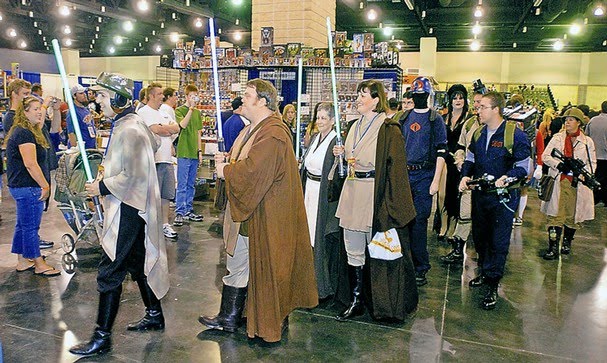
Photo credit – Knoxville News – Science Fiction convention – place and date unknown

In recent comments on the File 770 SF/F news blog criticizing veteran SF writer Robert Silverberg over comments he made about author NK Jemisin’s Hugo Award acceptance speech last summer, one of the things mentioned is that Silverberg hasn’t read any SF stories written in the past ten years, like that’s a bad thing.

In comments I made on twitter last summer criticizing the objectivity of the Hugo Awards, one person accused me of not being “a fan,” as if being a fan were some sort of exalted and coveted position.

But as I continued to gather information about the Hugos and how one is nominated for an award, I realized that although the pool of voters each year is relatively small (I’d estimate anywhere between a few hundred and a few thousand), probably all of them are avid SF/F readers and viewers who consume tons and tons of the latest available works. I guess that’s what my critic meant when she said I wasn’t a fan.

But wait a minute. How much SF/F do I read?

Continue reading

Cylinder

cylinder

Computer monitor wallpaper

Suspended from the airlock by his thick umbilical, Astronaut Jonathan Weaver watched the ring of illumination inside the enormous hollow tube code-named “Oumuamua” move away from him toward the other end of the spinning alien habitat, creating the illusion that he was now in early evening. The forty-two year old Air Force Captain, weightless because he was positioned near the center of the tube, marveled at the view. Essentially, the interior of a massive cylinder was filled with atmosphere that included clouds, with the entire rim covered with soil and water that supported farms, forests, lakes, rivers, small mountains, and even buildings and highways. And yet in the fifteen minutes since he had gone EVA inside the object, he had detected no sign of life.

“Weaver, this is Nguyen. Any change in your readings?” Danielle Nguyen was a civilian pilot and exobiologist who had been put in command, and at thirty, was the youngest member of the hastily assembled mission. After the Mauna Kea Observatory in Hawaii had located Oumuamua eight months ago and determined it was approaching the sun from outside the solar system, NASA, in cooperation with two private space exploration companies, had quickly adapted the Argonaut spacecraft, originally designed for a manned Mars mission, to intercept human history’s first visitor from interstellar space.

Continue reading

Oh Captain!

spacecraft

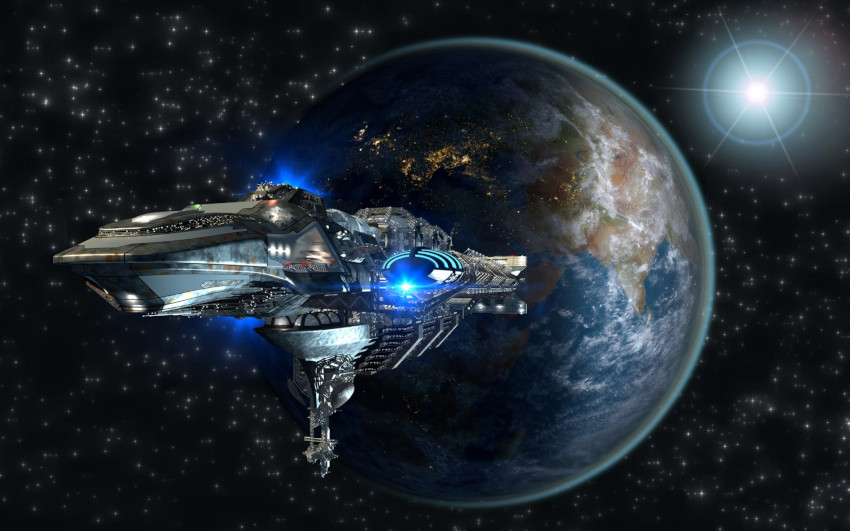
Image credit: iStock – Found at numerous sources including thepromiserevealed.com

Vanessa struggled to climb out of the Salubrious Pod, sickly yellow and greenish jelly oozing off of her smooth, dark skin. She rolled over the low rim of the tub onto the cold metallic floor of the eight-by-twelve foot featureless chamber, her nude body dimly illuminated by the few flickering light tubes in the ceiling ten feet above. She shivered as the gel evaporated, and she watched a thin mist rising overhead from her body, though some of the goo clung to her short-cropped black hair, and she blinked as one drop fell from her lashes into her left eye.

“Good morning, Captain Chapman. How are you feeling?”

They’d made Sophia’s voice feminine, but the echoes coming from multiple speakers  in the ceiling still made her sound inhuman.

“Like shit, Soph.”

“I’m sorry to hear that.” The AI’s reply was meant to communicate concern, but of course, as a machine, she felt nothing at all. “It is important you recover from hibernation quickly. There is a situation.”

Continue reading

An Ending in Fire

town

Photo credit: Anurag Bakhshi

Kurt stood on the cliff overlooking the tiny Southern California. It was 30 miles west of Santa Barbara and it was all his.

“It looks so peaceful from up here,” he said just to hear something besides the wind. Even the gulls and squirrels were gone, having deserted this doomed land if they could or otherwise having died, just like all the people.

He rubbed his left hand over his short-cropped gray and white hair. “Well, guess I’d better get to it while I still have daylight.”

He knew the National Guard had sealed off everything between Santa Maria and Ventura north and south, and Bakersfield to the east. No one would imagine anyone would want to stay in the danger zone with them, but Kurt did. His family was down there, what was left of them, and now that he’d wired the whole place to blow, he’d exterminate the last of the infected. He wasn’t planning to escape. His wife, kids, grandkids were turned into something like zombies or vampires by the mutant virus. Only he was immune. Standing in town with his back to the ocean, he pressed the remote and the next California wildfire began.

I wrote this for the Sunday Photo Fiction challenge hosted by Susan. The idea is to use the image above as the prompt for crafting a piece of flash fiction no more than 200 words long. My word count is 198.

I chose this theme for no particular reason other than it was what popped into my head. Although the limited word count didn’t allow for it, I set my tale in the small southern California town of Gaviota. I’m sure it doesn’t look like the image above, but I needed a location that was small and isolated.

To read other stories based on the prompt, visit InLinkz.com.

Survivalist

garnet mountain fire lookout

© Google 2017

Forty-five year old Faith had been hiding from the Qu’Tufot for over six months, ever since she’d escaped the work camp near Logan. There’d originally been four of them. Jodi and Kurt got shot by the Guard, what the humans collaborators with the aliens called themselves, and Ernie had a heart attack during the climb up Garnet Mountain. He showed her how the alien field generator they’d stolen worked. As long as she wore it, her energy signature was invisible to orbiting and ground sensors.

Hunting near the Fire Lookout was good. Pa had taught her to be a survivalist. The battery on the softball-sized generator would last another year, which would also keep her warm and reclaim water from the air for drinking.

It was just dumb luck that this was a storage cache for the local Resistance. Now all she had to do was wait until they returned.

I wrote this for the What Pegman Saw writing challenge. The idea is to use a Google maps image and/or location as the prompt for crafting a piece of flash fiction no more than 150 words long. My word count is 150.

Today, the Pegman takes us to Garnet Mountain Fire Lookout, Big Sky, Montana. I looked up the site at Recreation.gov and consulted a map of the general area for several hundred miles around.

The name of the aliens and the general situation is taken from a story I’ve submitted and that is still under consideration for an anthology about the fourth world war (yes, you read that right). The location and characters are different, but there are plenty of stories to tell under these circumstances.

To read other stories based on the prompt, visit InLinkz.com. Oh, I’m late today because we had our three-year-old granddaughter sleep over last night, and she’s been up since about seven this morning. I’ve got a bit of a window to write now that she’s taking her nap.

The Time Travel Game

tt

Image from the box top of The Time Tunnel board game

I’m putting this here mainly to keep track of it. I like the idea of time travel as a game, maybe like a scavenger hunt, but I’ve got too many other projects going to sufficiently develop this one now.

When I was a kid, I loved all of those Irwin Allen television shows such as Lost in Space and Voyage to the Bottom of the Sea. The Time Tunnel (1966-67) was high up on my list, even if it only made it two seasons. As an adult, I find all of Allen’s shows to be excessively cheesy, but I can tolerate some limited exposure.

I do periodically re-watch the Time Tunnel’s pilot episode Rendezvous with Yesterday, which introduces how our heroes get stuck jumping from one part of past and future history to another, and probably where a significant portion of the special effects budget was blown.

Continue reading

Book Review: Chill (Jacob’s Ladder Book 2)

chill

Cover image for Elizabeth Bear’s novel “Chill”

Today, I finished the science fiction novel Chill by Hugo and Sturgeon award-winning author Elizabeth Bear. Unfortunately, when I checked it out of my local public library, I didn’t notice that it was the second installment in the three-part Jacob’s Ladder series.

The series tells the tale of a generation ship, a proposed means of crossing interstellar space by having a space vessel carry multiple generations of people across long distances at relatively slow speeds. It’s a trope that’s very familiar with science fiction fans.

Ms. Bear did something new, but it was hard for me to figure out exactly what, since I was coming into the story in the proverbial middle of the second reel.

Apparently the generation ship, Jacob’s Ladder starts out in the first novel “Dust” trapped in orbit around a doomed star, using its resources to replenish the ship’s damage. I don’t know how that works, and like I said, I’ve never read the first book.

Continue reading

Book Review: “The Man in the High Castle

high castle

Cover image for the novel “The Man in the High Castle” by Philip K. Dick

My son Michael and I were talking about the television series The Man in the High Castle, which is based on the 1962 novel of the same name authored by the late Philip K. Dick. I’ve never seen the television show (and probably never will), but I did recall reading the novel sometime back in the 1970s.

Unfortunately, that’s all I remembered about it. Curious, I decided to check a copy of the book out of my local public library and re-read it.

The novel is set in the year it was published and postulates what the United States would have been like if the Axis powers had won World War Two thanks to the Nazis having developed the atomic bomb first.

The US is divided into three zones, with the Nazis in control of the East, the Japanese in control of the West, and a sort of DMZ existing across the Rocky Mountain States.

The “Man in the High Castle” refers to the author of a controversial novel called “The Grasshopper Lies Heavy” written by the mysterious Hawthorne Abendsen. It postulates what the world would have been like if the Allies had won the war. The book is tolerated in the West, but the Nazis have made it illegal in the East and there are rumors that there’s an ongoing attempt to assassinate the book’s writer. Thus Abendsen is said to live in a fortress (“High Castle”) in Cheyenne, Wyoming.

Continue reading

Book Review of Echo Volume 3: The Dialectic of Agony

echo 3

Cover image of Kent Wayne’s “Echo Volume 3: The Dialectic of Agony”

I’ve been following Kent Wayne’s (pen name) Echo series for a few years now. Kent is an indie author with a vision for life on and in orbit around a colony world called “Echo” set a thousand years in the future. Being a veteran, he renders military action with a keenly realistic voice, sometimes going over the top. After reviewing Echo Volume 1: Approaching Shatter over two years ago, and Echo Volume 2: The Taste of Ashes last October, I was anxious to get into the third installment, Echo Volume 3: The Dialectic of Agony.

“Agony” takes a very dramatic twist away from the first two novels. In “Shatter,” we are introduced to “Crusader” Kischan Atriya, an elite soldier who is becoming dissatisfied with his role as “Crew” but is unable to articulate why. He gets in deep with members of a despotic religious order who have ordered his death, and after a brief encounter with his mentor, the mysterious Verus, we follow him in a slow descent into what could be the end of his life, engineered by his own supposed allies during a mission into a “Scape.”

Volume 2 picks up right where the first tale leaves off, and the reader is thrust into an adrenaline-fueled power dive with wall-to-wall combat scenarios, the first half of the novel being non-stop action. Atriya manages to survive, thanks to his specialized enhancements, his own wits, and his unimpeachable sense of honor, but at a terrible cost to his body and mind. Having barely survived by the end of the story, he has few options left, all of them leading to tragedy and death.

Continue reading

The Hunted

Frankfurt Christmas Market

The Frankfurt Christmas Market – image found at frankfurt-tourismus.de – no credit listed

The Israeli had been born in Frankfurt, so the Christmas market was familiar. He used to sneak out with his Christian friends as a boy to sample the lights, the music, and the smell from the food vendors (though he was still observant enough not to partake).

Elon Rosenberg, late of the Israeli Air Force, victim of a tragic air crash after his F161 fighter had been shot down by a Syrian missile, horribly mutilated, and rebuilt from scratch by an eccentric Scottish scientist, had altered his appearance to look like a typical Frankfurter. His would-be assassins did not recognize him, but he saw the pair very clearly.

“I could just walk away,” he muttered. “But no one must know my secret.”

Hours later, a cook found the two bodies in a garbage bin. By then, the synthetic man was halfway to Wiesbaden and his next assignment.

I wrote this for the What Pegman Saw flash fiction challenge. The idea is to use a Google Maps image/location as the prompt for creating a piece of flash fiction no more than 150 words long. My word count is 147.

Today, the Pegman takes us to Frankfurt, Germany. I discovered that there’s an annual Christmas Market in Frankfurt. Also, being a child of the 1960s, I love a good cold war thriller set in Europe, so I borrowed a character introduced late in my Mikiko Jahn/Synthetic Woman saga and inserted him here.

To read other stories based on the prompt, visit InLinkz.com.