One More Commentary on the Dragon Awards

dragon

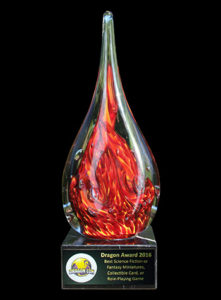
Image found at DragonCon.org

I’m new to the whole hype over awards for science fiction and fantasy, well, ever since last year when I learned about the controversy involving the Hugos and the so-called Sad Puppies and Rabid Puppies.

However, I’ve been paying attention to the Dragon Awards. Unlike most other awards of this type, anyone who has internet access can register for no cost and be able to vote for their favorite authors, books, television shows, and so forth (in other words we mere mortals). I even voted myself, but unlike others, the purpose of this blog post isn’t to share who I favored.

I discovered at least three other commentaries on the Dragons: File 770‘s Mike Glyer, Camestros Felapton‘s, an apparently associated blog which I’ve just started following, and Richard Paolinelli’s SciFiScribe.

They all had slightly different takes.

Continue reading

Film Review of “Beneath the Planet of the Apes” (1970)

Promotional image for the 1970 movie “Beneath the Planet of the Apes” featuring James Franciscus and Linda Harrison

I’m a huge fan of the 1968 movie Planet of the Apes starring Charlton Heston, Kim Hunter, and Roddy McDowell. Unfortunately, my local branch of the public library doesn’t have the film available in DVD, so I’d have to request it from a different branch. It does have three copies of the 1970 sequel Beneath the Planet of the Apes starring James Franciscus and Kim Hunter. It’s a horrible movie.

Okay, good things first. James Franciscus is heroic as hell. He’s a great looking guy, especially with his shirt off. Interesting side note. In the film’s beginning, his character Brent is seen nursing his skipper (no name given but played by Tod Andrews) outside their crashed spaceship. The skipper dies subsequently after having been blinded in the accident. The following year, Franciscus starred in a television show called Longstreet. The title character is a blind insurance investigator in New Orleans. No, I’m not kidding.

Continue reading

Tiptree Award Name May Change (Here We Go Again)

light

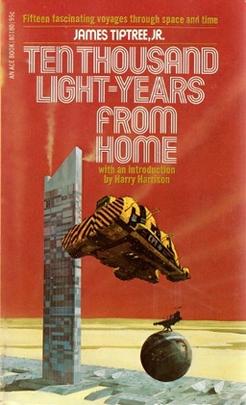
Cover image from “Ten Thousand Light-Years from Home”

I read Alice Sheldon’s (pen name James Tiptree Jr) anthology of short stories Ten Thousand Light-Years from Home decades ago when I was a kid (all right, a young man) and recall thoroughly enjoying it. I’ve probably heard of the award named after her, but didn’t pay much attention until reading Mike Glyer’s pixel scroll this morning.

In this case, the award name may be changed due to a personal tragedy in Sheldon’s life. From Wikipedia:

Sheldon continued writing under the Tiptree pen name for another decade. The last years of her life were not happy ones, as her husband was a nearly blind invalid incapable of caring for himself, and she herself was suffering health issues caused by a lifetime of smoking. In 1976, then 60-year-old Sheldon wrote to a friend expressing her desire to end her own life while she was still able-bodied and active, but she was reluctant to act upon this intention, as Huntington would have no one to care for him, and she could not bring herself to kill him.

Eleven years later, on May 19, 1987, Sheldon finally carried through her plan—by shooting her husband in his sleep, followed by herself; she had telephoned her attorney after the first shooting to announce her actions. They were found dead, hand-in-hand in bed, in their Virginia home. According to biographer Julie Phillips, the suicide note Sheldon left was written years earlier and saved until needed. In an interview with Charles Platt in 1980, Sheldon spoke of her emotional problems and of her previous suicide attempts over the preceding 20 years.

The James Tiptree Jr. Award is given in her honor each year for a work of science fiction or fantasy that expands or explores our understanding of gender. The award-winning science fiction authors Karen Joy Fowler and Pat Murphy created the award in February 1991. Novels such as Half Life by Shelley Jackson and Light by M. John Harrison have received the award.

At least one person commenting on File 770 had compassion, but who knows how many other people judge without understanding what Sheldon may have been going through (I still read 770 but choose not to comment there because of how I was recently treated by some of its other readers).

Continue reading

A Revelation on the Recent Passing of Brad Linaweaver

linaweaver

Photo of the late author Brad Linaweaver. This work is licensed under the Creative Commons Attribution 2.5 License. Attribution: Caran Wilbanks

I’ll say this upfront, I had no idea who Mr. Linaweaver was before today, and I apologize if what I’ve written here is offensive to anyone. It’s not my intent. Here’s what happened.

I was catching up with posting’s on Mike Glyer’s File 770 SF fanzine when I came across an article called Brad Linaweaver (1952-2019). First of all, I’m chagrined to say that up until this writing, I had no idea who Linaweaver was and now it’s my mission to read his works. After all, I’m barely two years younger than he is, or rather was.

As I said above, I absolutely mean no disrespect upon him or his loved ones in writing this wee essay, but something Glyer wrote not only caught my attention, it seized it in an iron grip:

I met Brad long ago through other Libertarian fans and knew about his good sense of humor – he attended the satirical Hogu Ranquets organized at Worldcons by Elst Weinstein and John Novak. –emph. mine

I’m sorry, did Glyer just call himself a libertarian? Trust me, I’m amazed.

Continue reading

The Hugo Award Will Not Be Renamed and Why Are All Conservatives (seemingly) Called Alt-Right?

gram

Author Anthony Gramuglia – found at Goodreads

I recently wrote three related blog posts: Jeannette Ng’s Campbell Award Acceptance Speech and Here We Go Again, Science Fiction, Opinions, and Why It’s Okay to Disagree, and especially The Sins of John W. Campbell Revisited. That last one started something of a minor storm in the comments section at File 770, Mike Glyer’s popular SciFi fanzine.

Although I’m still following that site, I haven’t commented there again since, what’s the use? Most people there ignored me (which is fine), one disagreed with me but was pretty civil about it, and two called me “dishonest” and “racist.” I ignored one and actually had to block the other on twitter since he looked me up just so he could continue to troll me.

File 770 does what they call Pixel Scrolls which I gather are collections of all the latest SF/F news, including noteworthy birthdays and such.

I slowed down when I saw a link to Steve Davidson’s article On Renaming Awards. I had previously mentioned that if John W. Campbell’s name was to be removed (and it has been), that perhaps all other awards named after people should be examined, just in case the person in question had a “difficult” past. I pulled Hugo Gernsback’s name out of a hat since the famed Hugo Award is named after him. Lo and behold, Davidson seems to have been thinking the same thing, but in his case, explained why Gernsback’s rather checkered past (in terms of his allegedly shady business dealings) won’t result in the Hugos being renamed.

Continue reading

The Sins of John W. Campbell Revisited

Author Jeannette Ng – image found at the Angry Robot website

Just for giggles, I revisited the comments at File 770‘s article Storm Over Campbell Award. As you may recall from my own wee missive Jeannette Ng’s Campbell Award Acceptance Speech and Here We Go Again, Ms Ng, a fantasy writer based in the UK, was recently given the John W. Campbell award for best new writer, which she accepted, and then went on to point out Campbell’s terrific flaws, which included being a fascist.

There are now over 200 comments on Mike Glyer’s commentary on Ng and Campbell, and of course, they all damn Campbell, some even comparing him (more or less) to Mussolini. Further, one person said that anyone with even the tiniest hint of actually liking anything Campbell ever did is considered a fascist sympathizer. Really. I had heard of Campbell, but before this, I never had any idea about his political beliefs.

However, even according to Wikipedia, while he may or may not have been a fascist, he certainly was a racist.

His opinions go far beyond the occasional “joke in bad taste,” and many well known authors, including Michael Moorcock and Isaac Asimov, lambasted Campbell for his even then unpopular and heinous ideas.

Continue reading

Review: “Shadows in Zamboula” by Robert E. Howard


wt

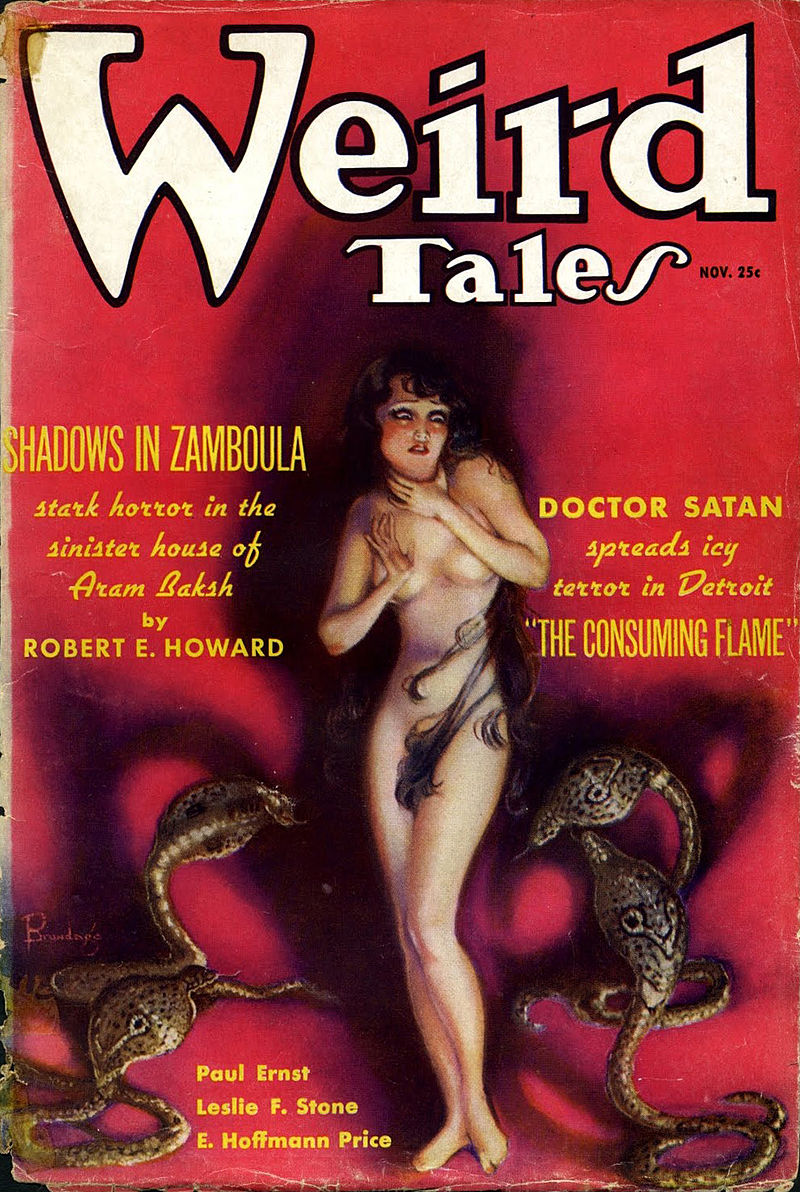
Cover of Weird Tales magazine 1935

Shadows in Zamboula is a classic Robert E. Howard tale of Conan the Barbarian. I read it to get my head in the right space for crafting a “Sword and Sorcery” short story, and I wasn’t disappointed. Howard’s Conan is the best version of the character ever, even after eighty or so years.

The tale was first published in 1935, and I accessed it as a free eBook through The Gutenberg Project (yes, the original cover of “Weird Tales” in which the story appeared is provocative by today’s standards).

Howard’s popular barbarian is lured into trouble once again by a beautiful woman, that is after being nearly captured and consumed by cannibals. His adversaries are black Africans (as we’d understand them today), and relative to the mid-1930s, the description of them might be considered racist (in the 21st century). That aside, the story is high adventure all the way. The swordplay is at its finest, and at the end, Conan outsmarts as well as outfights both his enemies and his supposed allies.

Continue reading

Review: “The Dunwich Horror” by H.P. Lovecraft

I read The Dunwich Horror by H.P Lovecraft as inspiration for a story I have been crafting. I’ve read Lovecraft before, but that was decades ago, so I expected the unexpected from this expedition into his classic horror.

Since the story is old (1928) and beyond its copyright, I looked for it at The Gutenberg Project and found a file I could download onto my Kindle Fire. Books with expired U.S. copyrights can be optioned for absolutely free, so you don’t want to pass up this magnificent opportunity.

Continue reading

Science Fiction, Opinions, and Why It’s Okay to Disagree

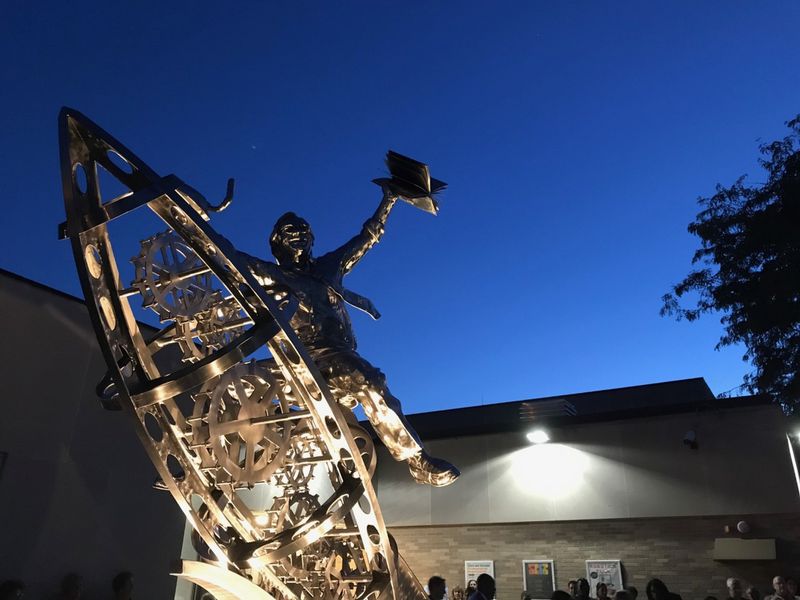
A statute honoring Ray Bradbury was unveiled outside the Waukegan Public Library just after sunset on Aug. 22, 2019, the 99th anniversary of the late author’s birth. (Dan Moran / Lake County News-Sun)

I just read an article at File 770 called Waukegan Public Library Unveils Ray Bradbury Statue (click the link and read, the story’s pretty short). Waukegan was Bradbury’s hometown and I’m thrilled to see that he is being honored. He is a truly timeless writer, and I can prove it, since my 33-year-old son Michael just read Something Wicked This Way Comes.

Over a year ago, I wrote my own wee Bradbury essay titled Should We Burn Ray Bradbury’s Books?. I crafted my missive in response to Katie Naum’s essay at Electric Lit called The New ‘Fahrenheit 451’ Movie Fails to Reckon with Bradbury’s Racism.

I seriously doubt he was a racist, at least in the dictionary definition sense, but assuming Bradbury had character flaws and perhaps some dated beliefs given that he was born in 1920, that doesn’t change his influence on the field of science fiction, nor make him unworthy of being honored.

Of course, we’ve seen this sort of thing before.

Continue reading

“The Toilet Zone” is Available Now

I know that sounds terrible, but my short story “Retired” is featured in the Hellbound Books horror anthology The Toilet Bowl, a fanciful send up on “The Twilight Zone.” It’s already got one 5-star review on the American Amazon site. Things are looking up. Please buy, read, and review. Thanks.

EDIT: That’s “Zone” not “Bowl.” My bad.

tz

Artwork for the Hellbound Books anthology “The Toilet Zone”