The Too Close Encounter

alien ship

Found at Mindlovemisery’s Menagerie blog – No photo credit given

Captain Isaiah Morrison, for such had he once been called, late of the Confederate States Army, having found himself without a home or family, thanks to that damned Yankee Major General William Sherman and his “Scorched Earth policy,” had spent these past ten years in the Territories of the untamed West prospecting for gold (among other activities). His living was meager but sufficient, and now approaching middle-age, a time when men add distinction to the beginnings of waning vigor, he was riding his paint toward town in the hour before dawn to resupply and spend some few short hours in the bed of a hired woman.

The stars were brilliant above him and he stopped momentarily to appreciate the grandeur of God’s great masterpiece, spread before him in all its splendor, ancient, spinning fires contrast against the utter blackness of the infinite void.

Sentient indigenous experiment number 47 commencing. Approaching two mammalian life forms, sentient biped atop non-sentient, non-intelligent quadriped [query: could this be a mating practice].

Morrison was captivated by one star which did not match the pattern of the others. For one thing, it was moving against the flow of the constellations, for the second, it was growing larger, and finally, it was approaching his position.

Continue reading

Returning to Life

ferry

Photo credit: Dorothy

They seemed just two more Asian tourists sitting on a bench watching the ferry at Angel Island.

“When did you die here?” During her lifetime, she would never have asked such as direct question of a man, but death is very liberating.

“1899.” He was staring at the ferry and the multinational conglomeration of visitors, all happily chattering and oblivious to the history they were walking upon. “I had been a dock worker and got the plague. They sent me here for quarantine, but I was also sent here to die. You?”

“1922 when the island was an immigration station. I was suspected of having a disease, but I actually got a parasite from another Chinese immigrant. I suffered on the island eighteen months before I died.”

“How many others like us do you think are here?” He turned toward her finally, noticing that like him, she was dressed in modern clothing.

“Too many, but most won’t let go of the past.”

“If you’re ready, we can rejoin the living.”

They stood and held hands. “Yes, let’s.”

I wrote this for the FFfAW Challenge Week of April 3, 2018 hosted by Priceless Joy. The idea is to use the image above as a prompt to craft a piece of flash fiction between 100 and 175 words long. My word count is 175.

I was stuck about where the photo was actually taken, so I made something up.

When I lived in the San Francisco Bay Area, I visited Angel Island many times. It’s accessible by ferry and you can take bicycles and ride around the entire island. It has a very interesting history, some of it very grim.

You can read the details of both when the island was used as a Quarantine Station and later as an Immigration Station (people could be held on the island for anywhere between two weeks and two years) for the context of my two characters.

In this case, I’ve given my couple a second chance at life, though I’ve kept the mechanism of how deliberately vague. If you can learn to let go of the pain of the past, you might find your way back to a new life and the rest of your future.

Guilty confession. I read this story before crafting my own and yes, it influenced me. My bad.

To read other stories based on the prompt, go to InLinkz.com.

The Beggarman Goes Hunting

Bass Reeves

Bass Reeves. (Credit: Public Domain)

Indian Territory – Oklahoma – 1880

The fact that he was a former slave was obvious because he was a black man of a certain age, but his clothes and his manner also marked him for a beggar and a thief on the run from the law, or at least that’s what it seemed.

Most folks thought they were safe from the law in Indian Territory. The region that would one day be known as Oklahoma was ruled by five tribes, the Cherokee, Seminole, Creek, Choctaw and Chickasaw, all forced from their ancestral homelands because of the Indian Removal Act of 1830. The tribes governed through their own courts but only had authority over themselves. That meant anyone not of the tribes, from a scalawag to a murderer, could only be pursued by Federal officers and not local law enforcement once they crossed into Indian Territory.

The beggarman had walked twenty some miles that day and he had another ten to go. He ate some of the hardtack and jerky he carried in a ratty looking burlap sack while he watched the small fire burn in front of him. He’d brought a blanket to guard against the cold as he slept on the grasslands of the high plains, but that was all the belongings a man could see. None of that bothered him including being approached silently from behind.

Continue reading

Notzrim

jerusalem

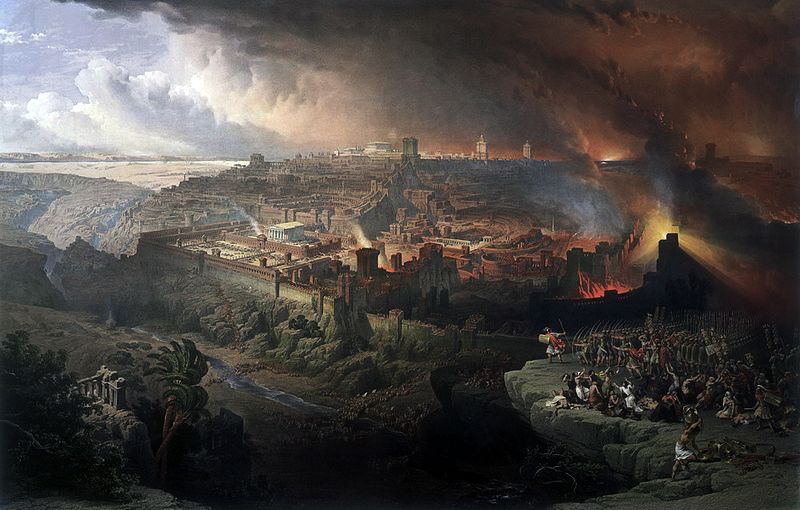
David Roberts’ The Siege and Destruction of Jerusalem by the Romans Under the Command of Titus, A.D. 70

The group of men entering the synagogue at Terni caused murmuring among the Jewish men and not a few of the women. Everyone’s hearts sagged with news of the fall of Jerusalem and the destruction of the Holy Temple of Hashem by the Romans. These men had been there. They were refuges forced into the diaspora. How long had it been since any of the Terni Jews made the journey to the Holy City to offer Korban to Hashem?

After the reading of the Torah and the Prophets the synagogue officials sent to them, saying, “Brethren, if you have any word of exhortation for the people, say it.”

Yochanan stood and said, “Men of Yisrael, and you who fear Hashem, listen. Hashem has brought to Yisrael a Savior, Yeshua Ben Yosef, after Yochanan had proclaimed before his coming a mikvah of teshuvah to all our people and even the Goyim.”

I wrote this for the What Pegman Saw writing challenge. The idea is to take a Google Maps street image and location and use them as a prompt for creating a piece of flash fiction no more than 150 words long. My word count is 150.

Today, the Pegman takes us to Terni, Italy. Like most places in Europe, Terni has a rich history going back to ancient times. Wikipedia says Terni was founded around the 7th Century BCE and was conquered by the Romans in the 3rd Century BCE. I have no idea if in the late First Century CE there was a Jewish population and a synagogue present, but I pretended there was.

After the Romans destroyed Jerusalem and the Holy Temple in 70 CE, there would doubtless have been countless Israeli refuges who were forced into the diaspora (exile among the nations). The Jews who had long lived in the cities and nations in the Roman empire would have journeyed to the Holy City only rarely because of the distance and difficulty in traveling in those days, so seeing a group of their Hebrew brothers arriving from the recently destroyed Jewish capital would have caused quite a stir, but there’s more than that.

It is a common belief in Christianity, Judaism, and even among other religions and in atheism that Jesus and then the Apostle Paul created a new religion called “Christianity” and converted many Jews and many more Gentiles to it. It is often thought that the Law (Torah) and all of the Jewish customs and traditions mandated by God were “nailed to the cross with Jesus.” My studies have convinced me that nothing could be further from the truth for the Jewish people.

The group of men from Jerusalem in my story are devout Jewish followers and disciples of Yeshua (Jesus) the foretold Maschiach (Messiah) and many witnessed him after the resurrection and then they told many others.

I borrowed a bit of Acts 13, specifically verses 15, 16, and 23 to put words in the mouth of my fictional Yochanan (John). Although Jewish devotion to Yeshua eventually fell away, we are unsure of just how many years or centuries such Jewish faith in him continued, perhaps even into the 3rd Century CE and beyond. No one knows for sure. However, that devotion would be a wholly Jewish extension of Pharisaic belief, not something that had no resemblance to its root source. That’s what I tried to communicate in 150 words.

For the sake of my narrative, I used a classic painting of the siege of Jerusalem above rather than an image associated with Terni, Italy.

To read other stories based on the prompt, go to InLinkz.com.

Fugitive

wheelbarrow

© Dawn M. Miller

Even when he was a kid, he had always wanted a place in the country away from people. Sure, he had to put a lot of work into it over the years, but he was still in pretty good shape. He’d just cleared that dead tree which he’d turn into firewood tomorrow.

“Leave the freaking wheelbarrow for later, too.” He wiped the sweat from his brow with an old rag and then took a moment to look back down the dirt drive. It was almost a mile to the road, and that was just some little, rural ribbon of crumbling asphalt. He drove into town every other week or so to buy supplies augmenting what he grew in his field out back and the two hothouses.

He never had internet put in or used satellite for TV. Power came from solar and wind, used a septic tank since he was too far out for sewage, he was as self-sufficient as he could manage.

Conceivably they could still find him. He was as about off the grid as you can get, but they were relentless. When you pull off the world’s first skyjacking, you’ll never fall off their radar.

I wrote this for the Sunday Photo Fiction Challenge of February 4th 2018. The idea is to use the photo above as a prompt to create a piece of flash fiction no more than 200 words long. My word count is 198.

In case you haven’t guessed, I’m talking about the man authorities know as D.B. Cooper who, on 24 November 1971, hijacked a Boeing 727 extorting $200,000 (a lot of money in 1971) and then bailing out of the aircraft somewhere between Oregon and Washington. His true identity and whereabouts, assuming he survived the parachute jump, have never been established.

I read a news story yesterday where someone claimed to have broken the code Cooper left behind in his note of demands. Supposedly, Cooper is really Robert Rackshaw, a former member of Army intelligence, and the code he employed was one recognized as used by his unit.

Rackshaw is still alive and residing in the San Diego area but the FBI issued a statement saying they have no evidence to solve the case.

I had “Cooper” on my mind, so I thought I’d write about him.

To read other stories based on the prompt, go to InLinkz.com.

Stepping Back

swanage pier

© Sandra Crook

“It’s not real.”

The building and pier are quite real, Jonathan.”

“But the scene inside the cafe looks like a painting, Raven.”

“Simply step through the door as you did previously.”

Jonathan Cypher walked toward the painting on the building in the English coastal town. Then there was an actual door and everything changed.

“It is now 1927. The men inside are members of the Communist party. A Soviet agent has recruited them to assassinate the King of England. You must stop them.”

The man without a past stepped back in time ninety years on his mission to rewrite history.

I authored this for the Rochelle Wisoff-Fields writing challenge for 26 January 2018. The idea is to use the image above as the inspiration for crafting a piece of flash fiction no more than 100 words long. My word count is 100.

I did a Google image search and discovered the Pier Head Cafe is located at Swanage Pier in Southern England. The Bizarro comic strip for 24 January 2018 depicted a one-panel joke set in 1927 so I had the year stuck in my head. I looked up 1927 at Wikipedia and discovered the following items:

  • January 19 – Great Britain sends troops to China to protect foreign nationals from spreading anti-foreign riots in Central China.
  • March 24 – Nanking Incident: After six foreigners have been killed in Nanking and it appears that Kuomintang and Communist Party of China forces would overrun the foreign consulates, warships of the U.S. Navy and the British Royal Navy fire shells and shot to disperse the crowds.
  • November 12 – Leon Trotsky is expelled from the Soviet Communist Party, leaving Joseph Stalin with undisputed control of the Soviet Union.

So I hatched a plot of the Communist party of China to assassinate King George V of England. The man who is passing himself off as a Soviet agent is really working for the Chinese (I edited this paragraph to be more historically accurate as per my conversation with Neil below). The word limit prevented me from explaining things in more detail.

I once again am using the characters Jonathan Cypher and Raven last seen in The Kepler Tomb. Of course there was no real plot to assassinate the King of England in 1927, but I needed to make up something.

To read other stories based on the prompt, go to InLinkz.com.

Primordial

primordial soup

© Gyaban

The last place Christopher Sanderson expected to wake up was in a comfortable bed in a richly furnished and adorned room, though he was surprised to be waking up at all. Bright sunlight from the large open window on his right momentarily blinded him, but he welcomed the warm breeze, the rustling of tree branches, and what sounded like friendly bird cries which were so different from the cries of dying men.

Then it all came back to him and his beating heart began to race.

He heard two quick knocks on the door which then immediately opened. A very large Japanese man entered carrying a tray. Christopher sat up in bed and noticed for the first time he had been dressed in silk pajamas. Last he recalled, he had been draped in rags soaked in sea water and blood.

“Do I have you to thank for my rescue?”

Without replying, the fearsome looking man set the tray down on a side table, stepped back, and then bowed.

Not knowing what to do, Christopher nodded back. “If this is a Japanese prison camp, the accommodations are certainly a great deal better than I would have expected.

The large man finished his bow and though the gesture seemed polite and genteel, his facial expression was one of hostility and even malevolence. Without a word, he then turned and left closing the door behind him. Christopher was directing his attention to the tray when he distinctly heard the sound of a lock being engaged. Perhaps he was a prisoner after all.

Continue reading

Killer on the Road

riders

From the YouTube video of the Doors’ performance of “Riders on the Storm.”

“I hate everybody’s guts,” he said as the Priest watched him being strapped in, “and everybody hates mine.”

“May God have mercy on your soul, Billy.”

“Even God hates me Father, so you can go screw yourself.”

Father James Buchanan looked over at the Warden who shook his head. Then he turned to the executioner whose name the Priest preferred not to know. They and the two prison guards filed out leaving William Edward “Billy” Cook Jr. alone to his fate.

Rafael Moody, the executioner, closed the hatch to San Quentin State Prison’s gas chamber.  Then he tightened the door handle making sure the seal was airtight. Father Buchanan took his place back in the gallery with the others. God had given him a mission inside these prison walls but certainly this was the most heart wrenching part of it.

Buchanan looked over at Warden Anthony Barnett who was staring impassively through the gas chamber’s windows at a still defiant Cook.

Continue reading

Na Gauna Ni Tevoro

wayfinders

Scene from the film “Wayfinders a Pacific Odyssey Hawaii”

Father Francisco DelVega Ortiz cursed Lucifer as he was brought before the pagan Chief. He had been part of a special mission to these islands, but Captain Scarr’s foolishness caused his ship to collide with an uncharted reef. Rough seas and high winds tore the Esteban apart. The Priest was the only survivor.

“I have met Europeans before.” The savage spoke in surprisingly good Spanish. “You make fine sacrifices and will strengthen the temple’s foundation.”

Father Ortiz was held by four mountain warriors but struggled defiantly. He spat out, “There will be others after me, Talamaur. Oh, yes. I know what you are. The Holy Order of Venandi will eradicate your kind in the name of the Virgin Mary.”

“Perhaps, Priest. My people will grow strong eating your sacrificed flesh, but I reserve the blood for myself.” The heathen Chief sitting on his obsidian throne bared long fangs and hissed.

Time for another short story for What Pegman Saw. The idea is to take a Google maps location and image and use it to inspire the creation of a piece of flash fiction no more than 150 words long. My word count is 150.

Today the Pegman takes us to Fiji. I was all set to write about a warm, tropical paradise when I looked up Fiji’s history and found some pretty disturbing news.

According to Wikipedia:

Over the centuries, a unique Fijian culture developed. Constant warfare and cannibalism between warring tribes were quite rampant and very much part of everyday life. During the 19th century, Ratu Udre Udre is said to have consumed 872 people and to have made a pile of stones to record his achievement. According to Deryck Scarr, “Ceremonial occasions saw freshly killed corpses piled up for eating. ‘Eat me!’ was a proper ritual greeting from a commoner to a chief.” Scarr also reported that the posts that supported the chief’s house or the priest’s temple would have sacrificed bodies buried underneath them, with the rationale that the spirit of the ritually sacrificed person would invoke the gods to help support the structure, and “men were sacrificed whenever posts had to be renewed”. Also, when a new boat, or drua, was launched, if it was not hauled over men as rollers, crushing them to death, “it would not be expected to float long”. Fijians today regard those times as “na gauna ni tevoro” (time of the devil). The ferocity of the cannibal lifestyle deterred European sailors from going near Fijian waters, giving Fiji the name Cannibal Isles; as a result, Fiji remained unknown to the rest of the world.
warrior

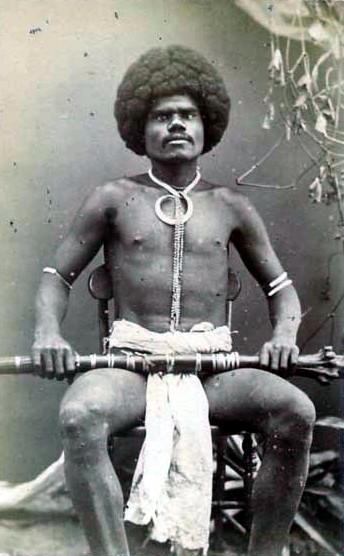
A Fijian mountain warrior, photograph by Francis Herbert Dufty, 1870s.

Yikes. Doesn’t sound like paradise to me. Also, as you can see, the title for my work of historical fiction and horror translates as “Time of the Devil,” which I found appropriate.

According to the same source, Dutch explorer Abel Tasman visited Fiji in 1643 and apparently lived to tell the tale. The first Europeans to settle in Fiji were beachcombers, missionaries, and whalers.

I’ve written eight chapters in my Sean Becker vampire series plus a number of “side tales” based on the same “universe.” I have introduced formal societies both of vampires and of vampire hunters. In the 20th and 21st century western nations, the Holy Order of vampire slayers is called “Van Helsing” after a fictional character in Bram Stoker’s 1897 novel “Dracula.” Earlier, including in the 17th century when this story is set, I gave them the name “Holy Order of Venandi” with “Venandi” meaning “hunter” in Latin (the best I could come up with…if someone more familiar with Catholicism can create a better name for a fictional order of fanatical vampire hunters, let me know).

I’m fascinated about how widely the legend of vampire-like creatures has spread and how far back in history they can be traced. Almost every human civilization and culture knows of vampires by one name or another. Vampire-like creatures of the island chain Vanuatu were called Talamaur. They weren’t bloodsuckers in the traditional “Dracula” vein, but they were close enough so I thought I could get away with “tweaking” the folklore.

Vanuatu is about 750 miles from Fiji and there is some evidence that ancient Polynesian people were able to make long sea voyages and settle on islands very distant from their origins. I don’t think it’s too much of a stretch to have a Talamaur arrive on Fiji in or before the 17th century (it is believed Fiji was settled between 3500 and 1000 BCE) and become a local chief.

Oh, in case you’re interested, the weather in Suva, Fiji today predicts thunderstorms with a high in the mid-80s F and a low in the mid 70s. Pretty humid and I doubt you’d be able to work on your tan.

To read other stories based on the prompt, go to InLinkz.com.

The Woman in Blue

blue light

© Sue Vincent

Obe was tending the fire on the shore by the bay. The sun had set to his right hours ago and most of the clan slept. Their tiny settlement was young and night predators hunted nearby so he kept watch, though the fire and the scent of the men should keep them away.

The moon shone blue through the clouds illuminating the water before him and the island beyond. Other clans of their tribe occupied the land across the bay to the south and east, but Nakuma’s people hoped to make the northlands their home.

Like most young men, waiting alone bored him and with the passing minutes, he became drowsy. He wrapped his blanket, woven by his sisters, tighter around him and with the fire, he felt warm. If his father found him sleeping, he would be struck and shamed in front of the other hunters, so he forced his eyes open. He heard her before he actually could see her.

Continue reading