Film Review of “Godzilla Minus One” (2023)

minus one

Promotional art or the 2023 film “Godzilla Minus One.”

If you like my work, buy me a virtual cup of coffee at Ko-Fi.

Yesterday, I heard that Godzilla Minus One (2023) was on Netflix starting June 1st. I don’t have Netflix, but I checked and it was available to rent and stream elsewhere so I watched it last night. Lucky me.

This was one of the very few movies I wanted to see in the theater. From the start, it received terrific reviews and was an authentic blockbuster made with the fraction of the budget Hollywood spends on most of their crap.

On top of all that, it won eight awards including an Oscar for Best Visual Effects, an Asian Film Award for Best Sound, and Blue Ribbon Awards for Best Film and Best Actor (Ryunosuke Kamiki). This one hit it out of the park. But would it live up to the hype?

Yes, it did.

The movie wasn’t what I expected. I knew it was a period piece, set in Japan at the end of World War Two, but not much more.

Oh, Spoiler Alert: If you didn’t see it in the theater and haven’t streamed it yet and you want to be surprised, stop reading here.

Continue reading

Book Review of “Captain Video: The New Adventures” (2024)

Cover art for “The New Adventures of Captain Video” by Jason Russell

If you like my work, buy me a virtual cup of coffee at Ko-Fi.

When I saw that Jason Russell at Starry Eyed Press had written a new Captain Video book I was a little surprised. I guess I shouldn’t have been. After all, they were the ones who had asked me to write my Tom Corbett, Space Cadet serial (which, by the way, is picking up more traction on Kindle Vella).

I think Russell and Starry Eyed Press have their eye on reviving a lot of old science fiction television that is now in the public domain. That’ll be exciting. I can’t wait.

Curious, I picked up a virtual copy.

It’s a fast read, which is good. This could easily have been serialized on Kindle Vella as well, but it works as a small book, too.

I must admit to knowing next to nothing about the original Captain Video and His Video Rangers TV show (1949-1955).

According to the summary at Amazon:

Continue reading

Review of “Exhalation: Stories” (2019) by Ted Chiang

chiang

© James Pyles

If you like my work, buy me a virtual cup of coffee at Ko-Fi.

I became aware of Ted Chiang‘s book Exhalation: Stories (2019) when it was recently promoted on Bookbub (I get an email from them daily). I was curious, so I looked the book up on Amazon.

First of all, 90% of its Amazon reviews are four and five stars. That’s pretty impressive.

Secondly, under “Editorial Reviews,” there’s a long, long list of quotes from professional reviewers giving the book high praise. Even former President Barack Obama said:

“A collection of short stories that will make you think, grapple with big questions, and feel more human. The best kind of science fiction.”

Joyce Carol Oates of “The New Yorker” said:

Continue reading

Book Review of “The Pride of Chanur” (1982)

chanur

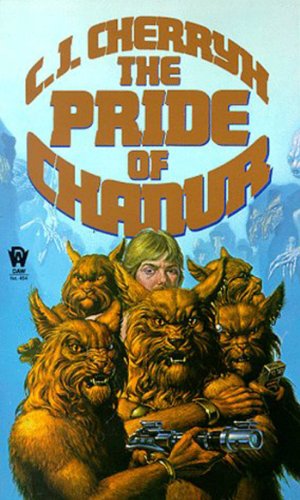
Cover art for C.J. Cherryh’s “The Pride of Chanur.”

If you like my work, buy me a virtual cup of coffee at Ko-Fi.

I finished C.J. Cherryh’s The Pride of Chanur a few days ago but am just now getting the time to write the review.

I remembered reading this back in the 1980s but didn’t recall the details (forty years is a long time). When I saw it on Bookbub, I was curious. There wasn’t a copy in my public library system so I bit the bullet and bought a digital copy from Amazon.

The story is set in a universe involving a species called the Hani. They’re cat-like, their space traveling freighters are captained and crewed by females, as the males aren’t suited to space travel, and their particular region of space is dominated by them and other races who trade with each other via a system of space stations in an alliance called “The Compact.”

The chief “baddy” in this tale are the Kif which are tall, thin, and hairless. They are also predatory, cunning, and devious.

While the ship “Pride of Chanur” is at Meetpoint station, a strange alien is seen to be skulking on the docks. It finally manages to slip by the Captain, Pyanfur Chanur, into her ship, but is wounded in the attempt.

Communication is a chore since the creature doesn’t speak a civilized language. It’s eventually discovered that this is an intelligent creature which had been a captive on a Kif ship and was trying to escape.

Continue reading

Book Review of Orson Scott Card’s “Wakers” (2022)

wakers

© James Pyles

If you like my work, buy me a virtual cup of coffee at Ko-Fi.

I finished Orson Scott Card’s novel Wakers last night. Naturally it’s the first book in a trilogy because all books have to be trilogies if not expanded series these days.

Like most people, I was introduced to Card’s writing long ago through Ender’s Game and the subsequent novels in that series. I’m glad to see that Card is still writing and still successful.

In the past twenty years or so, the current gatekeepers of science fiction determined never again to heap any sort of award upon him. This was because he had committed the grievous crime of being religious and making public statements about how his beliefs are guided by such. Between 1978 and 1995, he did win numerous accolades, but the only award post 2000 he’s been granted is the ALA Best Books for Young Adults for “Shadow of the Hegemon.”

Yes, I read “Wakers,” in part, to thumb my nose (like they even know I’m alive) at the exclusionists who run “official” science fiction and fantasy. You know, the folks who claim they want to be “inclusive” and then just shuffle around the players so certain groups are favored at the expense of others, what they say has always been done and they’re still doing it. The only difference is which groups are included and which groups are not. That’s not inclusive, that’s a shell game.

I’m a sucker for an “underdog” (Card’s doing pretty well, but still…) so I checked “Wakers” out of my local public library.

Continue reading

Book Review of “The Andromeda Evolution” (2019)

AS3

© James Pyles

If you like my work, buy me a virtual cup of coffee at Ko-Fi.

I heard about Daniel H. Wilson’s novel The Andromeda Evolution almost by accident and found that my local public library had a copy.

I read Michael Crichton’s 1971 novel The Andromeda Strain way, way back in the day and I’ve seen the 1971 movie adaptation a number of times and enjoyed them both.

But fifty years later and written by another author, even with the Crichton family’s blessing, how would this turn out?

A lot better than I expected.

The book started out very slowly and I was afraid it would be a hard slog all the way through. On top of that, Wilson sometimes decided to lecture the reader on the evils of colonialism and how bad white people and civilization is for indigenous people (the main action takes place in a protected reserve in the Amazon). I thought if this was going to be the tone of the book, it would be tedious and I almost stopped reading it once or twice.

Fortunately, Wilson didn’t belabor the point too much and then things began to pick up.

Continue reading

Book Review of “Cobra” (1986) by Timothy Zahn

cobra

Original cover art for “Cobra” by Timothy Zahn

If you like my work, buy me a virtual cup of coffee at Ko-Fi.

When I first read Timothy Zahn’s Cobra back in the 1980s and I liked it. Decades later, I still had that feeling but only vague memory of the book’s contents.

So I downloaded it onto my Kindle Fire and finally got around to reading it.

The novel holds up well. It’s really the “hero’s journey” of Jonny Moreau, a young boy from a backward frontier planet, who volunteers to undergo surgical procedures and specialized training to become an augmented soldier, a cyborg known as Cobra.

His idealism is stripped away when he and his fellow Cobras are sent to another world in their Dominion to fight the alien enemy known as Trofts. He sees destruction, death, and loss. He also first experiences distrust from his own allies. Cobras are highly dangerous. They were created that way. But because there was always the possibility they could turn on those they were helping, no one wanted to get too close.

Continue reading

Book Review of “Star Wars: The Last Command” (1994)

last

Cover of the novel “Star Wars: The Last Command.”

If you like my work, buy me a virtual cup of coffee at Ko-Fi.

I just finished reading the third book in Timothy Zahn’s “Thrawn Trilogy,” The Last Command. Oh “spoiler alert,” it is Thrawn’s last command because he dies, which I didn’t see coming.

Grand Admiral Thrawn having acquired the “Katana fleet” in the previous book and with a massive army of clones to man them, proceeds to press the offensive, even to Coruscant.

Leia has her twins and cares for the infants with the help of her aide Winter, but that doesn’t keep her out of the action as the story progresses.

The clone of Jedi Master Joruus C’baoth goes further off the rails, claims the Empire, galaxy, and the whole universe for his own, and is still raving about having Luke, Mara, Leia, and her babies as his apprentices. He decides to leave the Grand Admiral’s ship for the planet Wayland, which is where Thrawn originally found him. Thrawn grants this, but turns the tables. He makes C’baoth his prisoner in the Emperor’s own throne room in the mountain fortress where the clone factory and all of the Emperor’s other secrets are hidden.

Continue reading

Book Review of “Star Wars: Dark Force Rising” (1993)

dark force

Cover of the novel “Star Wars: Dark Force Rising”

If you like my work, buy me a virtual cup of coffee at Ko-Fi.

I finished reading Star Wars: Dark Force Rising, book 2 in the Thrawn trilogy and I have to say I’m having a blast.

It doesn’t quite nail down the original film trilogy, but it comes close. I suppose because more details can be packed in a novel than a two-hour film, those details take a little away from its “Star Wars-ness.”

The race is on to find the derelict Katana fleet, a group of Dreadnoughts dating back to the Clone Wars. Both the New Republic and the revitalized Empire are in desperate need of ships.

Supposedly Talon Karrde, head of the smuggler’s guild, knows the secret location and might be persuaded to tell the New Republic, but then there are others.

Following her promise in the last novel, Leia, Chewbacca, and Threepio meet with their Kashyyyk contact in orbit around Endor. Leia and the rest leave the Millennium Falcon and travel with their companion Khabarakh to his home world in an attempt to convince this warrior race to abandon the Empire and join the New Republic. Eventually, she finds evidence of the Empire having poisoned their planet during the clone wars, rather than the Rebellion, convincing them they have been betrayed by the Empire.

Continue reading

Review of the Movie: “Demolition Man” (1993)

demo poster

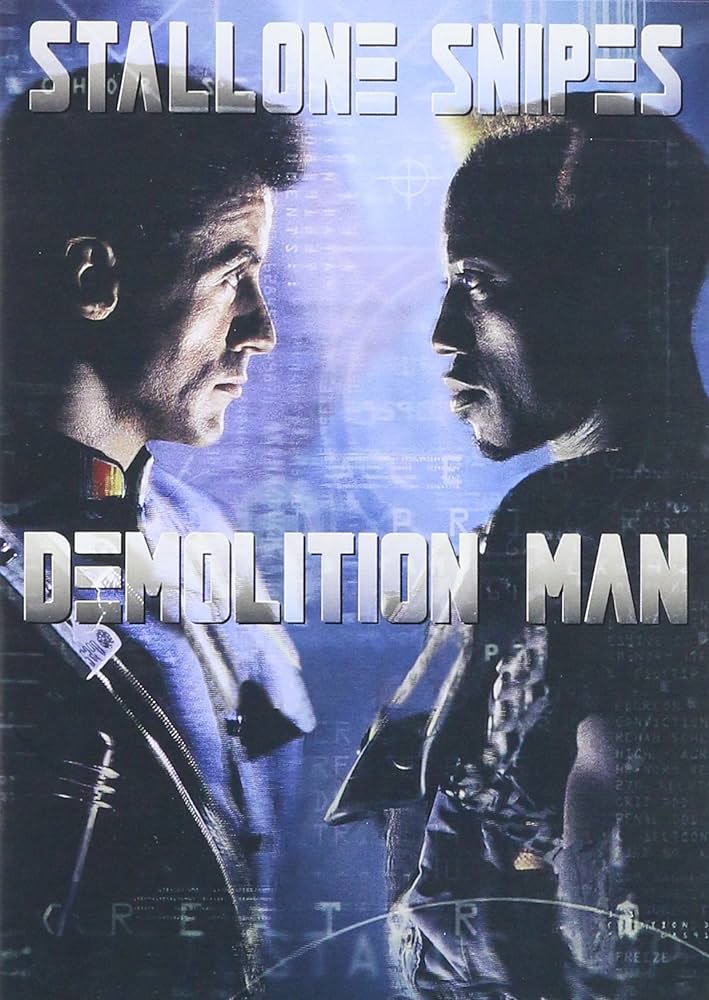
Poster for the 1993 film “Demolition Man”

If you like my work, buy me a virtual cup of coffee at Ko-Fi.

Last night I finally got around to watching the 1993 film Demolition Man starring Sylvester Stallone as Detective John Spartan (some of these made up names are lame) and Wesley Snipes as Simon Phoenix. This is an action/adventure science fiction film with some unique insights on the future, but I’ll get to that.

The story opens in 1996 Los Angeles. Spartan is in a helicopter with two other cops (the pilot Zachary Lamb is played by Grand L. Bush, who played “Little Johnson” in the 1988 classic Die Hard).

Spartan is closing in on his nemesis, the notorious criminal Simon Phoenix, who is holding hostages taken from a commercial aircraft. This L.A. is even more brutal and lawless than the actual Los Angeles in the 1990s, already establishing a break between the film and the reality of the audience.

In typical “Rambo” style, Spartan breaks into the bad guy headquarters and caps off all of the baddies before confronting Phoenix. A heat scan didn’t show any signs of the hostages and Spartan and Phoenix fight over where they are. But Phoenix has rigged enough gasoline and C4 to blow the building into orbit.

Spartan drags Phoenix outside just in time before the whole building goes up (there’s a reason Spartan is called “The Demolition Man”). Turns out the hostages were in the building all along. Phoenix said that Spartan knew that and didn’t care. I guess L.A. coroners in this movie are dumb because they should have figured out Phoenix killed the hostages (no heat signatures) well before Spartan’s arrival.

Both Phoenix and Spartan are convicted of their crimes. Spartan is sentenced to 70 years cyrofreeze. While he’s under, his brain will be reorganized to give him more productive behaviors upon thawing. So both of these men undergo a deep freeze.

Continue reading