Being Published in the Anthology “World War Four”

zpp ww4

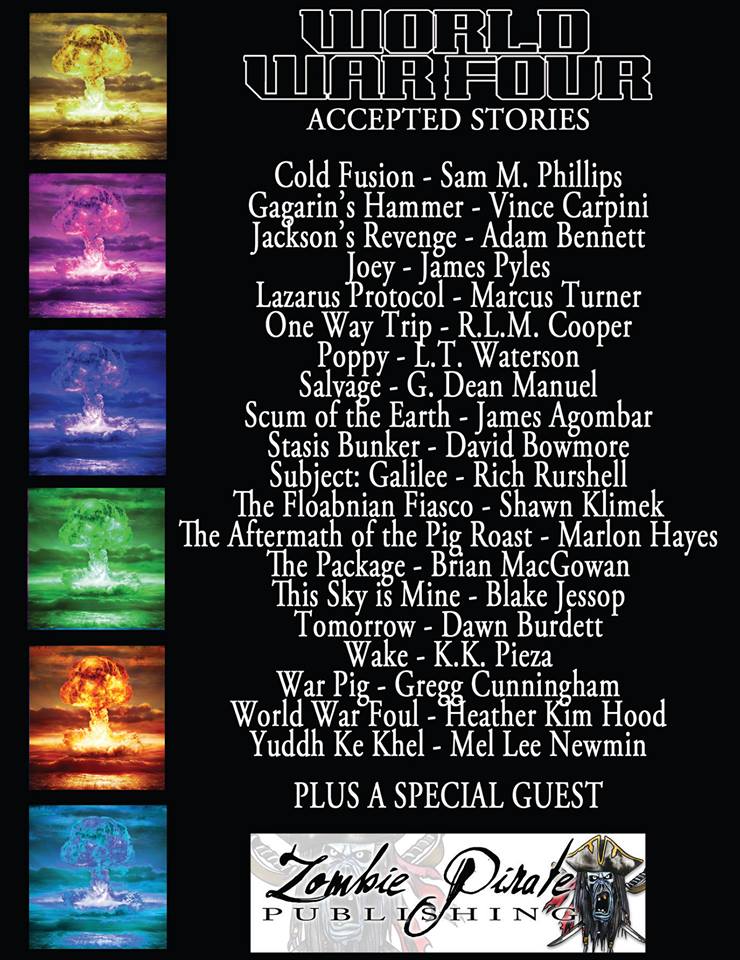
Promotional image for Zombie Pirate Publishing’s “World War Four” anthology

Fantastic news. On the heels of receiving an email saying that my first story was accepted for an anthology on Sunday morning, yesterday, I received the following:

Thanks for contributing to WORLD WAR FOUR. When we started Zombie Pirate Publishing in 2017, we could not have guessed at the enthusiastic support we would get from writers around the world. WORLD WAR FOUR received more than forty submissions. We thank you for your contribution.

We really enjoyed your submission Joey and would like to inform you it will be included in the publication released March 1st. Congratulations!

Yes, Adam Bennett and Sam M. Phillips at Zombie Pirate Publishing accepted my short story “Joey” for their World War Four (yes, you read that right) anthology, due to be published March 1, 2019.

Continue reading

Hugo Award Winning Novels I Have Read

fifth

Cover image of NK Jemisin’s 2015 Hugo Award winning novel “The Fifth Season

You might be wondering about why I’ve posted the lengthy lists of tabular data below.

Last summer and so on, when I was writing blog posts critical of the Hugo Awards, WorldCon, and a seeming lack of objectivity in how the Hugos are awarded, I learned a lot.

I’m not going to post a bunch of links to past blog missives, but I did learn that the Hugos were never meant to be particularly objective. Various works, including novels, are voted on by people who have paid to be at that year’s convention, people who are, for all appearances, very hard-core Science Fiction and Fantasy fans, and not necessarily the sort of person who might casually pick up a SciFi novel to read here and there (like most of us).

I also noted one of the criticisms leveled against SF author Robert Silverberg in the comments section at File 770 after Silverberg criticized NK Jemisin’s most recent Hugo Award acceptance speech, was that it was said Silverberg hadn’t read a SF novel in the past decade, like that’s a bad thing.

Continue reading

Across the Hell Land

apocalypse

Post apocalyptic art by Albert Goodwin, 1903 – a work in the public domain

Gray-haired, burnt-skinned Santos had forgotten the number of times he had appealed to the Glow for an end to his journey through the hell lands. He couldn’t fool himself with the placebo anymore, and so as he put out the campfire and slipped on his rucksack, the dull pain in his right knee became his rough companion with each step, thanks to the oblique scar left by the direwolf last Fall.

The old woman he encountered in one of the shelters reclaimed from a flatlands hell crater had tried to minister to him, but the scar tissue had already formed, and her potions were far too weak to repair damaged cartilage. Being maimed didn’t bother him as much as the fact that having to leave her alone again, she died two days hence, probably by the same pack that had struck at him, as evidenced by the sign of the carrion birds circling above her hut.

But heartstrings weren’t something he could afford. She had refused to go with him when he asked. The reluctant ranger told her the plague to the East was spreading by rats and sand hares, had consumed his community, and that the only safety was his destination, the half-mythical city beyond the western foothills. But she said she’d made her peace with the high desert and the hell lands. Her husband and five sons had died during the first disaster, and being of prairie stock, she chose to stay, to tend their graves, living off of a meager garden, wearing sackcloth and ashes.

She never said her name or how long she’d been alone, but he kept seeing her face, cut and grooved with wrinkles like a river delta as step by step, limping, praying to the Glow with each gasp of pain, he kept walking.

Continue reading

The Sacrificed

alternate universes“I can’t do it, Erickson. I’m no killer.” Rafael Isaiah Johnson had traveled back in time 172 years to stop a global extinction event and save the human race, but the man he hoped to enlist as an ally, Austin Randolph Erickson had another idea, a murderous one.

The two men, one a Hispanic-African-American who wouldn’t be born for another 135 years was standing in the other man’s kitchen between the refrigerator and the stove, the exit to his back, while the opposing person, a white American man of Scandinavian ancestry was facing him and holding out the butt of a loaded semi-automatic Glock 20. The drawer to his left and second from the top was still pulled open.

“You’ve got to do it, Johnson. I believe you. I believe all of the holographic evidence you brought with you, that my unborn son is the key in time, the critical element in preventing the reversal of the effects of climate change. Take the gun. If I don’t exist, then he won’t be born.”

Continue reading

Book Review of “The Strange Affair of Spring Heeled Jack: A Burton and Swinburne Adventure”

jack

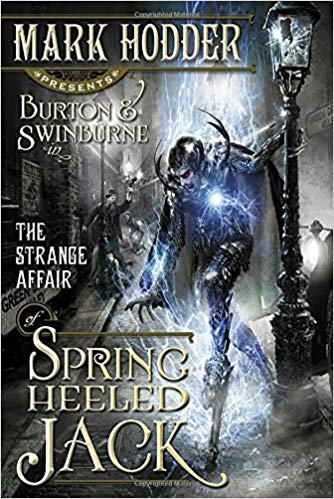
Cover image for Mark Hodder’s 2010 novel The Strange Affair of Spring Heeled Jack

Some months ago at work, a friend of mine and I got to talking about steampunk as a sub-genre of science fiction, and, long story short, he recently lent me his copy of Mark Hodder’s 2010 novel The Strange Affair of Spring Heeled Jack: A Burton and Swinburne Adventure.

Basically, Hodder takes real places (London specifically) and actual historical figures, such as Sir Richard Burton, poet Algernon Swinburne, Charles Darwin (yes, that Charles Darwin), and Florence Nightingale, and transforms them into bizarre, distorted, “steampunkish” versions of themselves in a much larger than life adventure set against a highly improbable background.

The result is an amazing romp that could never have happened (time travel notwithstanding) but is nevertheless, is a lot of fun.

Recently, I said that I’d be making a concerted effort to read more recently produced science fiction novels and stories as defined by those having been published within the last ten years or so. Mr. Hodder’s novel certainly qualifies, so here we go.

Continue reading

Resisting the Echo Chamber

inherit

Original cover for James P. Hogan’s 1977 novel “Inherit the Stars”

Somewhere on Facebook, I saw an image of a familiar book cover, the cover to James P. Hogan’s 1977 science fiction novel Inherit the Stars. I remember reading it while my wife and I were on vacation in Europe in 1985, traveling with a Catholic choir group (long story).

As with a lot of books I read decades ago, I remember liking it, but I can recall almost nothing of the plot. Yes, it all starts with the mystery of a dead human being found on the Moon, a person 50,000 years old. Intriguing.

I thought about adding it to my list of books to re-read, even though a day ago, I dedicated myself to reading science fiction and fantasy of a more recent vintage.

I was surprised to discover that “Inherit” was the first book in a five-part series. I was also surprised to discover that it was the first book Hogan ever wrote, and that he did so on a dare.

I decided to look up Hogan on the internet. He died in 2010 at the age of 69, just a few years older than I am now.

I also found out he wasn’t a nice man.

Continue reading

Dabbling in Science Fiction Fandom

sf convention

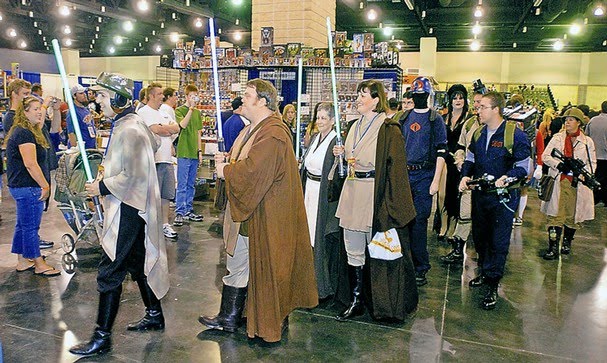
Photo credit – Knoxville News – Science Fiction convention – place and date unknown

In recent comments on the File 770 SF/F news blog criticizing veteran SF writer Robert Silverberg over comments he made about author NK Jemisin’s Hugo Award acceptance speech last summer, one of the things mentioned is that Silverberg hasn’t read any SF stories written in the past ten years, like that’s a bad thing.

In comments I made on twitter last summer criticizing the objectivity of the Hugo Awards, one person accused me of not being “a fan,” as if being a fan were some sort of exalted and coveted position.

But as I continued to gather information about the Hugos and how one is nominated for an award, I realized that although the pool of voters each year is relatively small (I’d estimate anywhere between a few hundred and a few thousand), probably all of them are avid SF/F readers and viewers who consume tons and tons of the latest available works. I guess that’s what my critic meant when she said I wasn’t a fan.

But wait a minute. How much SF/F do I read?

Continue reading

Cylinder

cylinder

Computer monitor wallpaper

Suspended from the airlock by his thick umbilical, Astronaut Jonathan Weaver watched the ring of illumination inside the enormous hollow tube code-named “Oumuamua” move away from him toward the other end of the spinning alien habitat, creating the illusion that he was now in early evening. The forty-two year old Air Force Captain, weightless because he was positioned near the center of the tube, marveled at the view. Essentially, the interior of a massive cylinder was filled with atmosphere that included clouds, with the entire rim covered with soil and water that supported farms, forests, lakes, rivers, small mountains, and even buildings and highways. And yet in the fifteen minutes since he had gone EVA inside the object, he had detected no sign of life.

“Weaver, this is Nguyen. Any change in your readings?” Danielle Nguyen was a civilian pilot and exobiologist who had been put in command, and at thirty, was the youngest member of the hastily assembled mission. After the Mauna Kea Observatory in Hawaii had located Oumuamua eight months ago and determined it was approaching the sun from outside the solar system, NASA, in cooperation with two private space exploration companies, had quickly adapted the Argonaut spacecraft, originally designed for a manned Mars mission, to intercept human history’s first visitor from interstellar space.

Continue reading

Oh Captain!

spacecraft

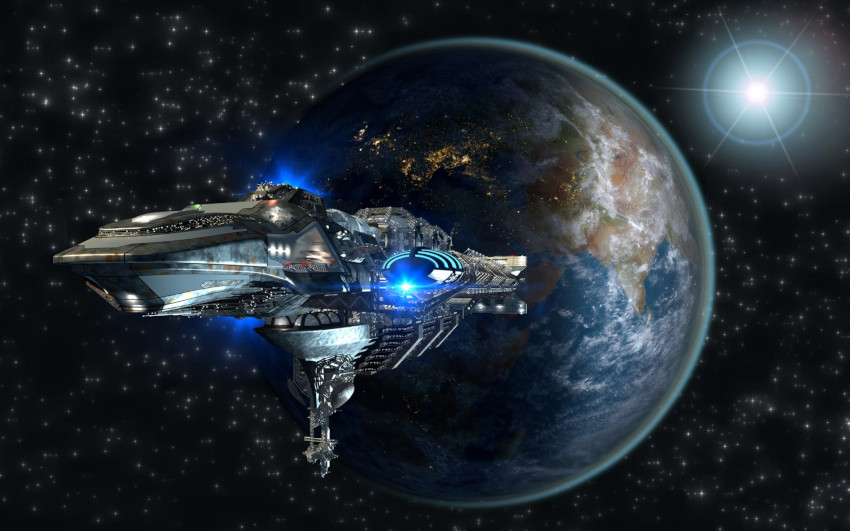
Image credit: iStock – Found at numerous sources including thepromiserevealed.com

Vanessa struggled to climb out of the Salubrious Pod, sickly yellow and greenish jelly oozing off of her smooth, dark skin. She rolled over the low rim of the tub onto the cold metallic floor of the eight-by-twelve foot featureless chamber, her nude body dimly illuminated by the few flickering light tubes in the ceiling ten feet above. She shivered as the gel evaporated, and she watched a thin mist rising overhead from her body, though some of the goo clung to her short-cropped black hair, and she blinked as one drop fell from her lashes into her left eye.

“Good morning, Captain Chapman. How are you feeling?”

They’d made Sophia’s voice feminine, but the echoes coming from multiple speakers  in the ceiling still made her sound inhuman.

“Like shit, Soph.”

“I’m sorry to hear that.” The AI’s reply was meant to communicate concern, but of course, as a machine, she felt nothing at all. “It is important you recover from hibernation quickly. There is a situation.”

Continue reading

An Ending in Fire

town

Photo credit: Anurag Bakhshi

Kurt stood on the cliff overlooking the tiny Southern California. It was 30 miles west of Santa Barbara and it was all his.

“It looks so peaceful from up here,” he said just to hear something besides the wind. Even the gulls and squirrels were gone, having deserted this doomed land if they could or otherwise having died, just like all the people.

He rubbed his left hand over his short-cropped gray and white hair. “Well, guess I’d better get to it while I still have daylight.”

He knew the National Guard had sealed off everything between Santa Maria and Ventura north and south, and Bakersfield to the east. No one would imagine anyone would want to stay in the danger zone with them, but Kurt did. His family was down there, what was left of them, and now that he’d wired the whole place to blow, he’d exterminate the last of the infected. He wasn’t planning to escape. His wife, kids, grandkids were turned into something like zombies or vampires by the mutant virus. Only he was immune. Standing in town with his back to the ocean, he pressed the remote and the next California wildfire began.

I wrote this for the Sunday Photo Fiction challenge hosted by Susan. The idea is to use the image above as the prompt for crafting a piece of flash fiction no more than 200 words long. My word count is 198.

I chose this theme for no particular reason other than it was what popped into my head. Although the limited word count didn’t allow for it, I set my tale in the small southern California town of Gaviota. I’m sure it doesn’t look like the image above, but I needed a location that was small and isolated.

To read other stories based on the prompt, visit InLinkz.com.